Grandma Put On Music While She Cleaned the Kitchen. Someone Joined In.
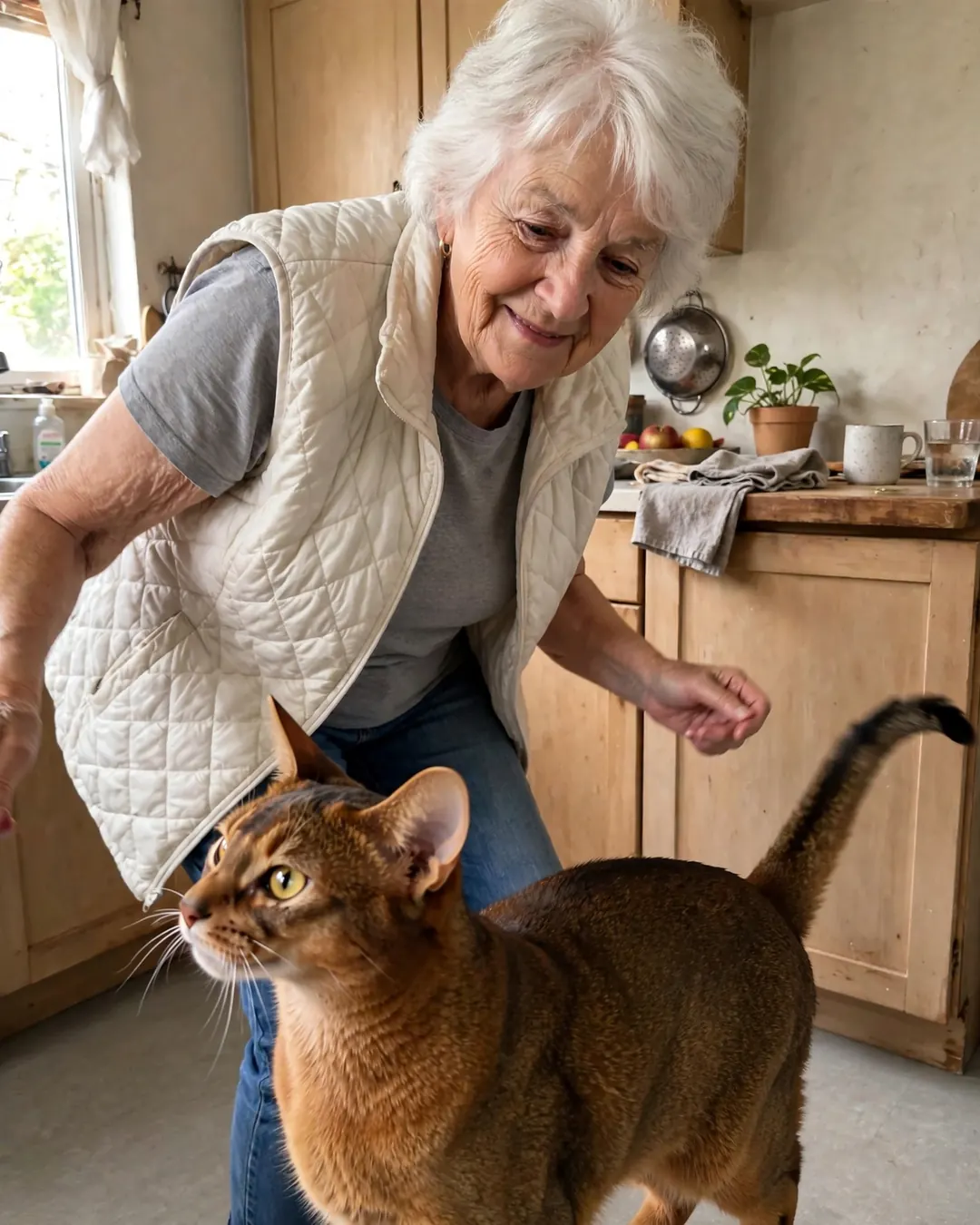
A little kitchen shuffle is underway, and Saffron has decided to join in. Grandma Ruth, wearing a cream quilted vest over a gray tee and jeans, sways as she bends low with one hand stretched out, her eyes crinkled with delight. The ruddy Abyssinian circles past her legs with his tail standing straight up like a flagpole, the tip curled in a tiny hook. Morning sunlight pours through the window over the counter, catching a hanging pot, a small potted herb, a bowl of fruit, and a folded dish towel left beside the sink. It is the kind of unplanned, happy moment that turns an ordinary breakfast cleanup into a dance party for two.
That upright tail is one of the clearest signals a cat can give. A tail held high, especially with a slight curve or hook at the tip, is widely read as a friendly, confident greeting. Cats often approach the people they like this way, sometimes weaving around legs and rubbing their cheeks along the way to leave their scent. Abyssinians are known as social, people-oriented cats that like to be in the middle of whatever is happening, so following a person around the kitchen fits right in. Learning a few of these body-language basics, like a slow blink for trust or a twitching tail for irritation, makes it much easier to understand what a cat is feeling.
Ruth does not need a guidebook to know what that tail means. Saffron is glad to see her, glad the music is on, and fairly sure there might be a treat at the end of this song.