The Court Astronomer Is Calculating a Distant Orbit. He's a Weimaraner.
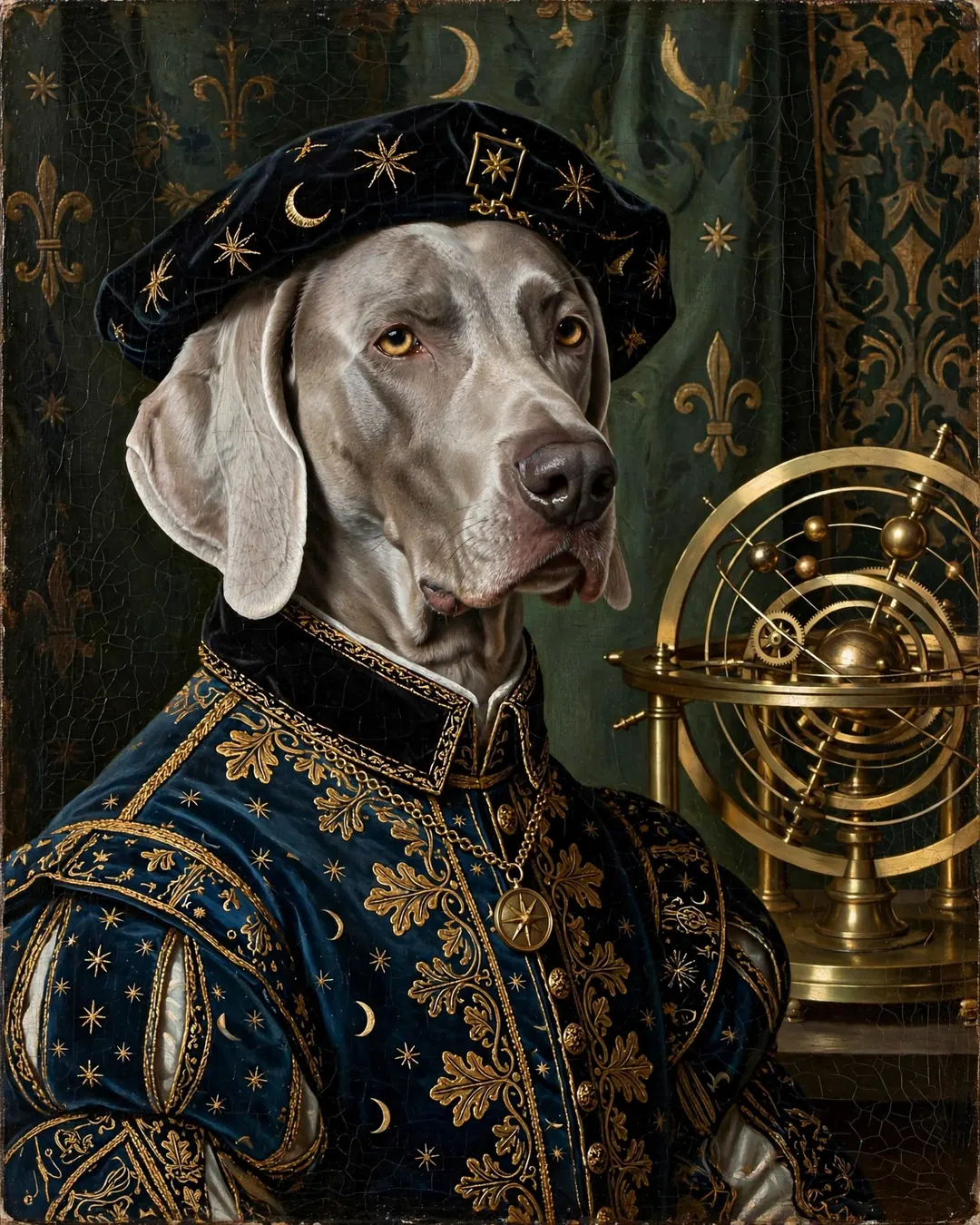
Gazing past the viewer as if calculating the orbit of a distant planet, this court astronomer is lost in thought. A silver Weimaraner with velvety drooping ears and pale amber eyes wears a black cap embroidered with golden stars and crescent moons. His navy doublet glitters with more stars, moons, and golden leaves, and a medallion hangs at his chest. Beside him stands a gleaming brass orrery, its rings and tiny spheres arranged to model the heavens. The wall behind is hung with dark green fabric patterned with gold fleur-de-lis and moons.
The Tudor era overlapped with a revolution in how people understood the sky. In 1543, during Henry VIII's reign, Nicolaus Copernicus published his idea that the Earth and planets move around the Sun rather than the other way around. In Elizabeth I's court, the scholar John Dee was a famous adviser known for his work in mathematics, navigation, and astronomy, along with astrology. The beautiful brass orrery beside our astronomer, though, is a later invention. Mechanical models of the solar system like this became popular in the 1700s and took their name from an Earl of Orrery.
None of that seems to trouble this thoughtful Weimaraner, who looks every bit the brilliant stargazer. With his serious expression and celestial wardrobe, he appears ready to explain the movements of the planets to anyone patient enough to listen.