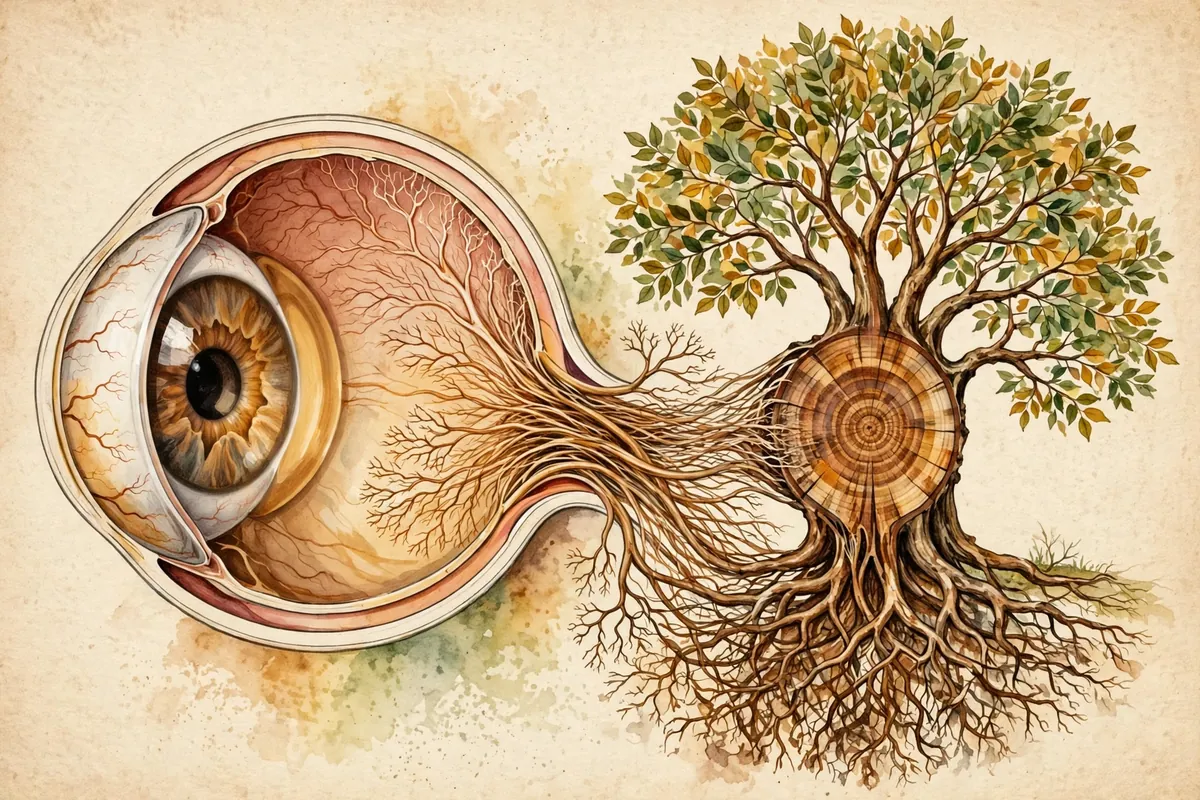
Look at a tree out the window. It stands upright, roots down and leaves up, exactly where you expect them. But at the very back of your eye, that same tree is hanging upside down. So why doesn't the world look like it's standing on its head?
The short answer: your eye works a lot like a simple camera, and its lens projects an upside-down, reversed image onto the retina. Your brain doesn't need that image to be right side up. It learns how signals from the eye line up with the real world, using touch, movement, and experience, and the result simply feels normal.
Your Eye Is a Little Dark Room
Long before cameras, people played with a device called a camera obscura, which is Latin for "dark room." Light passes through a small opening into a dark box and forms an upside-down image on the far wall. It's a basic rule of optics, not a trick of biology.
The human eye works in much the same way. Light enters through the pupil, gets focused by the lens, crosses the dark inside of the eyeball, and forms an inverted image on the retina at the back. Leonardo da Vinci compared the eye to a camera obscura and filled his notebooks with roughly 270 drawings of the device.
Who Figured It Out?
The upside-down image puzzled thinkers for centuries. Around the year 1000, the scholar Ibn al-Haytham showed through experiments that we see light reflected from objects into the eye. But he decided vision couldn't start at the retina, precisely because the image there would be inverted.
The astronomer Johannes Kepler is generally credited as the first to recognize that the eye's lens projects images inverted and reversed onto the retina. He described it in a book published in 1604. Kepler didn't think fixing the image was really an optics problem. He suggested it was corrected somewhere "in the hollows of the brain."
The Man Who Turned His World Over
In the 1890s, an American psychologist named George M. Stratton decided to test the question on himself. He built glasses that flipped everything he saw upside down and left to right. He wore them over one eye, covered the other with a patch, and slept blindfolded so he'd never see the world normally.
In one version, he wore the glasses for eight days. The first day he felt nauseated, and the flipped landscape seemed unreal. By the second day, mostly his own body position felt strange. By day seven, things felt normal. He had adapted.
When he finally took the glasses off, the world looked right side up again, but it felt odd for a while. He caught himself reaching with his right hand when he meant to use his left. Stratton concluded that we link sight and touch through learning over time.
So Does the Brain Flip the Picture?
It's a popular way to put it, but scientists have long debated what really happens. Did Stratton truly see the flipped world as normal, or did he just learn to move around in it? Brain scans done about a century later found no difference in the early stages of visual processing. That suggests the brain doesn't simply rotate the image back.
Instead, "up" and "down" seem to be something the brain works out by matching what you see with what you feel and do. Upside-down goggles are still used today to study how people adapt, and even to explore ways of preventing motion sickness.
So the next time you admire a tall tree, give your brain a little credit. It's been quietly making sense of an upside-down picture every moment of your life, and it never once complained.