Some soldiers in World War II went to war with rifles. Others went with paintbrushes, air compressors, and giant speakers. Their job wasn't to beat the enemy in battle. It was to make the enemy see an army that wasn't there.
They were the Ghost Army, officially the 23rd Headquarters Special Troops of the U.S. Army. This 1,100-man unit used inflatable tanks, sound trucks, fake radio messages, and a lot of acting to mislead German forces about where Allied troops really were and how many of them there were. Over the course of the war, they carried out more than 20 deception campaigns.
A Traveling Road Show of Fakes
The unit was activated on January 20, 1944, and arrived in Europe that May, shortly before D-Day. The idea drew on British deception tricks used at the Battle of El Alamein in 1942.
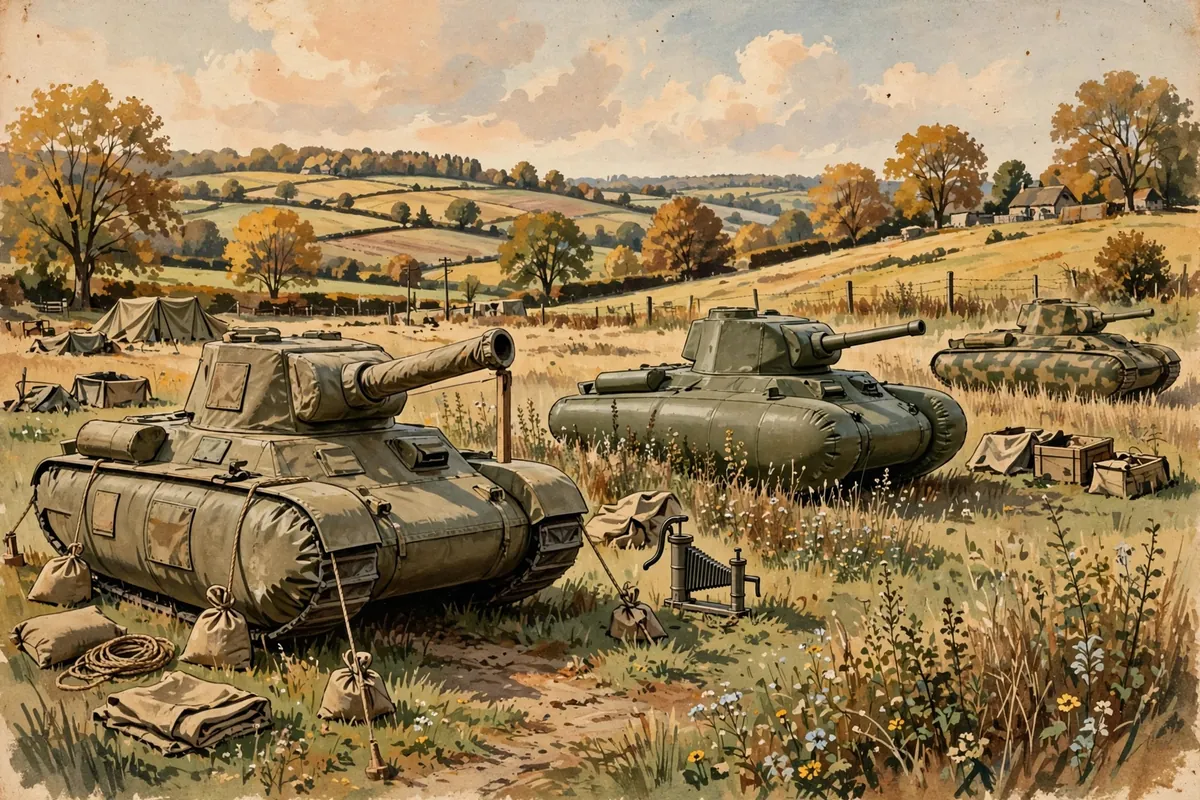
The visual team, the 603rd Camouflage Engineers, carried inflatable tanks, cannons, jeeps, trucks, and even airplanes. They pumped them up with air compressors and then camouflaged them badly on purpose, so enemy planes flying overhead could spot them. In just a few hours, they could build a fake airfield, a tank formation, or a whole troop camp, complete with laundry hanging on clotheslines.
The Sound of an Army That Wasn't There
Fooling eyes was only half the trick. A sonic deception team, the 3132 Signal Service Company Special, worked with engineers from Bell Labs to record the sounds of real tank and infantry units at Fort Knox.
In the field, they mixed those recordings to fit each scenario, then blasted them from powerful speakers mounted on halftracks. The sounds could be heard 15 miles away. Picture lying in the dark and hearing what seems like an entire armored division rumbling into place, when it's really a few men and a set of records.
Fake radio traffic rounded out the show. Together, sight, sound, and radio chatter painted a convincing picture of forces that didn't exist.
From Normandy to the Rhine
Some members went to Normandy two weeks after D-Day, where they used lights at night to fake an artificial harbor and draw German artillery away from the real ones. The whole unit later helped tie up German defenders at Brest by pretending to be a much bigger force.
As the Allies pushed east, the Ghost Army followed, staging fake river crossings and positions. One of their last big shows was a major Rhine River crossing, meant to pull German troops away from the real crossing sites.
An Army of Future Famous Artists
The Army recruited many of these soldiers from art schools, advertising agencies, and other creative jobs. Many came from art schools in New York and Philadelphia. In civilian life, they had been artists, architects, actors, set designers, engineers, and lawyers.
Several went on to big careers. Fashion designer Bill Blass, painter Ellsworth Kelly, wildlife artist Arthur Singer, and photographer Art Kane all served in the 603rd. Many of them sketched and painted their way across Europe between missions.
Their work stayed secret for more than 50 years and wasn't declassified until 1996. A PBS documentary told their story in 2013, and in 2022 a law signed by President Joe Biden awarded the Ghost Army the Congressional Gold Medal. It was a long-overdue thank-you to the soldiers whose greatest weapon was their imagination.