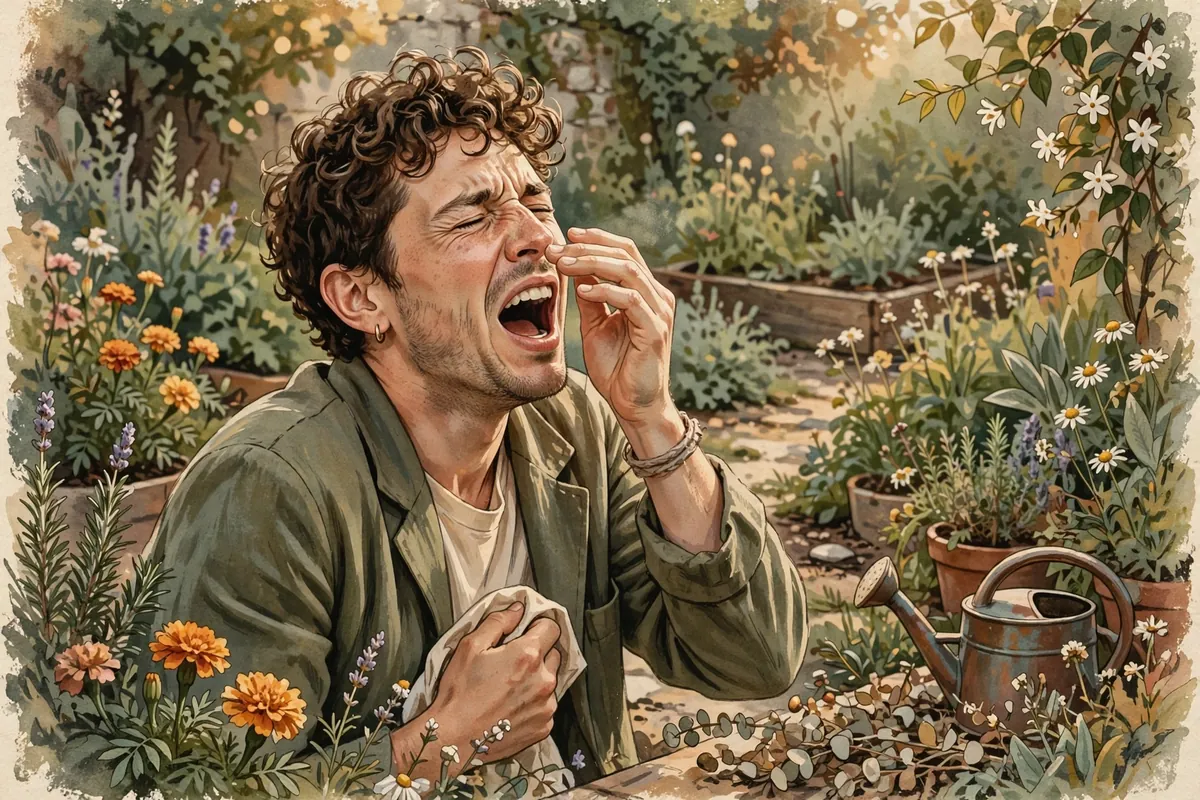
Try to remember the last time you sneezed with your eyes wide open. Chances are you can't. The moment that tickle builds, your eyelids squeeze shut on their own, as if someone flipped a switch.
The short answer: closing your eyes is part of the sneeze reflex itself. As your chest and belly muscles contract to blast air out, your eyelid muscles contract too, automatically. But it's not mandatory. Despite what many people believe, it is possible to sneeze with your eyes open, because the reflex can be suppressed.
How a Sneeze Actually Works
A sneeze starts when something irritates the lining of your nose, like dust or pollen. Special sensory nerve cells pick up the irritation and send signals along the trigeminal nerve to your brainstem.
Your brainstem then takes over. It sends signals to a whole team of muscles at once, in the throat, chest, and abdomen, to force the irritant out. That's why a sneeze feels like it involves your entire body.
Two Phases and One Blink
The action happens in two steps. First comes the inhale, when your diaphragm and the muscles between your ribs pull in a big breath. Then comes the exhale, when your chest and belly muscles squeeze hard and push the air out in a powerful burst through your nose and mouth.
It's during that second step that your eyelids close. They're simply part of the package of muscles that fire together. Science hasn't settled on exactly why evolution bundled the eyelids in, so treat any confident explanation you hear with a little caution.
Why Some People Sneeze at the Sun
Here's a related oddity. Some people sneeze when they step out of a dark building into bright sunshine. It's called the photic sneeze reflex, and it affects somewhere between 18 and 35 percent of people worldwide.
It's inherited, passed down in families, and it seems to be triggered by a sudden change in brightness rather than a particular color of light. Its playful nickname is ACHOO syndrome, a made-up acronym that scientists clearly had fun with. Exactly how the reflex works is still not well understood.
It's mostly harmless, but a sudden fit of sneezing can be risky while driving. If bright light often sets you off, that's worth keeping in mind on sunny roads.
Sneezes in History
People have been reading meaning into sneezes for thousands of years. In ancient Greece, sneezes were thought to be signs from the gods. In 401 BC, when the Athenian general Xenophon urged his soldiers to fight the Persians, a soldier sneezed at the end of his speech, and the troops took it as a favorable omen.
Even today, in parts of Greece, if a listener sneezes right after someone makes a claim, the speaker may reply with a phrase meaning "bless you, and I am speaking the truth."
A Good Habit to Keep
Sneezes can spread germs through tiny droplets, so it's a good idea to cover your nose and mouth with a tissue or the inside of your elbow. Looking down can help, too, by sending droplets away from other people's faces.
So the next time your eyes snap shut mid-sneeze, you'll know it's your brainstem running a well-practiced routine. And if you ever manage one with your eyes open, congratulations: you just overruled a reflex.