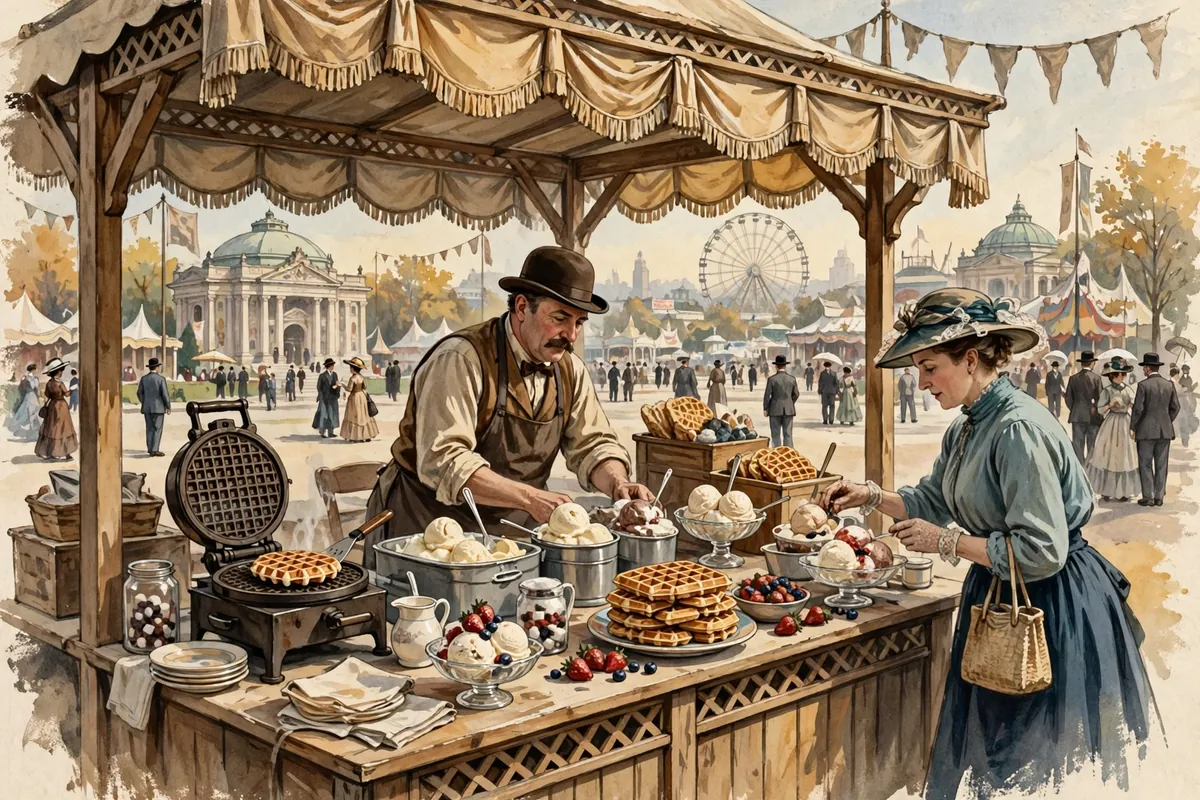
It's one of America's favorite food stories. At the 1904 World's Fair in St. Louis, an ice cream vendor runs out of dishes on a hot day. A waffle seller next door rolls up a warm waffle, the vendor plops a scoop inside, and the ice cream cone is born. It's a perfect little tale, but is it true?
Not quite. The 1904 fair may well have helped make ice cream cones popular, but cones existed before then. The earliest certain evidence comes from an English cookbook published in 1888, and edible ice cream cups were being patented in the years just before the fair.
The Famous Fair Story
The most popular version credits Ernest A. Hamwi, a Syrian concessionaire at the 1904 St. Louis World's Fair. When a nearby ice cream vendor ran out of paper cups, Hamwi is said to have curled a waffle cookie into a holder for the ice cream. Some believe this was the moment cones went mainstream, though that claim is much disputed. Hamwi did start his own cone-making company a few years later.
He isn't the only one with a claim. The Doumar family of Norfolk, Virginia, says a 16-year-old Abe Doumar rolled a waffle into a cone, topped it with ice cream, and began selling cones at the St. Louis Exposition. At the Jamestown Exposition in 1907, he and his brothers sold nearly 23,000 cones. The family business, Doumar's Cones and BBQ, still operates in Norfolk.
Cones Came First
Rolled wafers baked hard go all the way back to ancient Greece and Rome. When people first used them for ice cream isn't clear. Some historians point to France in the early 1800s, where an 1807 picture of a Parisian girl may show an ice cream cone. French cookbooks mentioned edible cones as early as 1825.
The earliest certain evidence comes from Mrs A. B. Marshall's Book of Cookery, published in 1888 by English cook Agnes B. Marshall. Her recipe for "Cornet with Cream" used cones made with almonds and baked in the oven. Because of this, Marshall is often regarded as the inventor of the modern ice cream cone.
Patents Before the Fair
In the United States, edible ice cream holders took off in the early 1900s. In 1902 and 1903, two Italian ice cream merchants patented molds for them. Antonio Valvona of Manchester patented a gadget resembling a cup-shaped waffle iron for baking biscuit cups for ice cream.
The next year, Italo Marchiony of New York City patented an improved design with a break-apart bottom, which allowed more unusual shapes to be made from the delicate waffle batter. Both patents came before the 1904 fair opened its gates.
From Fair Treat to Factory Product
After the fair, cones spread fast. By 1912, Frederick Bruckman of Portland, Oregon, had perfected a machine that molded, baked, and trimmed cones at high speed. Machines like his made it possible to sell cones by the thousands. He sold his company to Nabisco in 1928.
Missouri hasn't forgotten its role in the story. In 2008, the ice cream cone became the official state dessert of Missouri.
So the fair didn't invent the cone, but it gave the cone its big moment in the spotlight. And whoever deserves the credit, we can all agree on one thing: it was a brilliant idea to make the bowl edible.