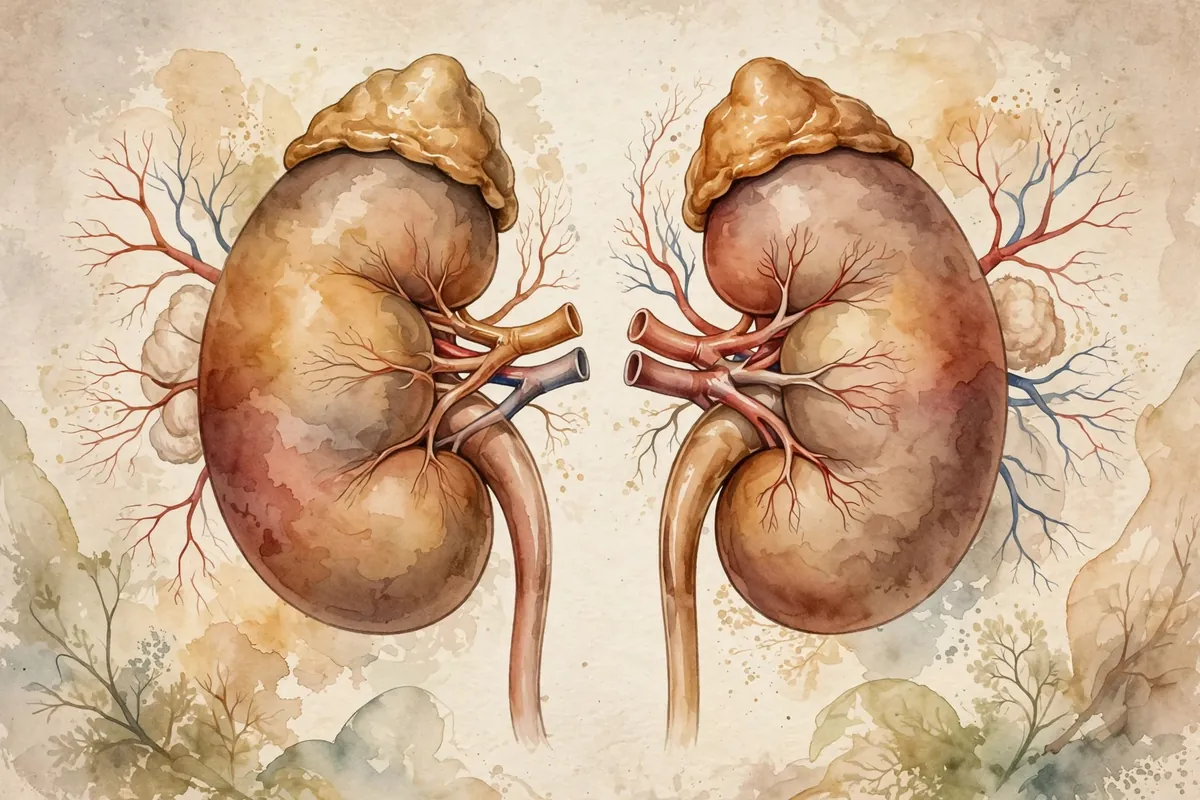
Here's a puzzle. Most of us are born with two kidneys, tucked one on each side of the spine. Yet people donate a kidney to loved ones every day and go on living normal lives. If one is enough, why did we get two?
The short answer has two parts. First, your body is built on a left-right mirror plan, so many organs come in matched pairs, from eyes and ears to lungs and kidneys. Second, each kidney has far more working tissue than you need to survive. Generally, a person can live normally with just one, because a single healthy kidney carries plenty of spare capacity.
A Body Built in Mirror Image
Humans belong to a huge group of animals called bilaterians. Our bodies develop with bilateral symmetry, meaning they divide into two roughly mirror-image halves, left and right. That's why you have two arms, two legs, two eyes, and two ears.
The kidneys follow the same pattern. They sit high in the abdomen, one on each side of the spine, each fed by its own artery and drained by its own vein. Each one also has its own tube, the ureter, carrying urine down to the bladder.
The mirror isn't perfect, though. The liver takes up a lot of room on the right side, so the right kidney usually sits slightly lower and is a little smaller than the left.
Built-In Spare Capacity
Each adult kidney is only about four and a half inches long, but it's packed with around a million tiny filtering units called nephrons. For comparison, a mouse kidney has only about 12,500.
That's a lot of filtering power. Problems like chronic kidney disease only develop when the amount of working kidney tissue drops a great deal. Doctors usually turn to dialysis or a transplant only when kidney function falls very low.
Some people are even born with just one. In about one of every 750 births, one kidney never forms. If you have questions about your own kidney health, talk to your doctor.
Not Just a Filter
Kidneys are best known for cleaning the blood and making urine, but they handle a surprising number of other jobs. They help control the amount of fluid in your body, balance salts like sodium and potassium, and keep your blood from becoming too acidic. Along the way, they clear out toxins and the waste products your body makes as it burns fuel.
They're hormone makers, too. The kidneys produce erythropoietin, which helps your body make red blood cells, and renin, which plays a part in blood pressure. They also turn vitamin D into its active form, calcitriol.
How Two Kidneys Changed Medicine
Having a spare made one of medicine's great milestones possible. On December 23, 1954, surgeons in Boston performed the first truly successful kidney transplant between identical twins, Ronald Herrick, the donor, and his brother Richard. Surgeon Joseph Murray later won the Nobel Prize in Physiology or Medicine for this and related work.
Today, living donors provide a large share of transplanted kidneys. In 2018, more than a third of the kidney transplants performed worldwide came from living donors.
So your pair of bean-shaped organs is part body blueprint and part generous safety margin. They quietly do their work every minute of the day, and thanks to that extra capacity, one of them has even been able to give someone else a second chance.