Long Live the King. All Seven Pounds of Him, Seated on a Lion Throne.
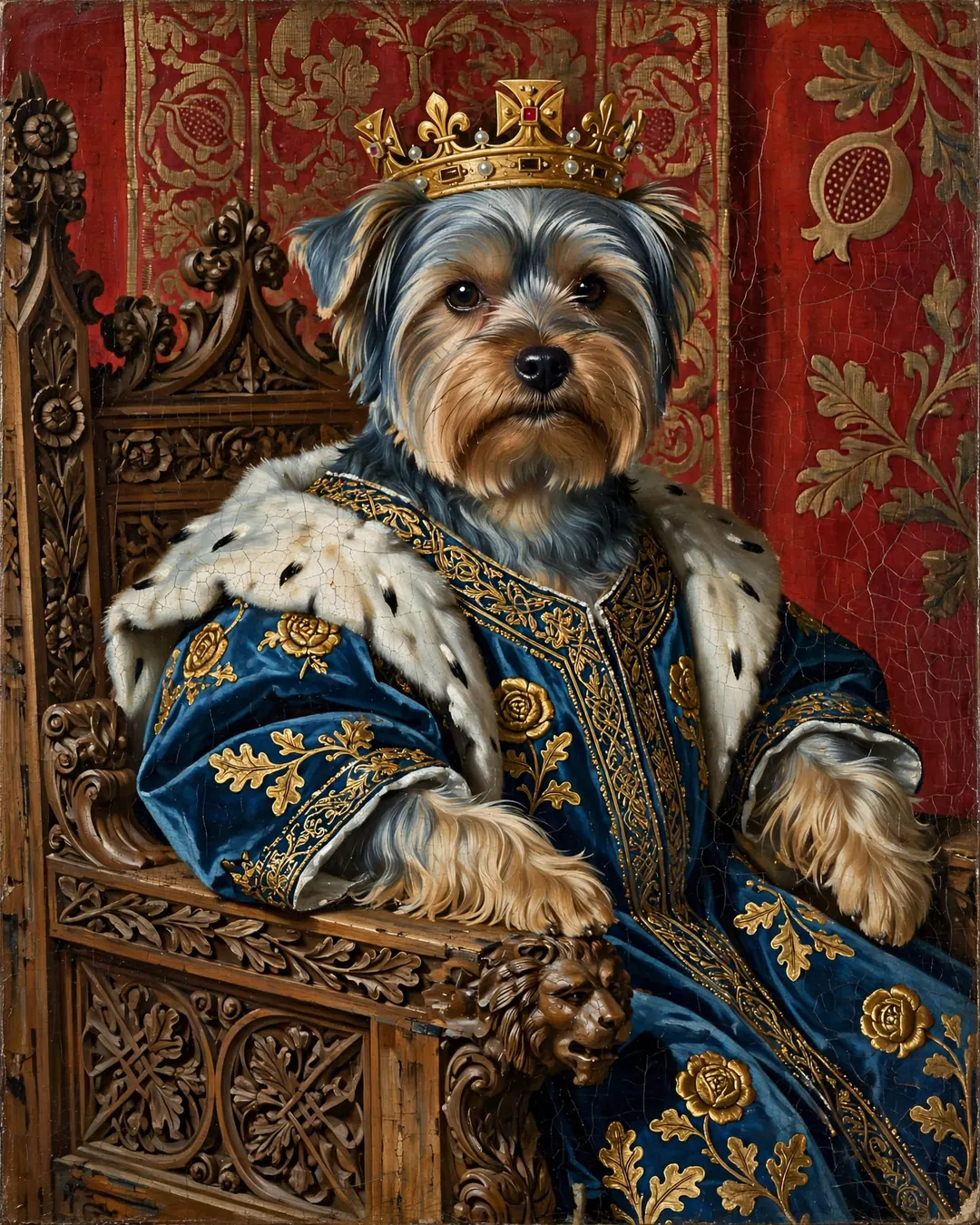
Long live the king, all seven pounds of him. A blue and tan Yorkshire Terrier sits enthroned with tremendous dignity, a golden crown set atop his silky head and a stern little expression on his face. His royal robe is deep blue velvet embroidered with golden roses and leaves, and a broad collar of spotted white ermine drapes across his shoulders. His paws rest on the arms of a dark, intricately carved wooden throne finished with a snarling lion's head. Behind him hangs a crimson tapestry patterned with gold pomegranates and vines.
Ermine was the ultimate royal fur. It comes from the stoat, a small relative of the weasel whose coat turns white in winter, except for the black tip of its tail. Pelts were sewn together with those black tips scattered across the white, creating the distinctive spotted pattern seen in so many royal portraits. In Tudor England, the right to wear ermine was tightly restricted to royalty and the highest ranks of nobility. The lion carved into the throne carried meaning too, as it had long been a symbol of English monarchy and appeared on the royal coat of arms.
This tiny monarch clearly takes his duties seriously. Yorkies were bred as ratters, and they have never been told that they are small dogs. Seated on his grand throne with crown in place, he rules the room with all the confidence of a much larger king.