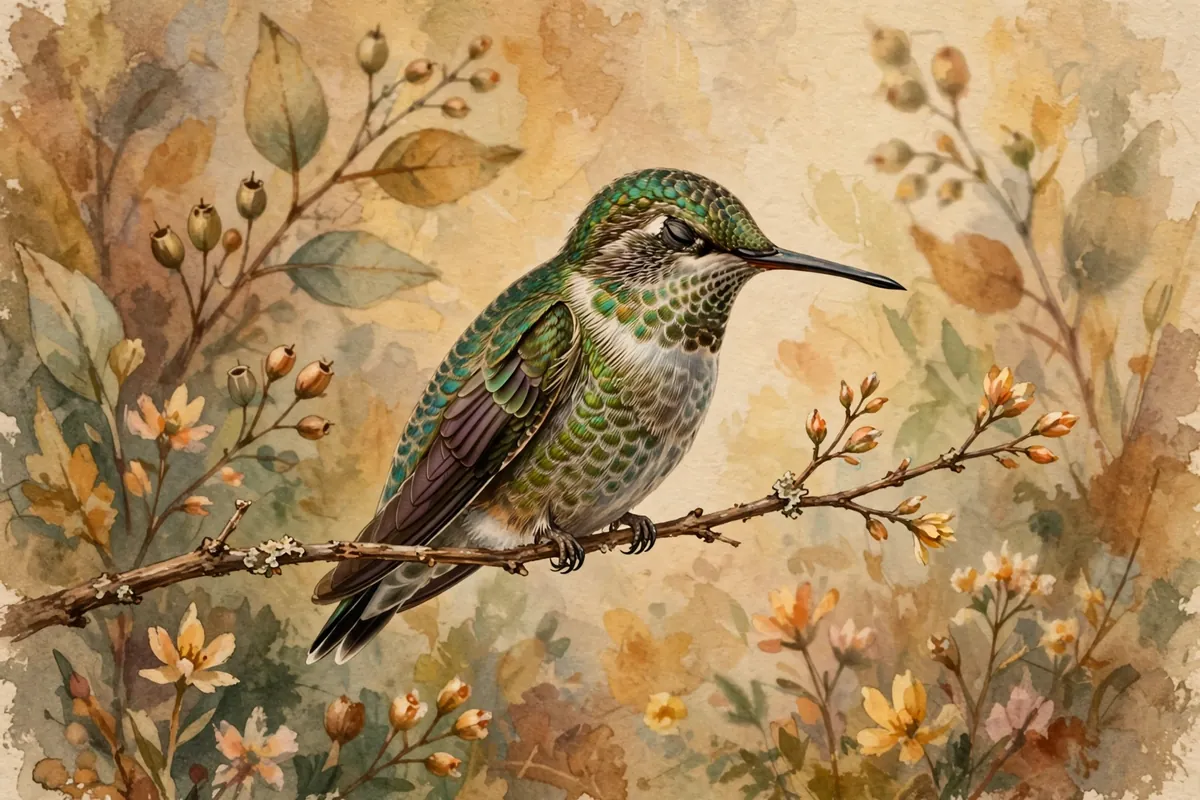
A resting human heart usually beats somewhere around 60 to 100 times a minute. Now picture a bird that could sit in the palm of your hand, with a heart that can go more than ten times faster. That's everyday life for a hummingbird.
The short answer is that hummingbirds have the highest metabolism of any vertebrate animal, and their hearts have to keep pace. The fastest rate on record is about 1,260 beats per minute, measured in a blue-throated hummingbird. It's the price of hovering, which burns enormous amounts of energy.
Why the Engine Runs So Hot
Hovering in midair is one of the hardest things a bird can do. The highest wingbeat rate recorded for hovering hummingbirds is about 99 beats per second, in tiny birds called woodstars. Some males go past 100 beats per second during courtship displays.
All that motion needs a constant supply of oxygen. During flight and hovering, a hummingbird's flight muscles use about 10 times more oxygen per gram than an elite human athlete's muscles. Their flight muscles are packed with tiny blood vessels and mitochondria, the parts of cells that turn fuel into energy. A racing heart is what keeps that oxygen-rich blood flowing.
Scaled up to human size, a hummingbird's daily energy use would equal about 150,000 calories. That's estimated to be about 10 times what a marathon runner burns during a race.
Fueled by Sugar, Almost Instantly
Hummingbirds are unusual among vertebrates because they can burn the sugar they just drank to power their flight, covering up to all of their energy needs this way. They eat many small meals and drink about half their body weight in nectar each day.
They can store fat when they need to, as well. A migrating ruby-throated hummingbird can nearly double its weight before flying about 500 miles nonstop across the Gulf of Mexico. Still, they don't spend all day buzzing around. That would cost too much energy. Hummingbirds spend about 20 percent of their time feeding and most of the rest sitting and digesting.
The Nightly Slowdown
Here's the surprising part. A body that runs that hot can't simply keep going all night without food. So hummingbirds can drop into a deep, sleep-like state called torpor, which is a bit like a mini hibernation.
In torpor, their metabolism can slow to about one-fifteenth of its normal rate. In one Caribbean hummingbird, body temperature fell from about 104°F to about 64°F, and the heart rate dropped from more than 1,000 beats per minute to roughly 50 to 180. One hummingbird studied high in the Andes cooled to just 38°F, the lowest body temperature known for any bird or non-hibernating mammal.
Even their kidneys take a break. During torpor, kidney function slows down to help the bird hold on to water and nutrients. In the morning, the bird warms back up and gets right back to work.
Small Bird, Long Life
You might expect such a fast-living creature to burn out quickly. Yet hummingbirds live surprisingly long for their size. Many common North American species typically live 3 to 5 years, and one female broad-tailed hummingbird was at least 12 years old when she was recaptured.
So the next time a hummingbird zips up to your feeder, take a second to appreciate the engine inside. That little heart is racing faster than a drumroll, and by nightfall it will be slowing down to rest. It's a pretty clever way to live life in the fast lane.