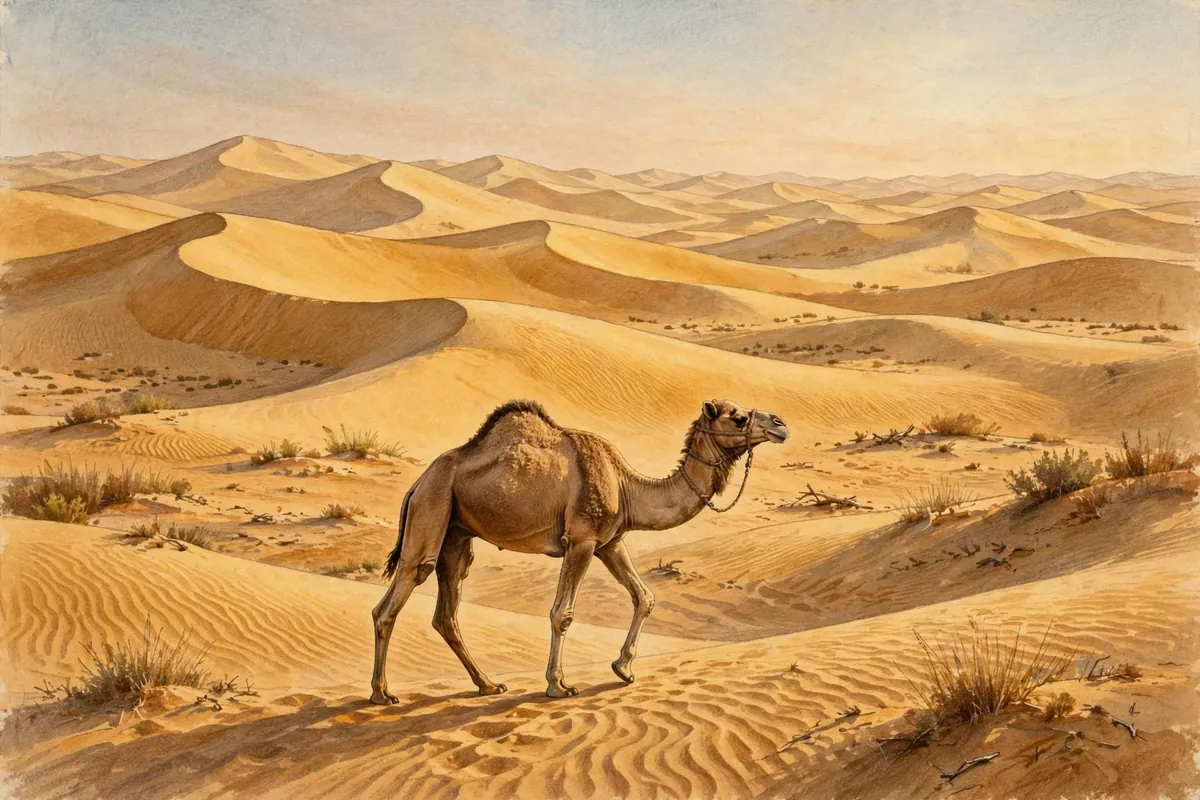
Picture a camel plodding across the desert, days from the nearest well. For generations, the explanation seemed obvious: that big hump must be full of water, like a built-in canteen. It's one of the most widely repeated animal facts there is.
It's also a myth. A camel's hump is made of fat, not water. It's a reserve of fatty tissue the animal can draw on for energy when food is scarce. The water a camel drinks is stored in its bloodstream, not in its hump.
What's Really in the Hump
On a dromedary, the one-humped camel, the hump stands about 8 inches tall or more. It's made of fat held together by fibrous tissue. Think of it as a packed lunch rather than a water jug.
There's a small grain of truth behind the old myth. When a camel's body burns that fat for energy, the chemical process actually produces more water by weight than the fat itself. But there's a catch. Burning fat requires oxygen, and breathing in all that air causes water to evaporate from the lungs. In a dry climate, the camel ends up with a net loss of water, so the hump isn't a secret water supply.
So How Do Camels Go So Long Without Drinking?
The real secret is a whole set of body tricks. A dromedary can go as long as 10 days between drinks, even in very hot weather. When it finally reaches water, it can gulp down as much as 30 imperial gallons, about 36 U.S. gallons, at a time.
Camels also hang on to the water they have. They rarely sweat, even when the air reaches 120°F. When they breathe out, water vapor gets trapped in their nostrils and is absorbed back into the body. Compared with other livestock, which can lose 20 to 40 liters of fluid a day, camels lose only about 1.3 liters.
Their body temperature is flexible too. It can start around 93°F at dawn and climb to about 104°F by sunset before cooling off again overnight. Swings like that would kill most other mammals, but camels handle them every day.
Built for Extremes
Camels can survive losing about a quarter of their body weight in water. Most other mammals can only handle about 12 to 14 percent before their hearts give out. Part of the reason lies in their blood. Unlike other mammals, camels have oval red blood cells instead of round ones, which keeps blood flowing when the animal is dehydrated and helps the cells survive a huge drink without bursting.
Their thick coat helps as well, shielding them from heat radiating off the sand. A camel that has been shorn has to sweat about 50 percent more to keep from overheating. Long legs hold the body away from ground that can reach 158°F, and dromedaries have a thick chest pad that lifts the body off the hot sand when the animal lies down.
One Hump or Two?
There are three surviving camel species. The one-humped dromedary makes up about 94 percent of the world's camels, and the two-humped Bactrian camel makes up about 6 percent. The third, the wild Bactrian camel, is endangered, with only around 1,000 left.
Camels even have their own sand protection kit. Long eyelashes, hairy ears, and nostrils that can close keep blowing sand out. If a grain still gets in an eye, a see-through third eyelid can sweep it away.
So the next time someone tells you a camel carries its water on its back, you can smile and set the record straight. The hump is a snack bar, and the rest of the camel is one of the best water savers on the planet.