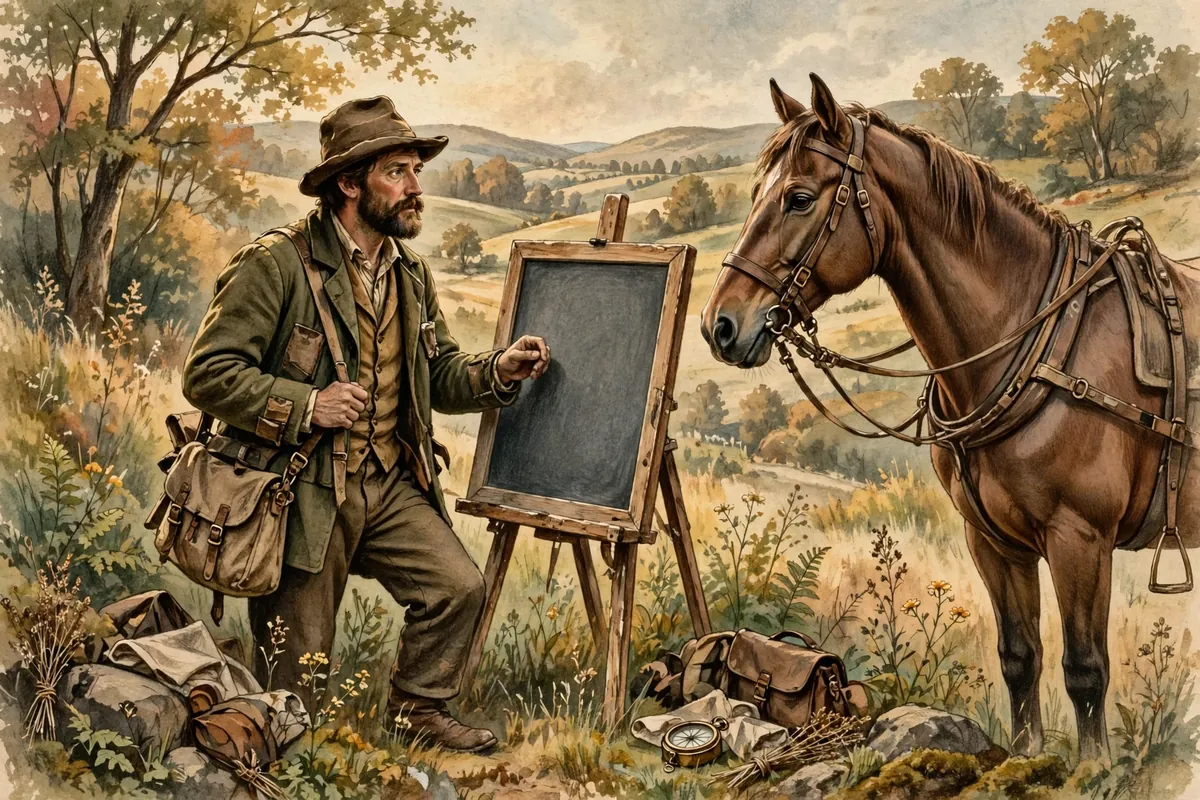
Imagine a horse in early 1900s Germany who could answer arithmetic problems by tapping his hoof. Ask him to add, subtract, or work out a date on the calendar, and he would tap out the right number. People came from all over to see him, and The New York Times even wrote about him in 1904.
His name was Clever Hans, and no, he couldn't really do math. In 1907, a psychologist named Oskar Pfungst showed that Hans was reading tiny, unconscious signals in the body language of the person asking the questions. Nobody was cheating. The people giving him the answers had no idea they were doing it.
The Teacher and His Star Pupil
Hans belonged to Wilhelm von Osten, a math teacher and amateur horse trainer. Von Osten claimed Hans could add, subtract, multiply, divide, work with fractions, tell time, keep track of the calendar, and even read and understand German.
A typical question went like this: if the eighth day of the month falls on a Tuesday, what is the date of the following Friday? Hans would tap his hoof 11 times. Von Osten showed him off all over Germany and never charged admission, which made the whole thing seem even more sincere.
The Experts Were Stumped
So many people were talking about Hans that the German board of education set up a commission to look into it. The panel of 13 included a veterinarian, a circus manager, a cavalry officer, several schoolteachers, and the director of the Berlin zoo. In September 1904, they concluded that no tricks were involved.
That was true, as far as it went. But the case was handed to Pfungst for a closer look, and he set up some clever tests. He kept the horse away from the crowd, had people other than von Osten ask the questions, used blinders so Hans sometimes couldn't see the questioner, and varied whether the questioner even knew the answer.
The Moment the Mystery Cracked
The results were striking. Hans could answer correctly even when strangers asked, so it wasn't a scam by his owner. But he only got it right when the questioner knew the answer and Hans could see that person. When he could see them, he got 89 percent of the answers right. When he couldn't, he managed only about 6 percent.
Pfungst then watched the questioners closely. As the taps got close to the right number, people tensed up without realizing it. When Hans hit the correct tap, that tension eased, and he stopped. Horses are very good at noticing small changes in posture, so Hans had learned to read people with remarkable precision.
The strangest part? Once Pfungst understood the cues, he found he gave them himself without meaning to, even when he tried to hold them back. Von Osten, for his part, was never convinced and kept showing Hans to big, enthusiastic crowds.
Why a Horse Still Matters to Science
Hans left a lasting mark. Researchers now talk about the Clever Hans effect, the risk that a person running a test can accidentally signal the answer they expect. It's one reason scientists studying animals often test them in setups where no one nearby knows the right answer. The same idea shapes how studies involving people are designed, too.
In the end, Hans wasn't a math genius. But he was a genius at something else: paying close attention to the people around him. Maybe that's the most impressive trick of all.