Drop an ice cube into a glass of water and it bobs right back up. We see it so often that it hardly seems worth a second thought. But scale that up to an iceberg weighing millions of tons, and suddenly it's a little harder to believe that something so massive can float.
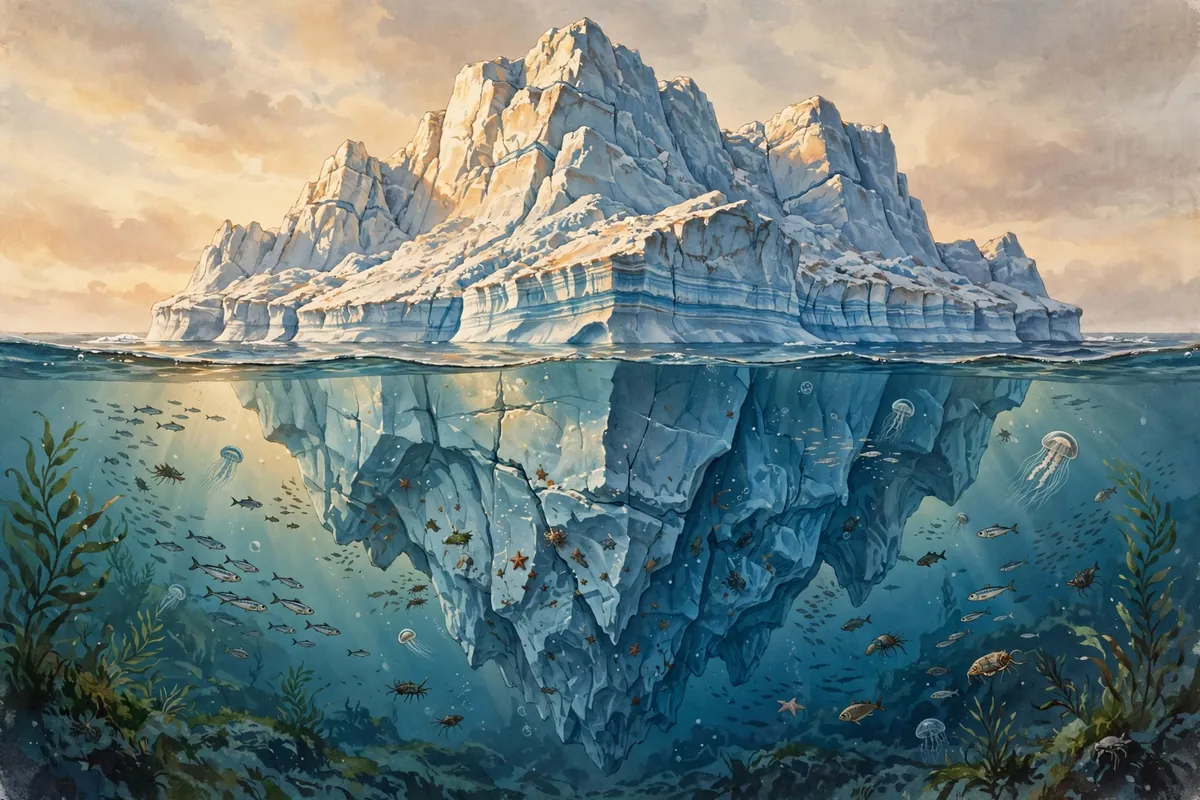
Here's the short answer: ice floats because it's less dense than liquid water. When water freezes, its molecules lock into an open, six-sided crystal pattern that takes up more room, so ice ends up about 8 percent less dense than the water it came from. An iceberg is made of fresh water ice, and floating in denser salt water, it rides with typically about one-tenth of its volume above the surface.
Water's Unusual Trick
Most substances get denser when they freeze, so their solid form sinks. Water does the opposite. As it cools toward freezing, the molecules start forming hexagonal ice crystals held together by hydrogen bonds. That arrangement packs the molecules less tightly than in liquid water.
This is a very good thing for life on Earth. Because ice floats, lakes and ponds freeze from the top down instead of from the bottom up. The floating ice acts like a lid, sheltering fish, plants, and other creatures in the water beneath.
Why Most of an Iceberg Hides
The amount that sticks out depends on the difference in density. Pure ice is a bit lighter than seawater, but not by much. Following Archimedes' principle, a floating object pushes aside its own weight in water, so an iceberg settles until roughly nine-tenths of it is below the waterline.
That's where the phrase "tip of the iceberg" comes from, meaning a small visible part of a much bigger hidden problem. It's also why icebergs are dangerous to ships. The shape of the underwater portion can be hard to judge by looking at what's above the surface.
The Disaster That Changed the Seas
The most famous iceberg in history struck the brand-new RMS Titanic in April 1912. Around 1,500 people died, even though the ship was considered practically unsinkable and had received wireless warnings about ice in the area.
The tragedy led to new safety rules at sea. In less than two years, maritime nations formed the International Ice Patrol to track icebergs near the Grand Banks of Newfoundland and warn ships where the ice was.
Giants of the Ocean
Not all icebergs look alike. Those that break off Greenland's glaciers are often jagged and irregular. Antarctica's vast ice shelves tend to release flat-topped icebergs called tabular icebergs, and those include the biggest icebergs in the world.
Icebergs can be enormous. The largest one on record, spotted in 1956 near Antarctica, measured about 208 by 60 miles, bigger than the country of Belgium. In the North Atlantic, one iceberg towered 551 feet above the sea, about as tall as a 55-story building, and that was only the tip.
Icebergs even make noise. The ice can hold up to 10 percent trapped air, squeezed in from ancient snow. As the berg melts, the tiny bubbles pop and fizz, a sound some people call "bergie seltzer."
So the next time you drop ice into your lemonade, you're watching the same science that keeps a mountain of ice afloat in the open ocean. The only difference is that your ice cube doesn't need its own patrol.