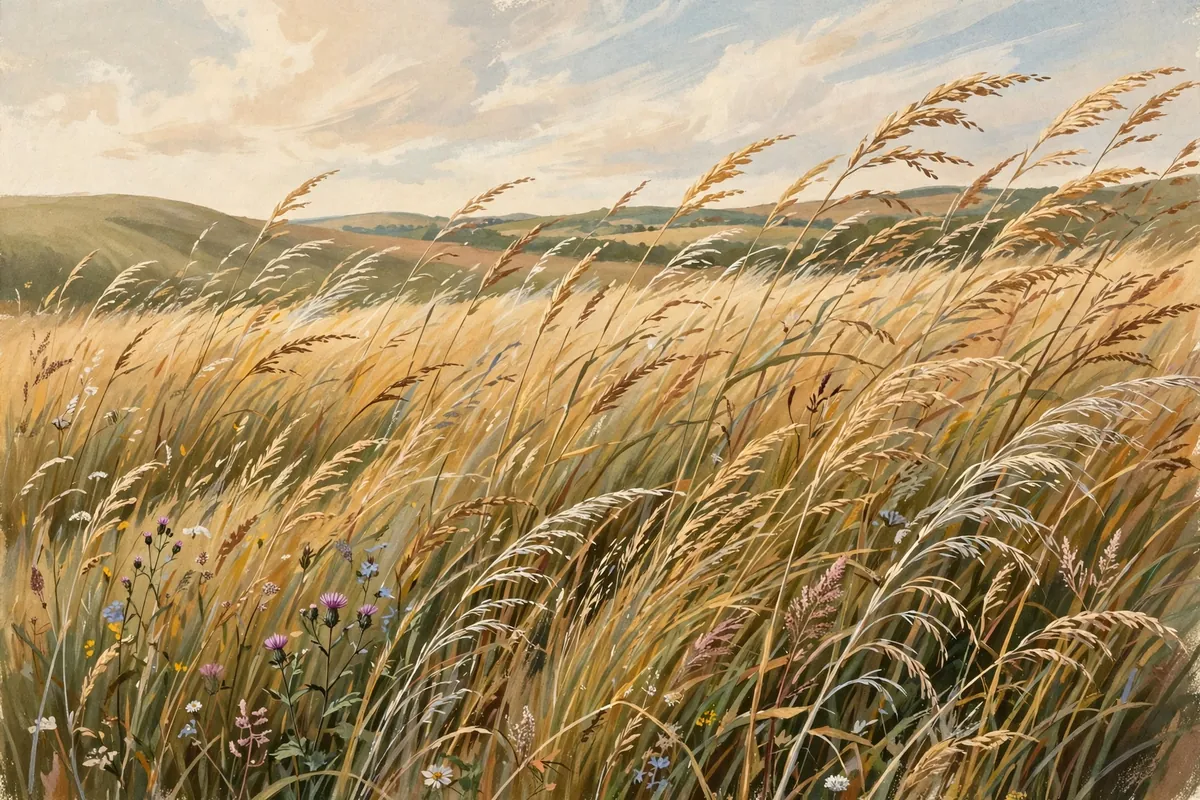
You can't see it, but you can feel it on your face, hear it rattle the windows, and watch it bend a whole field of grass. Wind is one of the most familiar things in the world. Yet if someone asked you where it actually comes from, you might have to stop and think.
The short answer: wind is air moving from one place to another, and the Sun is behind it. The Sun heats Earth unevenly. Warm air is lighter and rises, while cooler, denser air moves in to take its place. That flow from areas of higher air pressure toward lower pressure is what we feel as wind. On a planetary scale, Earth's spin bends those flows into giant patterns.
A Day at the Beach Explains It
The seaside is the perfect classroom. During the day, the Sun warms the land faster than the sea, because water takes more energy to heat up. The warm land heats the air above it, and that air becomes less dense and rises.
Over the water, the air stays cooler, with higher pressure. So it flows inland to fill the gap, and you feel a refreshing sea breeze. At night the situation flips. The land cools off faster than the ocean, the pressure over the water becomes lower, and a land breeze can blow back out to sea.
The Big Picture: Equator to Poles
The same idea works on a giant scale. The equator soaks up much more solar energy than the poles. That uneven heating, together with Earth's rotation, drives the planet's great wind belts. The effect of the spin, which deflects moving air, is known as the Coriolis effect.
Near the equator, the trade winds blow mostly from the northeast in the Northern Hemisphere and from the southeast in the Southern Hemisphere. They steer hurricanes across the oceans and even carry African dust westward across the Atlantic to the Caribbean and parts of the southeastern United States.
Farther from the equator blow the westerlies. Together, the trades and the westerlies gave sailing ships a round-trip route across the Atlantic and Pacific. Down in the Southern Hemisphere, where there's little land to slow them, the westerlies roar so strongly between 40 and 50 degrees south that sailors named them the Roaring Forties.
Gusts, Gales, and Record Breakers
Weather forecasters have plenty of names for wind. A short burst is a gust, and a strong wind lasting about a minute is a squall. Longer winds are called breezes, gales, storms, or hurricanes, depending on their strength.
Here's a detail that trips people up: winds are named for where they come from. A westerly wind blows from the west toward the east.
The strongest gust ever measured was 253 miles per hour on Barrow Island, Australia, during Cyclone Olivia in 1996. Before that, the record belonged to Mount Washington in New Hampshire, where a gust hit 231 mph in April 1934.
Wind Beyond Earth
Other planets have weather too. The strongest winds observed in the solar system blow on Neptune and Saturn. Even the Sun has a wind of its own, a stream of charged particles flowing out into space.
So the next time a breeze lifts your hat or cools you off on a summer porch, you can thank the Sun. It warms the world unevenly, and the air is always trying to even things out. That restless balancing act is the wind.