On a dark night, the stars aren't all the same color. Betelgeuse glows orange-red, some stars look icy blue, and many simply look white. But scan the sky as long as you like and you'll never find one that's clearly green. That seems odd, since green sits right in the middle of the rainbow.
The short answer is that stars shine in every color at once. Ordinary stars give off light in a broad, smooth spread across the whole rainbow, and our eyes blend that mix together. Cooler stars lean orange, hotter ones lean blue, and the ones in between come out white. A star whose light peaks in green still pours out plenty of red and blue too, so the overall color we see is whitish, not green.
The Sun Is the Best Example
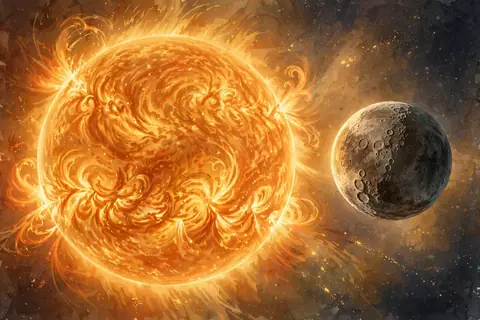
Here's the surprise. The visible light from our own Sun actually peaks in the green part of the spectrum. If color depended only on that peak, the Sun would be green.
Instead, it looks white, at least when it's high in the sky. That's because the Sun also gives off lots of red, yellow, and blue light, and all of those together add up to white. Astronomers sometimes call the Sun a yellow dwarf, but in reality stars like it are white.
The same rule applies across the sky. Stars range from orange at lower temperatures, through white, to pale blue at the hottest end. Green never gets its own spot on that scale. Under normal viewing conditions, there are no green, cyan, indigo, or violet stars.
Stars That Only Look Green
Some stars seem green thanks to a trick of the eye. When a bright reddish star sits right next to a bluish or white one, color contrast can make the neighbor look slightly green. The classic example is Antares, a red supergiant in Scorpius with a blue companion. Viewed together at low magnification, some observers describe the pair as greenish.
Then there's Beta Librae, a star most modern observers call white. Yet many earlier observers insisted it was green. There's still no agreed explanation for why some people saw it that way.
A few impostors aren't stars at all. Uranus appeared in old star catalogs before William Herschel figured out it was a planet, and in binoculars it looks like a greenish or blue-green dot.
A Rare Green Exception
The rule isn't quite absolute. White dwarfs, the dense leftovers of dead stars, can have unusual atmospheres that soak up certain colors of light. In a 2026 study, researchers modeled one white dwarf in the constellation Draco, about 280 light-years away, and found it would look chartreuse green if you could see it up close.
Its color comes from sodium and calcium in its thick atmosphere, likely from material that once belonged to a planetary system. The researchers called it the first known star reported to have that color. A couple of other white dwarfs were modeled with paler green tints.
Your Best Chance to See Green
If you want to see a green star with your own eyes, watch the sunrise or sunset over a clear, flat horizon. Once in a while, the very top of the Sun flashes green for a second or two, an effect called the green flash. It happens because Earth's atmosphere bends and scatters the different colors of sunlight by different amounts.
It's brief and easy to miss, but it might be the closest any of us will get to a green star.