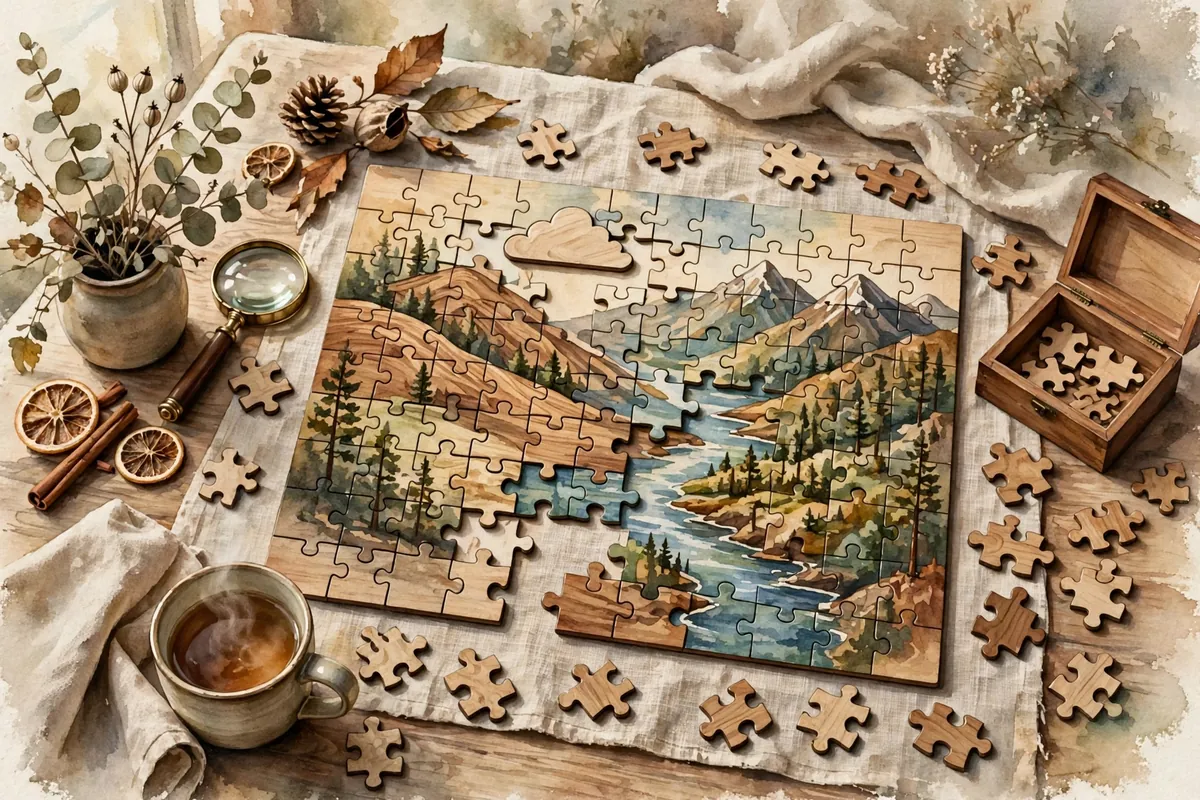
There's something soothing about a jigsaw puzzle on the kitchen table. You sort the edge pieces, hunt for that one tricky shade of blue, and feel a little thrill when a piece clicks into place. But the very first jigsaw puzzles weren't meant for relaxing at all. They were homework.
Here's how it started. Around 1760, a London mapmaker and engraver named John Spilsbury mounted world maps on wood and cut out the individual countries. Students then put the map back together as a way to learn geography. Spilsbury is credited with turning jigsaw puzzles into a business.
Maps You Could Take Apart
These early puzzles were known as "dissections." Makers glued a map to a sheet of hardwood and cut along national borders. Putting the pieces back helped children learn where each country belonged and what shape it had. It was a smart way to make a dry subject hands-on. Instead of memorizing a list of names, children could see and feel how the countries fit together.
Spilsbury wasn't the only one with the idea. A French author and teacher named Jeanne-Marie Leprince de Beaumont had been using dissected "wooden maps" in her lessons as early as 1759.
They even reached the palace. Lady Charlotte Finch, a royal governess, used dissected maps to teach the children of King George III and Queen Charlotte.
How the Jigsaw Got Its Name
Spilsbury is believed to have cut his first puzzle with a fine saw used for decorative woodwork. Around 1880, fretsaws became the favorite tool for cutting the shapes, and the name "jigsaw" became linked to the puzzles. The term "jigsaw puzzle" itself dates to 1906.
Cardboard puzzles showed up in the late 1800s but were slow to catch on. Manufacturers worried customers would see them as cheap, and wooden puzzles also earned bigger profits.
From Classroom to Grown-Up Craze
Puzzles became a full-blown craze among American adults from 1907 to 1910. These were tough. Pieces were usually solid wood, often didn't interlock, and there was typically no picture on the box to guide you.
Puzzle historian Anne Williams links that craze to a weak economy in 1907, more women taking up arts and crafts like puzzle making, and the arrival of the foot-powered scroll saw. Puzzles boomed again during the Great Depression, when they offered cheap, long-lasting entertainment that could be done over and over. Companies even gave them away as advertising, with customers assembling a picture of the product.
Still Going Strong
Today most puzzles are made of paperboard. A picture is glued to cardboard and pressed through a set of steel blades, called a puzzle die, a bit like a giant cookie cutter, though with far more force. Since the 1930s, big hydraulic presses have made this precise cutting possible.
Puzzles surged once more during the COVID-19 stay-at-home period, rivaling the boom of the Great Depression. There are even World Jigsaw Puzzle Championships, held yearly since 2019. Laser cutting now lets makers produce wooden or acrylic puzzles in any size or shape, and because the patterns are stored on computers, a lost piece can easily be remade.
So the next time you spread a thousand pieces across the table, remember where it all began: with a mapmaker, a saw, and a clever way to help children learn about the world, one country at a time.