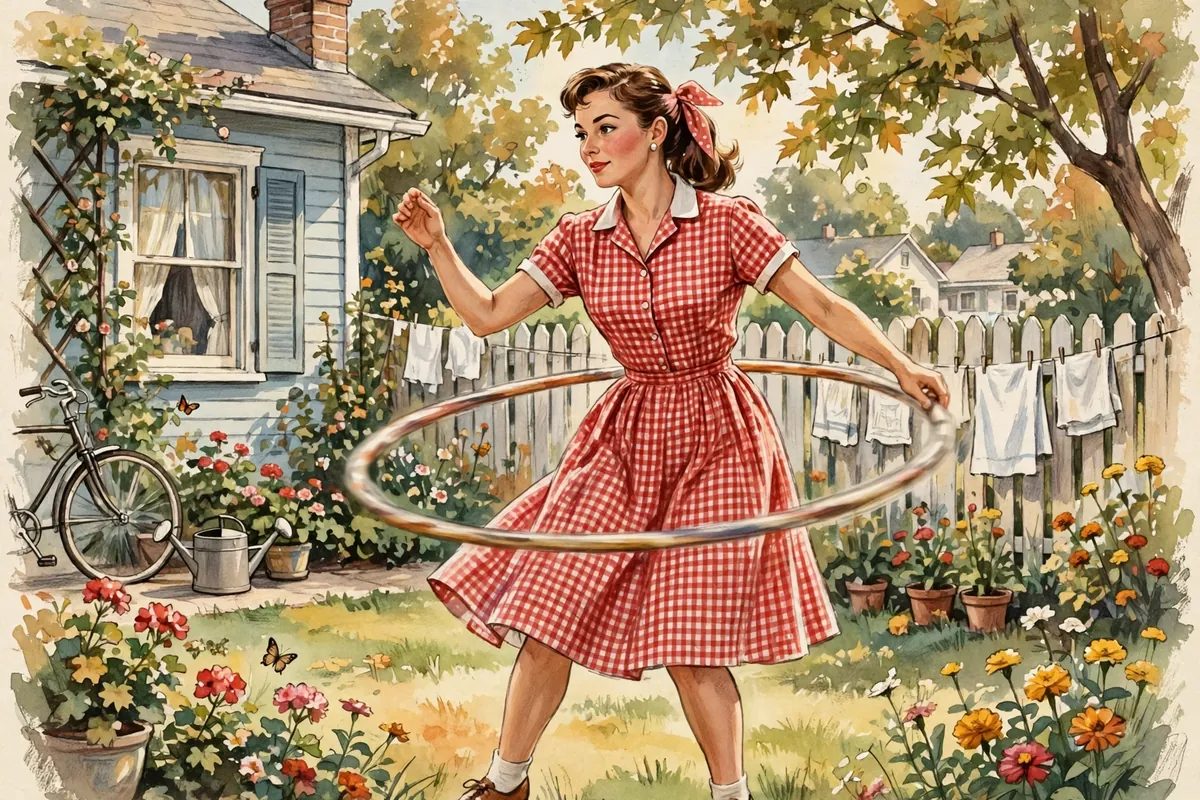
In the summer of 1958, it seemed like every backyard, sidewalk, and school playground in America had someone wiggling inside a plastic ring. Kids did it, parents tried it, and a few grandparents probably gave it a go too. How did a simple hoop become one of the biggest toy fads ever?
Here's the short answer: the hoop itself was ancient, but a new twist arrived from Australia. Children there were twirling bamboo hoops around their waists, and an Australian toy maker began producing lightweight plastic ones. California's Wham-O toy company then made its own plastic version, called it the Hula-Hoop, and launched it with a big marketing push. Twenty-five million sold in less than four months.
An Old Toy With a New Spin
People have played with hoops since at least 500 BC. For a long time, hoops were mostly rolled along the ground, with kids trying to keep them balanced for as long as possible. One author even describes a hoop craze in 14th-century England, complete with doctors treating aching backs.
In 1957, the idea of spinning a hoop around the body was catching on in several places. In the Norwegian town of Steinkjer, children started a rock-ring fad after seeing ring jugglers at a visiting circus. Before long, most of the town's children had caught the craze, and it spread all over Norway. That same summer, schoolgirls in Australia were swinging hoops around their middles.
From Bamboo to Plastic
In Australia, a Sydney teacher taught students to sway bamboo hoops in sports classes, and Coles department stores began selling them. Demand outran supply, so toy maker Alex Tolmer of Toltoys started making hoops from polyethylene, a light, sturdy plastic. In 1957 alone, Toltoys sold 400,000 of them in Australia.
The name came from a woman named Joan Anderson. While visiting Australia, she saw people twirling bamboo hoops and had one shipped to the United States. Her husband introduced it to Wham-O as the hula-hoop, after the Hawaiian dance with its similar hip movements.
The Summer America Went Hoop Crazy
Wham-O founders Richard Knerr and Arthur Melin made 42-inch hoops from a plastic called Marlex. The earliest known ad, from June 1958, offered them for $1.98 at a Los Angeles department store chain. With giveaways and national marketing, the fad took off that July.
Sales were staggering: 25 million hoops in under four months, and more than 100 million in two years. One manufacturer was turning out over 50,000 a day. In September 1958, singer Georgia Gibbs performed The Hula Hoop Song on The Ed Sullivan Show, one of five songs inspired by the craze.
Bust, Comeback, and the Hall of Fame
Fads fade, and this one left Wham-O with a pile of unwanted hoops. The company stopped making them until 1965, when it added ball bearings inside the tube to create a fun shoosh sound. The story had a sour note, too. Anderson sued Wham-O in 1960, saying she hadn't been paid, and eventually settled for $6,000.
The hoop never really disappeared. The craze swept the world before fading in the 1980s, except in China and Russia, where circus performers and rhythmic gymnasts kept hooping alive. In 1999, it was inducted into the National Toy Hall of Fame. So if you still have a hoop tucked in the garage, go ahead and give it a spin. You'll be joining a tradition that's thousands of years old.