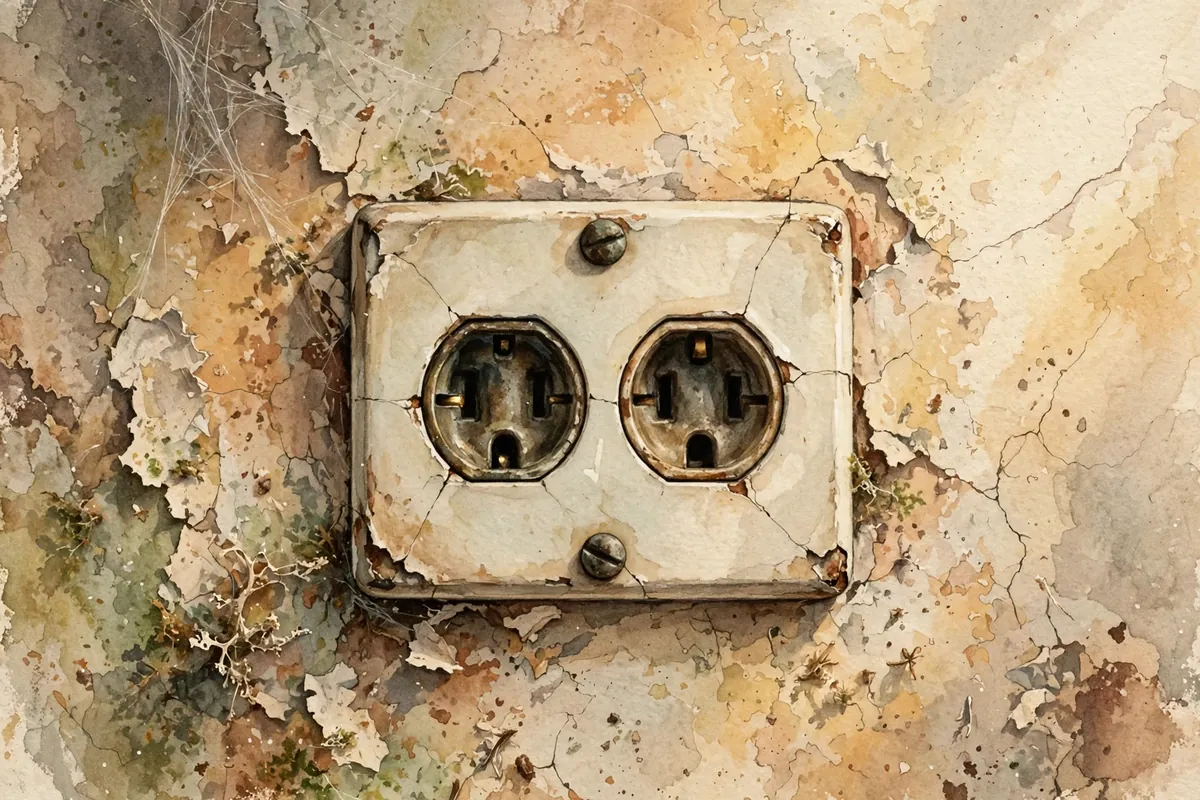
Is there a plug near the bed? Lots of people say it that way when they mean the spot on the wall where you plug something in. It's perfectly understandable. But it isn't quite what the word plug technically means.
Here's the short answer. In electrical terms, the plug is the connector on the end of a device's cord, usually with metal prongs sticking out. The fixed part in the wall is called a socket, receptacle, or outlet. Nobody recorded exactly when people began calling the outlet a plug, but since it's where everything gets plugged in, the shorthand is easy to understand.
Where the Word Came From
The English word plug comes from the Dutch word plugge, which was originally a sailors' term. It's still plug in Dutch today. For a long time, a plug simply meant something that fills a hole, like a stopper.
That idea fits electrical plugs nicely. The prongs fill the openings in the outlet. In connector language, the plug is called the male part and the socket is the female part. For safety, the live power is supplied through recessed contacts in the socket, so the exposed pins are always on the plug, not on the wall.
Before There Were Outlets
When electricity first came into homes in the 1880s, it was mostly used for lights. If you wanted to run something else, such as a fan, an iron, or a vacuum cleaner, you often connected it to a light bulb socket using a lampholder plug that screwed in where the bulb went.
There was even a money-saving reason. In places where electricity for lighting circuits was billed at a lower rate, lampholder plugs helped customers cut their electric bills. Adapters that let a plug screw into a bulb socket are still commonly used in the Americas.
Britain was ahead of the curve. In 1882, Thomas Tayler Smith of London received a British patent for an early electric-circuit connection, and recognizable two-pin plugs and wall sockets were on the market there as early as 1885.
The American Plug Takes Shape
In the United States, the key inventor was Harvey Hubbell of Connecticut. His most famous invention, the American electrical plug, was patented in 1904. It helped bring convenient, portable electric appliances into American homes. Before that, Britain had enjoyed such conveniences since the early 1880s. Hubbell is also known for inventing the pull-chain light socket.
In 1913, Hubbell patented a plug with two flat, parallel blades. In 1916, he patented a polarized version with one blade wider than the other, as well as a three-bladed plug with a ground prong. That three-blade design was later adopted as the standard in Australia.
Today, most two-prong plugs in the United States are polarized, with a wider neutral blade, so they only fit one way. That's why you sometimes have to flip a plug over to get it into the outlet.
A World of Different Shapes
There are about 20 types of plugs and sockets in common use around the world, which is why travelers pack adapters. Plugs and outlets differ in shape, size, voltage, and current rating.
So go ahead and call it a plug if you like. Everyone will know what you mean. But now you know the real name for that hardworking little spot on the wall, and the long history behind it.