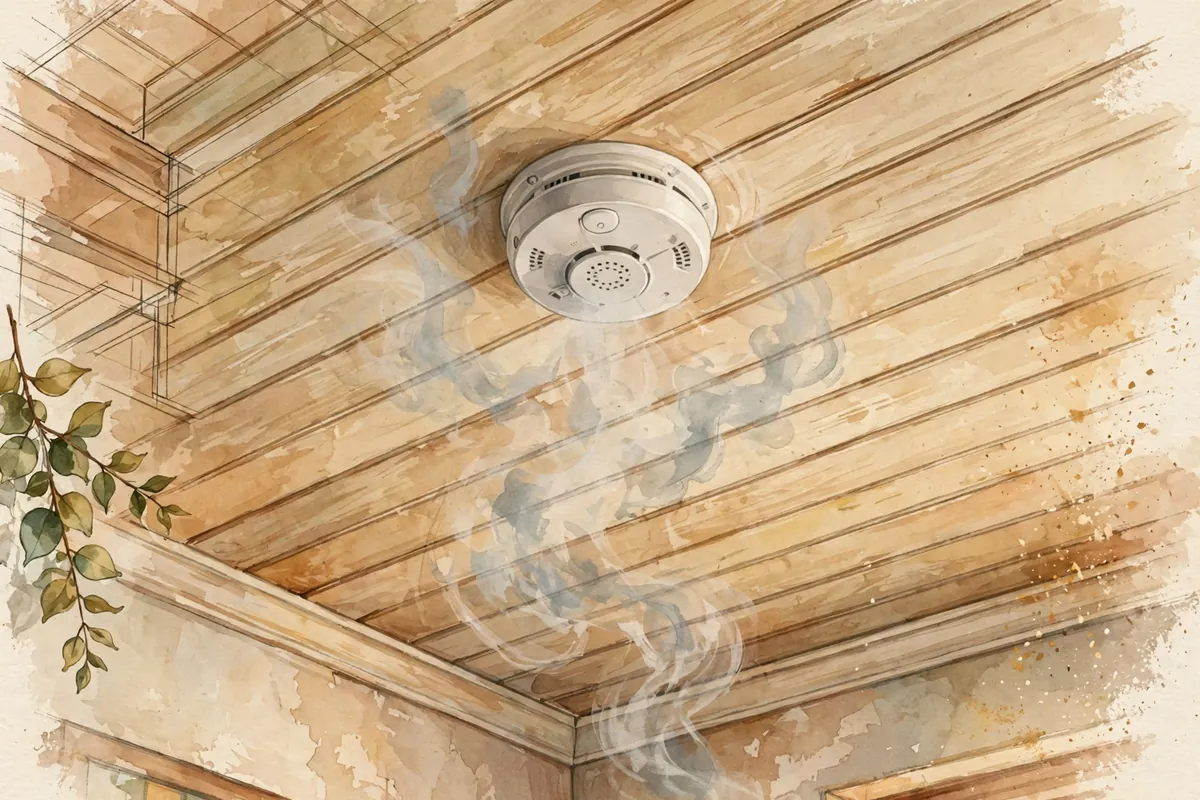
It's the little white disk on the ceiling that most of us forget about until it chirps at 3 a.m. demanding a new battery. But that humble gadget is one of the most important safety devices in any home. How does it actually know there's a fire, and how much difference does it make?
The short answer: a smoke detector senses tiny smoke particles in the air, either with a beam of light or with a weak electric current, and sounds an alarm when it finds them. And it truly matters. The risk of dying in a home fire is cut roughly in half in houses with working smoke detectors.
The Numbers Behind the Beep
According to the U.S. National Fire Protection Association, from 2009 to 2013 there were 0.53 deaths per 100 home fires in homes with working smoke detectors, compared with 1.18 deaths in homes without them. That's a big difference for a device that costs so little today.
The key word is working. Many battery-powered alarms in homes have dead batteries. In the United Kingdom, more than 30 percent of smoke alarms are estimated to have dead or removed batteries. That's why public campaigns remind people to change batteries regularly, often when the clocks change for daylight saving time.
Two Ways to Smell Smoke
There are two main types of smoke detectors, and some use both. A photoelectric, or optical, detector has a small light source, such as an LED, and a light sensor inside a chamber that lets in air. When smoke drifts in, it changes how light reaches the sensor, and the alarm goes off. These are especially good at catching slow, smoldering fires early.
An ionization detector uses a tiny speck of a radioactive material, typically americium-241, to make the air inside a chamber carry a small electric current. Smoke disrupts that current, which triggers the alarm. These are more sensitive to fast, flaming fires. The amount of radioactive material is very small, about 0.3 millionths of a gram, and it isn't considered a significant hazard as long as the sealed chamber stays intact.
An Invention Sparked by a Cigarette
The first automatic electric fire alarm was patented in 1890 by Francis Robbins Upton, an associate of Thomas Edison. But the modern smoke detector owes a lot to a happy accident.
In the late 1930s, Swiss physicist Walter Jaeger was trying to build a sensor for poison gas. It didn't work, because small amounts of gas didn't change the device's current. Frustrated, he lit a cigarette, and to his surprise, a meter on the instrument showed a drop in current. The smoke had done what the gas could not. His discovery helped pave the way for the smoke detector.
From Luxury to Lifesaver
The first single-station smoke detector arrived in 1970 and went on sale the next year. It ran on a 9-volt battery and cost about $125, more than $1,000 in today's money. Over the next few years, improved electronics made detectors cheaper and smaller.
In the U.S., the Life Safety Code first required smoke alarms in homes in 1976. Since 1999, the National Fire Protection Association has called for replacing smoke detectors after ten years. So take a look at the date on yours, test it, and swap the batteries if needed. That little beep is a sound worth hearing.