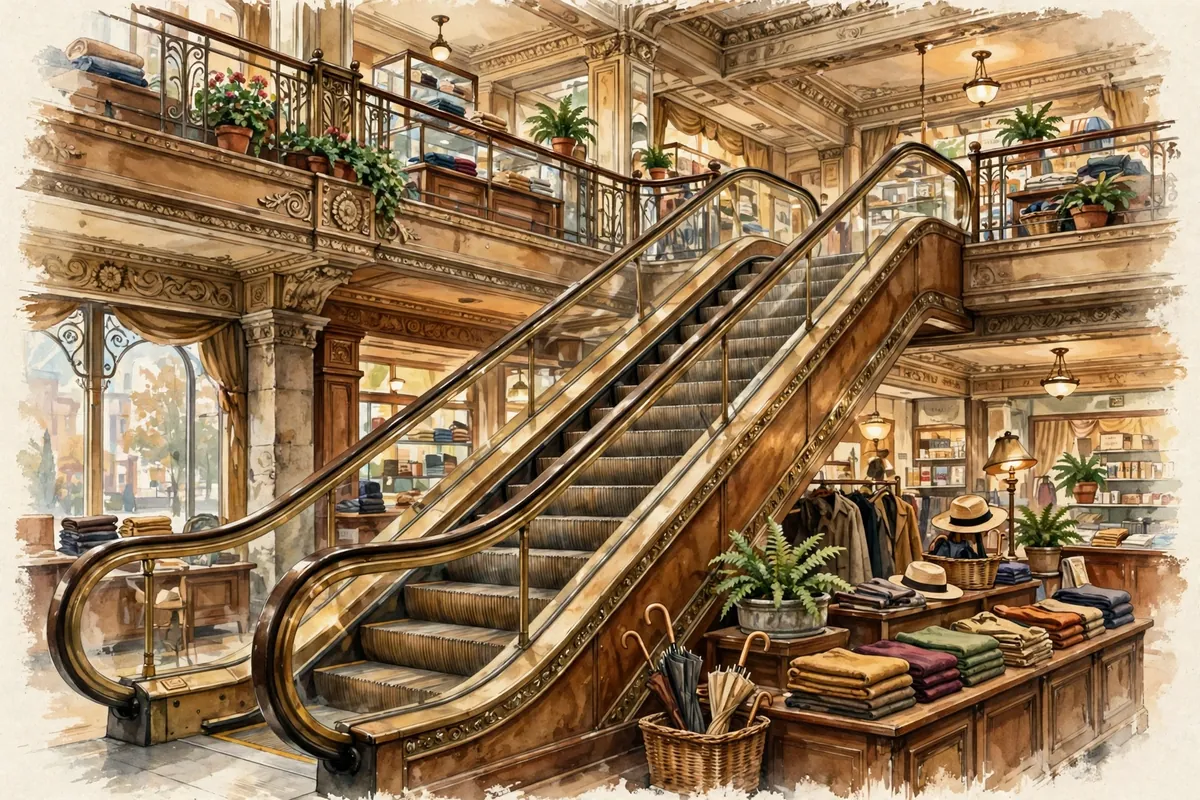
We step onto them at the mall, the airport, and the subway without a second thought. But escalator is a surprisingly new word, and it didn't start out as an ordinary word at all. It began life as a brand name.
Here's the short answer: inventor Charles Seeberger made up the word in the 1890s. According to his own account, he consulted a Latin dictionary and built it from scala, the Latin root for steps or a ladder, plus the prefix e and the suffix tor. He trademarked it in 1900. Otis Elevator, his partner, held the trademark for decades, until a 1950 ruling declared escalator a generic word that anyone could use.
A Name Built From Latin
Around 1895, Seeberger began drawing a moving staircase. His lawyer advised him to give his new invention a name, so he went looking for one. His handwritten notes show he adopted scala as the root, with e in front and tor at the end.
His own rough translation was a means of traversing from. He even had a pronunciation in mind: ess-KAL-ah-tor. The public had other ideas. By 1906, Seeberger noted that people were saying ESS-kuh-lay-tor instead, the way we still say it today.
The First Moving Stairs
Seeberger wasn't the first to dream up the idea. In 1859, a patent attorney from Massachusetts named Nathan Ames patented revolving stairs, though no working model was ever built. In 1892, Jesse Reno patented an endless conveyor, and in 1896 he installed a working inclined elevator at Coney Island in New York.
Seeberger teamed up with Otis in 1899, and together they produced the first commercial escalator. It won first prize at the 1900 Paris Exposition. His early design had one big difference from today's: riders had to step off sideways at the end.
Moving stairs could be unnerving at first. When London's Harrods department store unveiled its moving staircase in 1898, staff reportedly revived shaken customers with smelling salts and cognac. That one was really a continuous leather belt made of 224 linked pieces, and it was the first moving staircase in England.
The Motorstair and the Electric Stairway
Because Otis owned the trademark, rival companies had to call their products something else. New York's Peelle Company sold the Motorstair. Westinghouse offered the Electric Stairway. The Haughton Elevator company in Toledo simply called its version Moving Stairs. Otis, meanwhile, treated the word as its prized brand. Its advertisements often printed it in all capital letters, and Seeberger's original trademark application had listed it that way too.
How Otis Lost the Word
In 1950, a landmark case changed everything. The U.S. patent office rejected Otis's appeal to keep its trademark, noting that the public saw escalator as the name for a moving stairway, not as a brand. Otis itself had used the word as a plain descriptive term in its own patents and advertising.
With that, escalator officially became a generic word, free for anyone to use. Today it's a classic warning for companies that want to protect a famous brand name. Many famous brand names have met the same fate, slipping into everyday speech until they simply mean the thing itself.
So the next time you glide up to the second floor, you're riding on a word that was carefully crafted from Latin, guarded for half a century, and finally handed over to all of us.