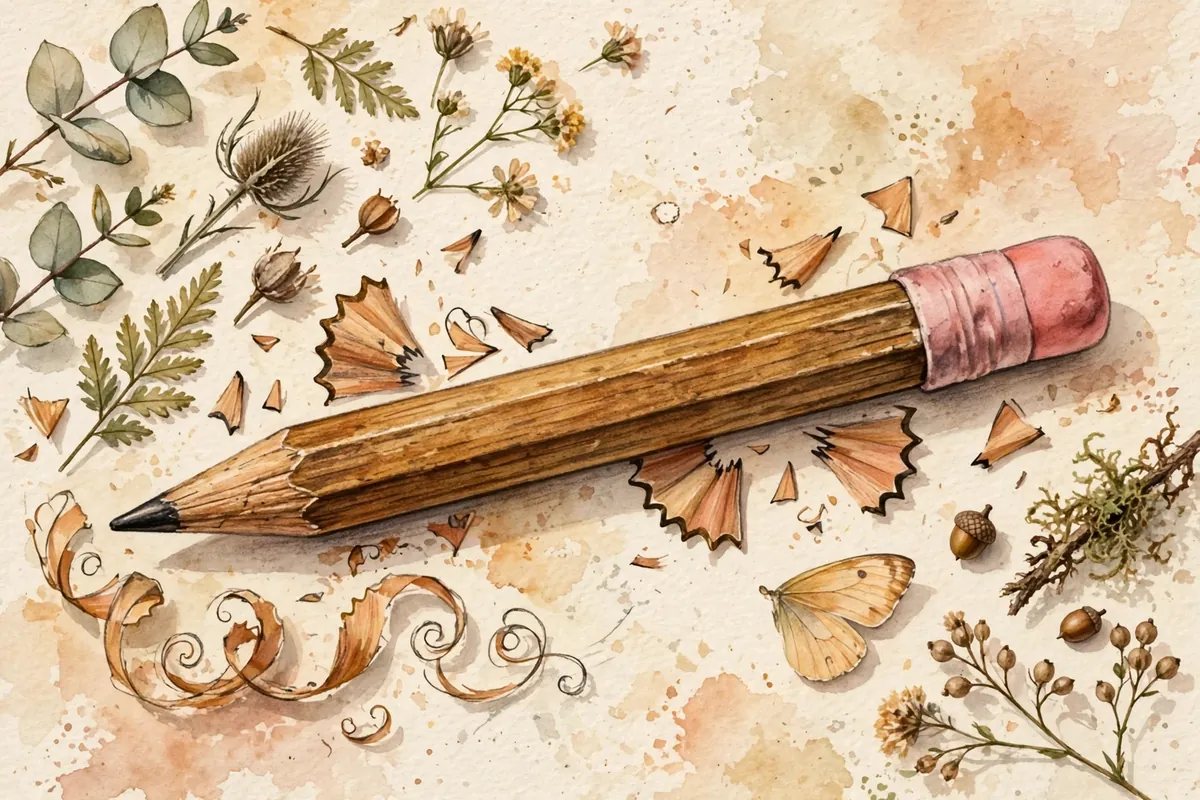
Pick up a yellow school pencil and flip it over. There it is: a little pink eraser held on by a metal band. It seems so obvious that it's hard to imagine pencils any other way. But that handy combination took a lucky mistake, a clever patent, and a trip to the Supreme Court.
The short answer: in 1858, a Philadelphia man named Hymen Lipman received the first patent for attaching an eraser to the end of a pencil. In 1875, the U.S. Supreme Court declared the patent invalid, ruling it was simply two existing items put together, not a truly new invention. With no patent standing in the way, any manufacturer was free to make pencils with erasers, and many, though not all, wooden pencils are now made that way.
From Breadcrumbs to Rubber
Long before the eraser, people used tablets of wax or crustless bread to wipe away pencil marks. Around 1770, an English instrument maker named Edward Nairne reportedly grabbed a piece of rubber by mistake instead of breadcrumbs and discovered that it erased beautifully.
He started selling rubber erasers at a steep price, three shillings for a half-inch cube. The scientist Joseph Priestley mentioned the new product that same year, calling it "excellently adapted" for wiping away pencil marks. That's also how the material got its English name. It was used for rubbing, so it became rubber. In Britain and some other countries, an eraser is still called a rubber.
Rubber Gets Tougher
Early natural rubber had a problem: it spoiled over time. In 1839, Charles Goodyear discovered vulcanization, a process that cured rubber and made it durable. After that, rubber erasers became common.
Today's pencil-top erasers are usually made from a cheaper synthetic rubber, mixed with a mild abrasive like pumice and a softener such as vegetable oil. They're made fairly hard so they stay attached, and they're frequently colored pink. They're held on with a little metal sleeve called a ferrule.
The $100,000 Patent Fight
Lipman's idea looked like a winner. In 1862, he sold his patent to Joseph Reckendorfer for $100,000, a huge sum at the time. Reckendorfer then sued the pencil maker Faber for copying the idea.
The case, Reckendorfer v. Faber, went all the way to the Supreme Court. In 1875, the justices ruled against Reckendorfer and declared the patent invalid. Putting two known things together, they decided, didn't make a new invention.
Why Pencils Are Yellow, Too
While we're at it, most pencils made in the U.S. are painted yellow. That tradition traces to 1890, when an Austrian company launched its Koh-I-Noor pencil, named after a famous diamond and meant to be the world's finest, with the end of each pencil dipped in 14-carat gold. It was yellow at a time when most pencils were dark or unpainted, and other companies copied the color so their pencils would look high quality too.
Pencils have a proud American history as well. William Munroe made the first American wood pencils in Concord, Massachusetts, in 1812, and the writer Henry David Thoreau helped improve pencil making at his father's factory there.
So the next time you erase a mistake on a crossword, remember that tiny pink tip carries a story of breadcrumbs, a lucky accident, and a Supreme Court decision. Not bad for something we wear down without a second thought.