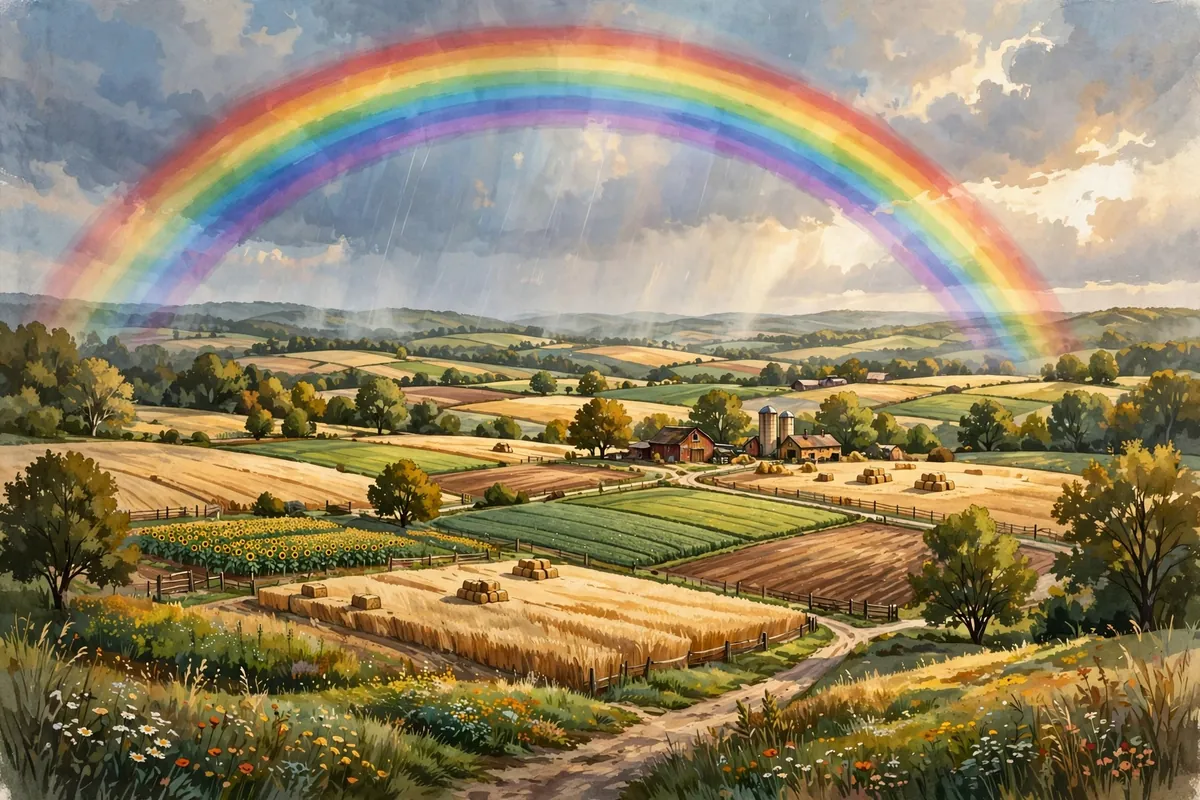
Think of a rainbow arching over a field after the rain. Red, orange, yellow, green, blue, and violet all blend into one another. It feels like we're simply looking at the colors as they are. But a lot of clever work goes on behind your eyes before you ever notice a single shade.
Here's the short version. The back of your eye is lined with light-sensing cells, and the ones in charge of color are called cones. Most people have three types, each tuned to a different range of light. Your brain compares how strongly each type responds and turns that comparison into the colors you see.
Light Comes in Many Wavelengths
Color starts with light. Isaac Newton showed that white light passed through a prism splits into a band of colors, and that those colors could be recombined into white light again. The light we can see ranges from about 380 to 740 nanometers in wavelength.
Longer wavelengths look red to us and shorter ones look violet, with orange, yellow, green, and blue in between. Light just beyond those edges, called infrared and ultraviolet, is invisible to us, though some animals can see it.
Meet Your Cones and Rods
Your eye has two main kinds of light-sensing cells. Rods work in dim light and play little, if any, role in color. That's why the world looks mostly gray in moonlight. Cones take over in brighter light, and they're the ones that let you see color.
Each eye has about six to seven million cones, compared with roughly 92 million rods. Scientists label the three cone types short, medium, and long, based on the wavelengths they respond to best. They're often called blue, green, and red cones, but that's a simplification. The so-called red cones are actually most sensitive to greenish-yellow light.
Your Brain Finishes the Painting
The cones don't send finished colors to the brain. They send signals about how strongly each type was triggered, and the color you see is worked out through layers of nerve cells and finally in the brain itself.
Scientists describe this with two ideas that fit together. The first, from the 19th century, says we have three receptor types. The second, proposed by Ewald Hering in 1872, says the visual system works with opposite pairs: red versus green, blue versus yellow, and black versus white. That's why you can picture a reddish yellow, like orange, but never a reddish green.
You can test this at home. Stare at a bright color for a while, then look at a white wall. You'll see a ghostly afterimage in a contrasting color, because the cells you tired out briefly stop pulling their weight.
Not Everyone Sees the Same Rainbow
Red-green color blindness affects up to 1 in 12 men and about 1 in 200 women. It's more common in men because the genes involved sit on the X chromosome. Color vision also naturally fades a little in old age.
Other animals live in different color worlds. Dogs and most farm animals have only two types of color receptors and can't tell oranges from reds. Bees can see ultraviolet light. And mantis shrimp have between 12 and 16 types of color receptors, the most complex system known in the animal kingdom.
So the next time a rainbow stretches across the sky, give your eyes and brain a little credit. Three kinds of tiny cells and a lot of quick thinking turn plain sunlight into that whole beautiful show.