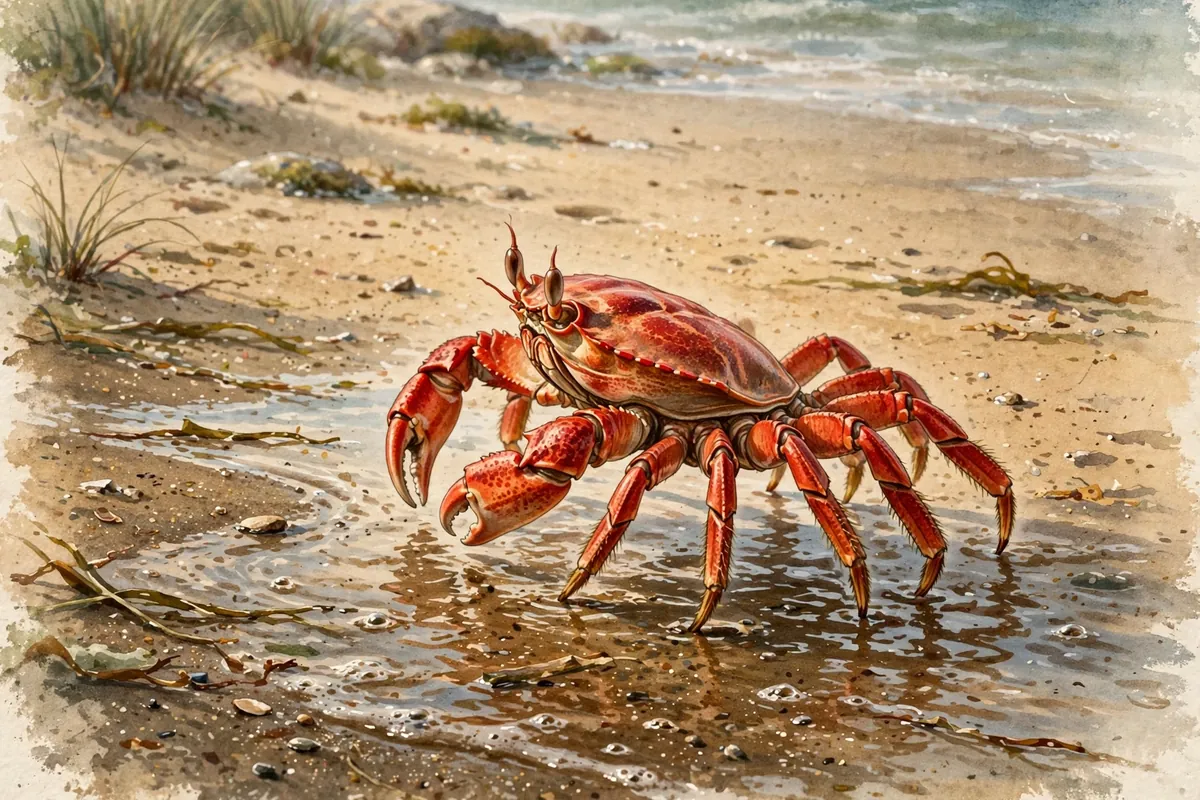
Anyone who has chased a crab across the sand knows the move. You step toward it, and it zips away to the side, legs flickering, never once turning to face where it's going. It looks almost comical, like a tiny armored dancer doing a side shuffle.
The short answer is that a crab's legs are built for it. True crabs usually walk sideways because of the way their leg joints are put together, which makes a sideways gait more efficient than walking forward. It's not that they can't go another direction. For most crabs, sideways is simply the easiest, fastest way to move.
Built Wide, Built Low
Picture the shape of a typical crab. It has a broad, flat body, a hard shell, and five pairs of legs sticking out from the sides. The front pair ends in claws, which work as pincers. The tail is tucked so far under the body that you'd hardly know it's there.
With legs arranged along the sides of a wide body, stepping sideways lets the legs swing without getting in each other's way. Walking forward with that layout would be a bit like trying to walk down a hallway while holding a long ladder across your chest.
Why the Crab Shape Keeps Showing Up
Here's something surprising. Crabs aren't one single family tree. The crab body plan has evolved separately in at least five different groups of crustaceans, a process scientists call carcinisation. King crabs and porcelain crabs, for instance, look crab-like but aren't true crabs.
Why does nature keep landing on the same design? Scientists point to life in the sea. Living in rocky crevices and getting tossed around by waves seems to favor armored protection, a broad, compact body, and the ability to scuttle sideways. In other words, the sideways walk is part of a package that works well again and again.
The idea has even become an internet joke, the meme that everything eventually evolves into a crab. Scientists point out that the process is real for certain crustaceans, but it doesn't apply to people or other animals.
The Crabs That Break the Rule
Not every crab goes sideways. Many crabs run swiftly sideways, but others walk forward, and some can swim. A few true crabs, including a group called raninids and a soldier crab known as Mictyris platycheles, walk forward or backward instead.
Some swimming crabs have turned their last pair of legs into flat paddles. They use them to row through the water instead of scuttling along the bottom.
More Crab Oddities
There are around 7,000 species of true crabs. They range from the pea crab, just a few millimeters wide, to the Japanese spider crab, whose legs can span up to 13 feet. They live in every ocean, in fresh water, and on land.
Growing up is tricky when you live in a hard shell. A crab has to molt many times, swallowing water to crack its old shell open and then pulling out everything, including its legs, eyestalks, and even the lining of its gut. It can take many hours. Afterward, the soft crab hides until its new shell hardens.
So the next time a crab dashes off to the side as you walk the beach, don't take it personally. It isn't being shifty. It's just using the legs it was given in the smartest way it knows.