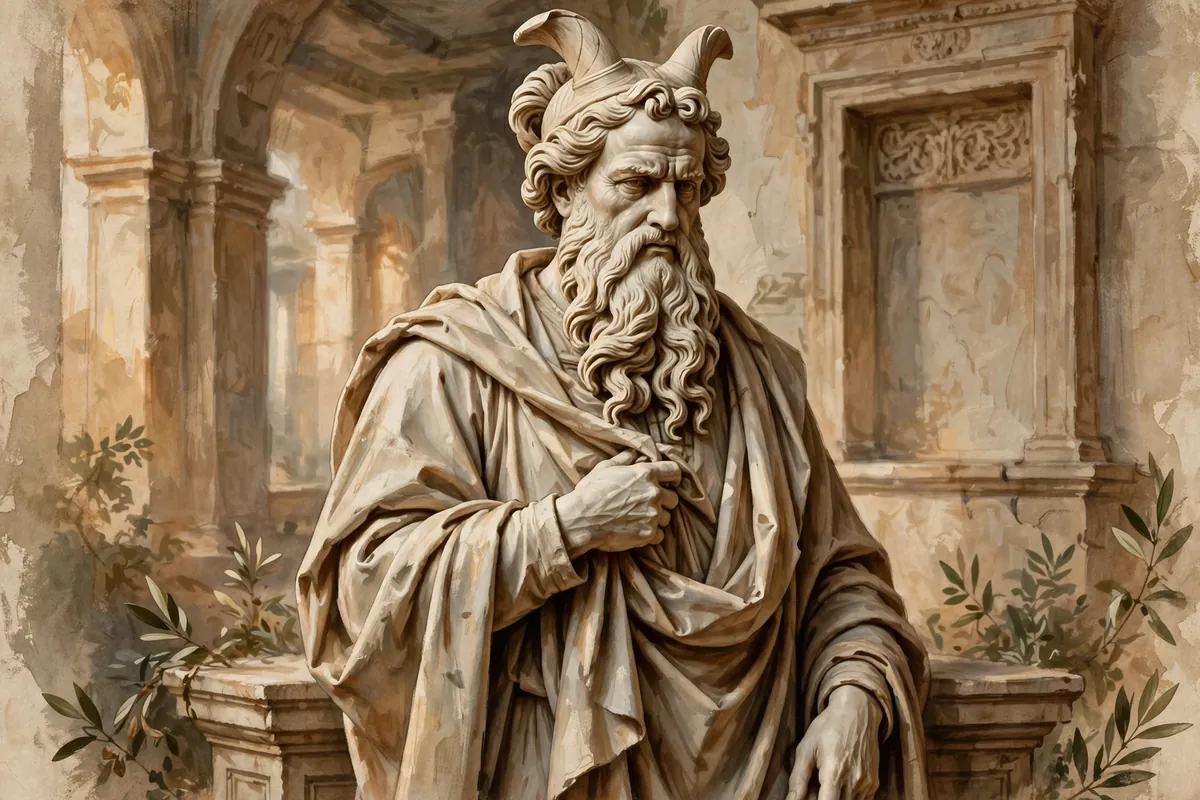
If you've ever seen photos of Michelangelo's marble statue of Moses, you may have done a double take. There, rising from the prophet's head, are two small horns. And Michelangelo wasn't the only one. For centuries, European artists gave Moses a pair of horns.
Here's the short answer. In the Book of Exodus, Moses comes down from Mount Sinai with the tablets of the law, and his face is changed. The Hebrew word used there comes from a root that often means horn. Saint Jerome's Latin translation, the Vulgate, described Moses's face as cornuta, or horned. Artists took it literally.
One Word, Two Meanings
The Hebrew term is qaran, based on qeren, a word that often means horn. Today it's generally understood to mean shining or giving off rays. Picture beams of light spreading out from his face, and you can see how the two ideas could get tangled.
You can see the difference in English Bibles. The Catholic Douay-Rheims Bible of 1609, translated from the Latin, says Moses knew not that his face was horned. The King James Version, published only a few years later, says instead that the skin of his face shone.
Was It Really a Mistake?
For a long time, people assumed Jerome simply made an error. But scholars have recently argued the story is more complicated. Calling Moses horned didn't start with Jerome at all. It goes back to the Greek translation by a Jewish scholar named Aquila of Sinope, active around the year 130, whose work Jerome knew well.
Jerome may also have meant it as a figure of speech. In another of his writings, he explained that Moses's face had become glorified, or as the Hebrew puts it, horned. In the Old Testament and in the ancient Middle East more broadly, horns often carried positive associations. Another old interpretation was that the word described rings of light, a sign that Moses had been enlightened by his encounter on the mountain.
Horns in Art
Moses with horns probably first appears in art in the eleventh century. Through the Middle Ages and the Renaissance, horned and unhorned versions of Moses appeared side by side. Many horned portraits were clearly respectful, showing him as a great prophet.
There was a darker side, too. Some depictions, especially in the later Middle Ages, likely carried antisemitic overtones. Historians think the horned Moses image may have reinforced the cruel and false belief that Jewish people had horns.
Michelangelo carved his Moses around 1513 to 1515, near the end of this tradition. It's generally seen as a positive portrayal of the prophet.
From Horns to Rays of Light
By about 1500, scholars had realized that horned was a mistranslation. Artists began swapping the horns for two bunches of light rays sprouting from the same spots on Moses's head. You can see these rays in the Moses frescoes in the Sistine Chapel, painted in 1481 and 1482.
The rays stayed popular until the nineteenth century. Some artists got so used to them that they even painted rays on baby Moses, long before he ever climbed Mount Sinai.
So the next time you see a picture of Moses with horns or glowing beams, you'll know the secret. It's the story of one ancient word, and of how hard it can be to carry meaning from one language into another.