Most of us cross a bridge without a second thought. But in Istanbul, Turkey, a short drive across the water takes you from one continent to another. Thousands of people do it every day on their way to work, then cross back again in the evening.
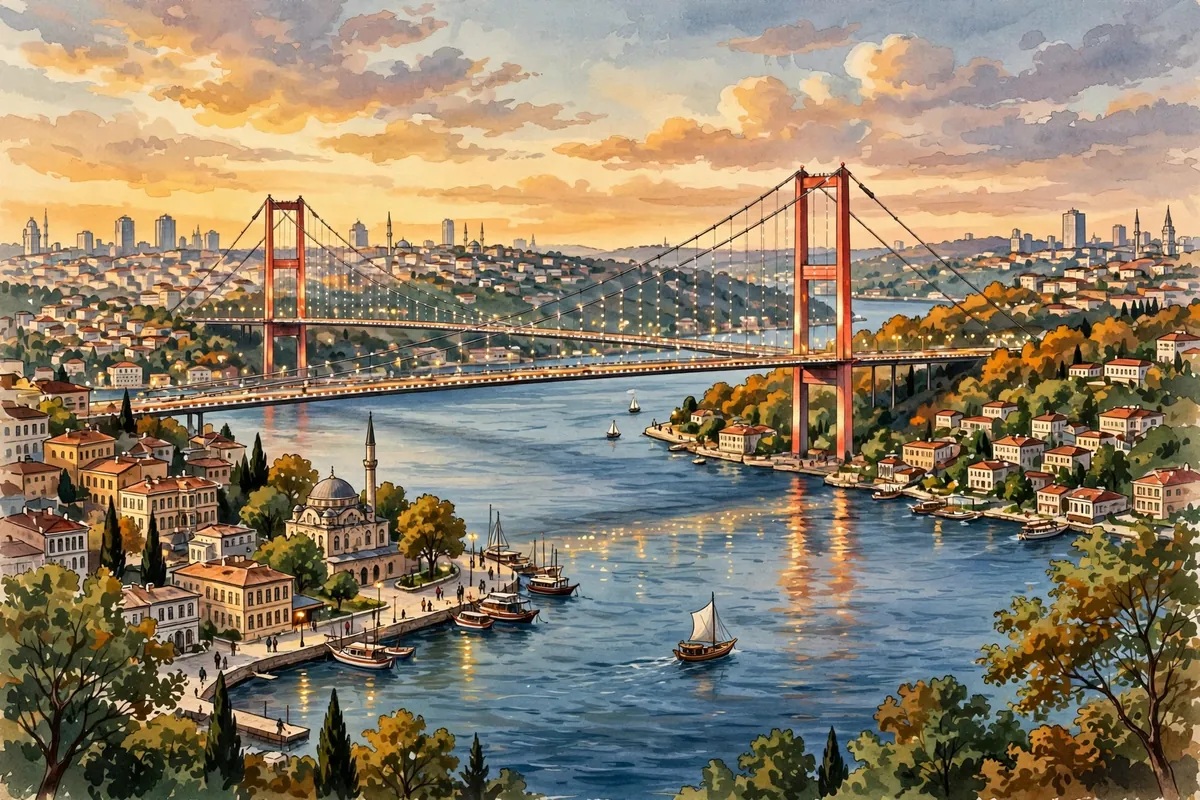
The famous crossing is the Bosphorus Bridge, which spans the Bosphorus strait and connects Europe and Asia. It runs between the neighborhood of Ortaköy on the European side and Beylerbeyi on the Asian side. Completed in 1973, it was the first of what are now three suspension bridges across the strait.
A Dream From Ancient Times
The idea of linking the two shores is very old. The Greek writer Herodotus described a pontoon bridge built across the Bosphorus on the orders of the Persian king Darius the Great, around 2,500 years ago, so his army could cross from Asia into Europe.
A permanent bridge took much longer. In 1900, a railroad company proposed one to the Ottoman Sultan Abdul Hamid II, but it was never built. Turkey's government finally decided to build a bridge in 1957, and construction began in February 1970.
An Engineering Giant
The bridge was designed by British engineers Gilbert Roberts, William Brown, and Michael Parsons, who also designed bridges in Britain. It's about 5,118 feet long, and its towers rise about 541 feet. The roadway sits about 210 feet above the water, high enough for big ships to pass underneath.
When it was completed on October 30, 1973, one day after the 50th anniversary of the Turkish Republic, it had the fourth-longest suspension span in the world. Only three American bridges were longer: the Verrazzano-Narrows, the Golden Gate, and the Mackinac Bridge. It cost about $200 million at the time.
Like any suspension bridge, it flexes. When fully loaded with traffic, the middle of the span sags about 35 inches. Its deck is about 110 feet wide, with eight lanes in all, including emergency lanes.
Rush Hour Between Continents
Today, around 180,000 vehicles cross the bridge every day, and almost 85 percent of them are cars. The one-billionth vehicle crossed on December 29, 1997.
Traffic flows like a tide. On weekday mornings, most commuters head west toward Europe, so four of the six lanes run westbound. In the evening, it flips, with four lanes heading east toward Asia. Trucks and pedestrians aren't allowed today, though for the bridge's first three years people could walk across, riding elevators up inside the towers.
A Stage for Unusual Events
The bridge has hosted some memorable moments. Since 1979, the Istanbul Marathon has crossed it every October, running from Asia to Europe while the bridge is closed to cars. In 2005, American tennis star Venus Williams played a five-minute exhibition match on the bridge with Turkish player İpek Şenoğlu, billed as the first tennis match played on two continents.
The bridge also has a more serious chapter. After soldiers took control of it during an attempted coup in July 2016, it was officially renamed the 15 July Martyrs Bridge in memory of those killed resisting the coup. Many locals still simply call it the First Bridge.
So if you ever visit Istanbul, take a moment on the shore to watch the traffic flow overhead. Where else can you see thousands of people casually changing continents on their way to the office?