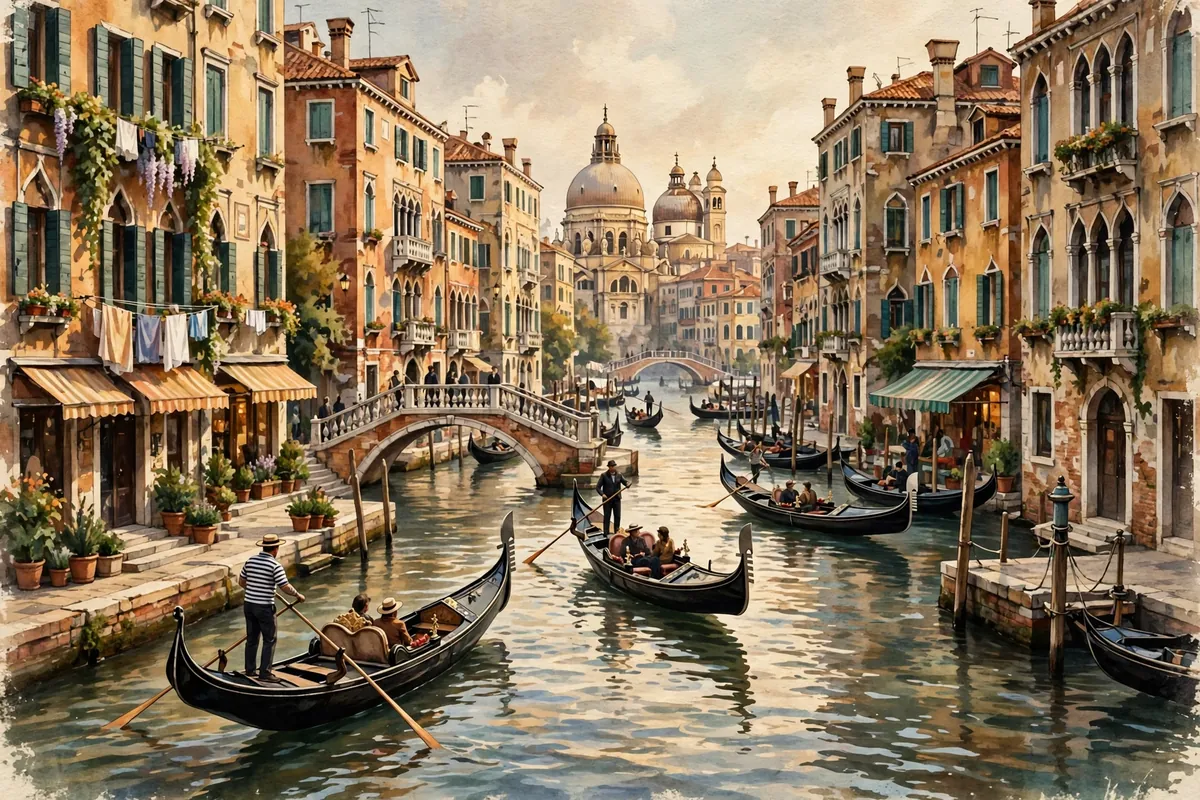
There's no place quite like Venice. Instead of streets, it has canals. Instead of cars, it has boats. Grand palaces and churches seem to float right on the water, as if someone set them down on a giant mirror. How on earth do you build a city like that?
Here's the short answer. Venice isn't really floating. It's built on a cluster of about 120 small islands in a shallow lagoon in northeastern Italy, separated by canals and connected by more than 400 bridges. Its early builders drove closely packed wooden piles deep into the mud until they hit a harder layer of clay, then set stone platforms on top to hold the buildings.
A City Built by Refugees
No surviving records describe exactly how Venice was founded. But historians generally agree that its first residents were refugees fleeing nearby Roman cities during waves of invasions. The marshy islands of the lagoon offered something precious: safety.
Living on islands, though, meant solving a tricky problem. The ground was soft mud and sand. To build anything heavy, they needed something solid underneath.
A Forest Upside Down
The settlers came up with a clever solution. They drove trunks of alder trees, a wood known for resisting water, closely together into the mud and sand. They kept going until the piles reached a much harder layer of compressed clay below.
On top of those piles, they laid plates of Istrian limestone, and the buildings rose from there. In a sense, much of Venice stands on a hidden forest of tree trunks pushed into the lagoon floor.
Life on the Canals
The city's most famous boat is the gondola. Two centuries ago there were about 10,000 of them. Today there are around 400 licensed gondoliers and a similar number of boats, mostly carrying tourists or used for weddings and other ceremonies.
Look closely at the metal piece on a gondola's bow, called the fèro. Its six prongs represent the six districts of Venice. For everyday travel, locals mostly ride motorized water buses called vaporetti. They still use traghetti, simple two-oar gondola ferries, to cross the Grand Canal where there's no nearby bridge.
The Fight Against High Water
Living with water has its downsides. Between autumn and early spring, tides from the Adriatic Sea can flood the city, an event known as acqua alta, or high water. St. Mark's Basilica, in the lowest part of town, sits only about 25 inches above sea level.
Venice has also been slowly sinking. In the 20th century, wells drew water from beneath the lagoon for industry, and the city began to subside. The sinking slowed after those wells were banned in the 1960s, but studies suggest the city still sinks about a millimeter or two each year.
To fight back, Italy built a system of 78 hollow gates on the seabed at the lagoon's entrances, called MOSE. On October 3, 2020, the gates rose for the first time and kept low-lying spots like St. Mark's Square from flooding.
Today nearly 50,000 people still live in the historic island city, though most residents of the wider municipality live on the mainland. Venice has survived more than a thousand years by working with the water instead of against it. If you ever glide down the Grand Canal, remember the forest of old tree trunks beneath you, still quietly holding the whole city up.