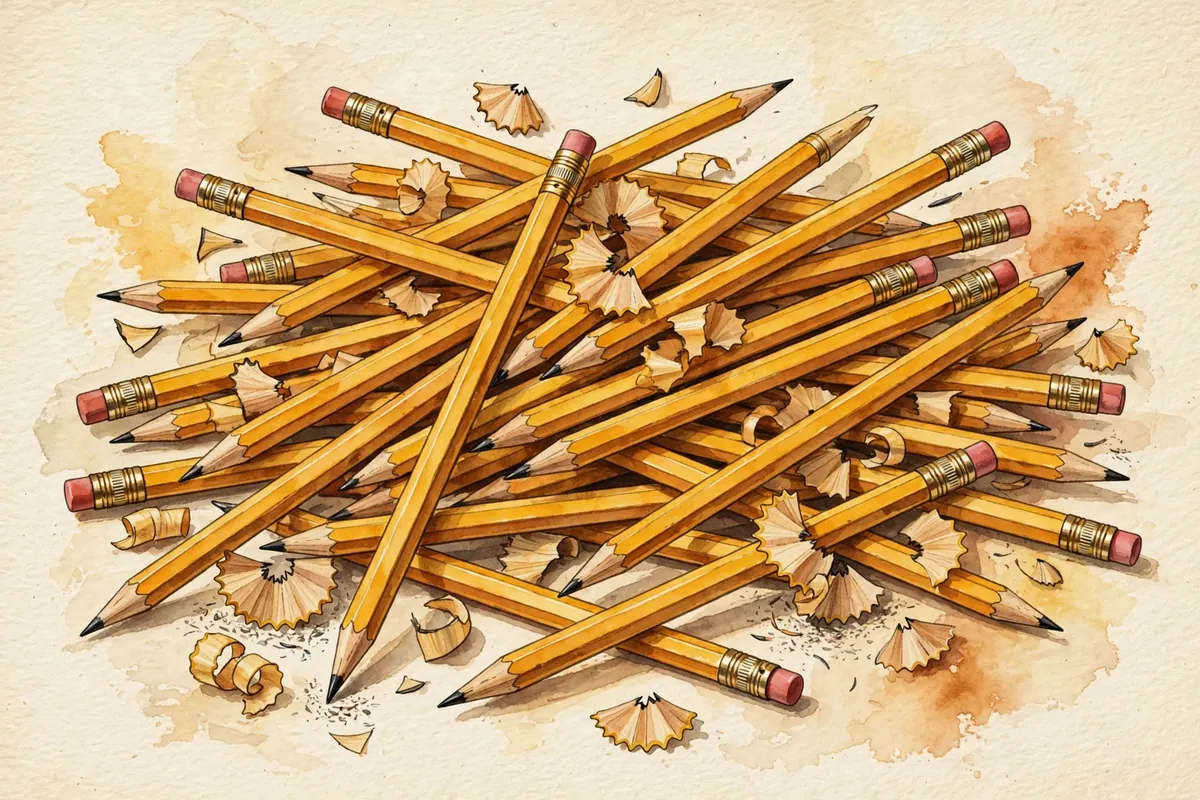
Picture a pencil, and odds are it's yellow with a pink eraser on top. It's the color of school days, crossword puzzles, and standardized tests. But there's nothing about a pencil that requires it to be yellow. So why are so many of them that color?
According to engineer and historian Henry Petroski, it started in 1890 with a luxury pencil. The L. & C. Hardtmuth Company of Austria-Hungary introduced its Koh-I-Noor pencil, named after the famous diamond, and painted it yellow. At a time when most pencils were dark or left unpainted, the bright yellow stood out. Other companies copied the color so their pencils would look like this high-quality brand.
A Pencil Fit for a Diamond
The Koh-I-Noor was meant to be the best and most expensive pencil in the world. Its end was even dipped in 14-carat gold. Yellow made it instantly recognizable on a store shelf.
Why yellow in particular? One idea is that the color was inspired by the yellow in the Austro-Hungarian flag. Another is that yellow suggested the Orient, at a time when the best-quality graphite came from Siberia. Copycat brands leaned into that idea with names like Mikado, later renamed Mirado, and Mongol.
Today, most pencils made in the United States are painted yellow. It's a habit that began as a way to borrow a little prestige from a fancy competitor.
Not Every Country Went Yellow
Travel abroad and pencils look different. In Germany and Brazil, pencils are often green, blue, or black, the trademark colors of the big German maker Faber-Castell, which has factories in both countries.
In southern Europe, pencils tend to be dark red or black with yellow lines. In Australia, they're often red with black bands at one end. In India, dark red with black lines has long been the most common pattern.
There's No Lead in a Pencil
Here's another pencil surprise. The gray core we call lead has never contained the metal lead. It's graphite.
The mix-up goes back to around 1565, when a large deposit of very pure, solid graphite was found in Borrowdale, in northern England. Chemistry was still young, and people thought the shiny black material was a form of lead. They called it plumbago, Latin for lead ore. The name stuck, and the German word for pencil, Bleistift, still literally means lead pen.
Pencil cores got a big upgrade in the 1790s. France needed a fix, because a British naval blockade had cut it off from English graphite. In 1795, Nicolas-Jacques Conté, an officer in Napoleon's army, found a way to mix powdered graphite with clay and bake it into rods. Austrian Joseph Hardtmuth, founder of the company that later made the Koh-I-Noor, had discovered the method earlier. Changing the ratio of graphite to clay changes how hard or soft a pencil writes, and that graphite-and-clay method is still in use today.
The Eraser Gets Attached
On March 30, 1858, Hymen Lipman received the first patent for attaching an eraser to the end of a pencil. He later sold the patent for $100,000. But when the buyer sued Faber-Castell for copying it, the U.S. Supreme Court ruled in 1875 that the patent wasn't valid.
Today more than 14 billion pencils are made every year. Many of them are still that same sunny yellow, all thanks to a gold-tipped pencil from more than a century ago.