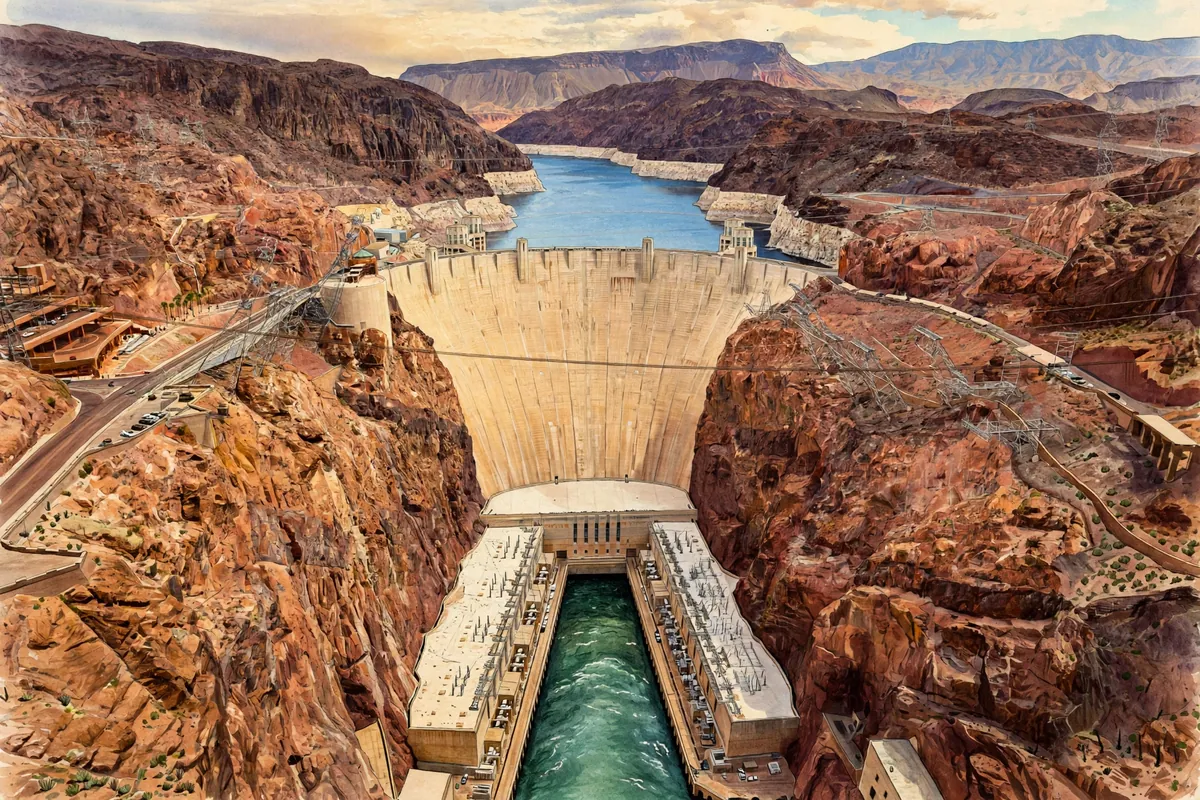
Standing on top of the Hoover Dam, you look down a sheer wall of concrete into a deep desert canyon. It seems impossible that people built it with 1930s technology, during the hardest years of the Great Depression. Even more surprising is how fast they did it.
The dam was built between 1931 and 1936 on the Colorado River, on the border of Nevada and Arizona. President Franklin D. Roosevelt dedicated it on September 30, 1935, and the builders formally handed it over to the government on March 1, 1936, more than two years ahead of schedule. Its power plant took much longer, with the last generator switched on in 1961.
A Job Nobody Had Done Before
Congress authorized the project in 1928, aiming to control floods, provide irrigation water, and generate electricity. A group of firms called Six Companies won the contract and started work in early 1931. A concrete structure this large had never been built, and some of the methods were untested. Workers also faced scorching summers and a remote site with few facilities.
The first concrete was poured on June 6, 1933, a full 18 months ahead of schedule. Pouring finished on May 29, 1935.
The Concrete Problem
Concrete heats up as it hardens and shrinks as it cools. Engineers calculated that if the dam were poured all at once, it would take 125 years to cool, and the stresses would crack it apart.
So they built it in blocks, some 50 feet square and 5 feet high. Inside each block ran steel pipes carrying cool river water and then ice-cold water from a refrigeration plant. In all, more than 582 miles of cooling pipe were buried in the concrete. There's enough concrete in the dam to pave a two-lane highway from San Francisco to New York.
You may have heard that workers fell into the wet concrete and are still entombed inside. That's a myth. Each bucket raised the concrete in a form by only about an inch, and engineers wouldn't have allowed a flaw like that.
The Big Day, With a Twist
The dedication was set for September 30, 1935, timed to fit President Roosevelt's western tour. Then, on the morning of the ceremony, officials discovered a mix-up. Interior Secretary Harold Ickes had reserved a 2 p.m. radio slot for the president, but it turned out to be 2 p.m. Eastern Time, not Pacific.
The ceremony was moved up three hours to 11 a.m. Even so, in 102-degree heat, about 10,000 people turned out to hear the president. Notably, he never mentioned former President Herbert Hoover, who wasn't invited.
The name was a political tug-of-war, too. Congress had called it Hoover Dam, but Roosevelt's administration named it Boulder Dam. In 1947, Congress made Hoover Dam the official name again.
The Human Cost
The project came at a price. In all, 112 deaths were associated with building the dam. In a haunting coincidence, surveyor J.G. Tierney drowned in a flash flood on December 20, 1922, while scouting for a dam site. On December 20, 1935, exactly 13 years later, his son Patrick became the last death on the official list.
By 1939, the dam's power plant was the largest hydroelectric facility in the world. And testing in 1995 showed its concrete is still slowly getting stronger. Not bad for a project finished early, in the middle of the Depression.