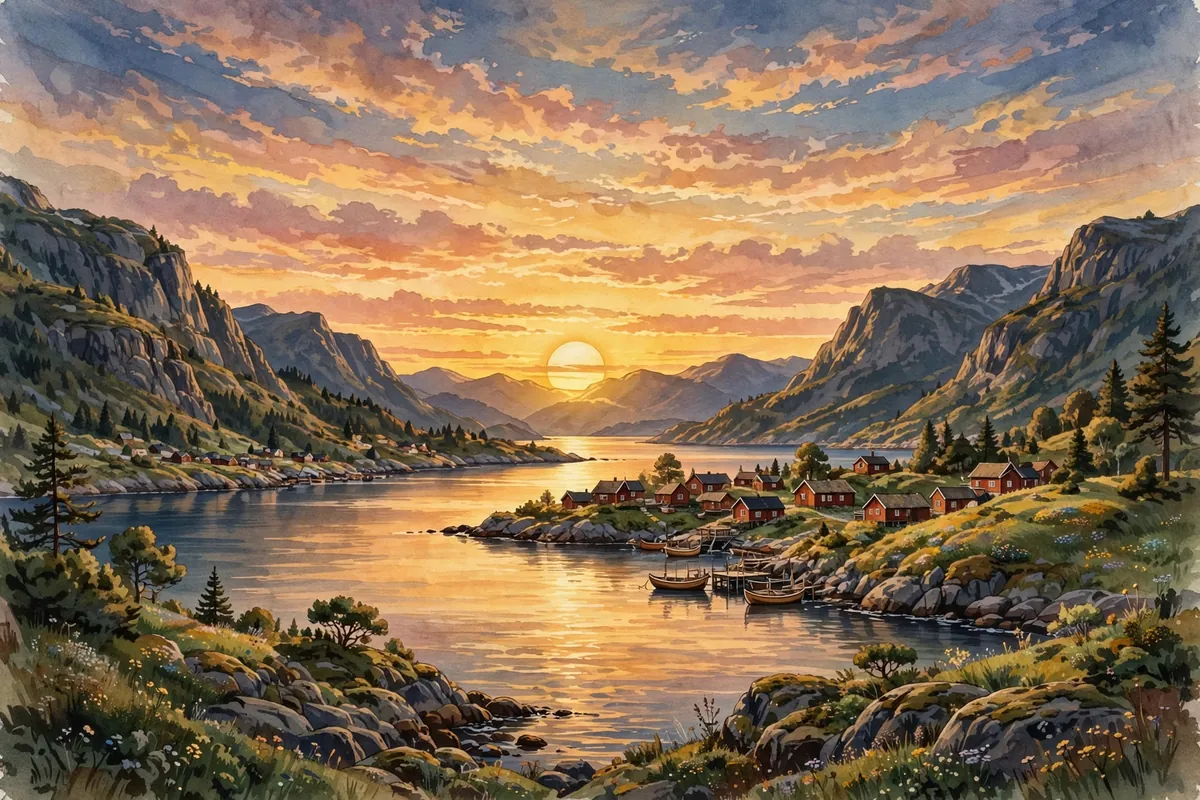
Imagine finishing dinner, going for a walk at midnight, and needing sunglasses. No streetlights, no stars, just a golden sun hanging low over the sea. For people living in the far north, that's simply summer.
It's called the midnight sun, or polar day. In summer, places north of the Arctic Circle, and south of the Antarctic Circle, see the sun stay visible even at midnight. In Norway's Arctic city of Tromsø, it lasts from late May to mid-July, and it draws summer visitors eager for outdoor activities under a sun that won't set. On Norway's Svalbard islands, the sun doesn't set from about April 19 to August 23.
Why It Happens
The secret is Earth's tilt. Our planet leans about 23.4 degrees on its axis. During the northern summer, the top of the planet is tipped toward the sun, so the far north keeps facing it even as Earth spins through the night.
Right on the Arctic Circle, the sun stays up for just one day around the summer solstice. Travel about 62 miles closer to the pole, and that stretches to several weeks. At the North Pole itself, the sun stays up for about six months, from roughly March 18 to September 24.
There's a bonus effect. Earth's atmosphere bends sunlight a little, and the sun is a disc rather than a point. So the midnight sun can be seen slightly south of the Arctic Circle too. That's why Iceland is known for the midnight sun, even though most of the country sits just below the circle.
Where to See It
Since nobody lives permanently in Antarctica apart from research stations, the people who experience the midnight sun all live in countries crossed by the Arctic Circle. That includes Norway, Sweden, Finland, Russia, Canada, Greenland, and the U.S. state of Alaska.
In Utqiagvik, Alaska, polar day lasts about 84 days. At Finland's northernmost point, the sun doesn't set at all for 72 days. Murmansk, Russia, the largest city north of the Arctic Circle, gets 62 days of midnight sun.
The Flip Side: Polar Night
There's a price for all that summer light. In winter, the same places get polar night, when the sun stays below the horizon all day. Interestingly, in the Northern Hemisphere the sunny stretch is longer than the dark one. In Utqiagvik, polar night lasts about 68 days, compared with 84 days of polar day. Very close to the poles, at places like the weather station at Alert in far northern Canada, there are even stretches when it never gets fully dark, yet the sun never actually rises.
That's because Earth's orbit isn't a perfect circle. Our planet is a bit farther from the sun in early July and closest in early January, and that difference stretches out the northern summer.
White Nights and Midnight Baseball
Places a little farther south get “white nights” instead. The sun dips just below the horizon, but the sky stays bright enough to read outside. Saint Petersburg, Russia, celebrates with a White Nights Festival in late June.
Fairbanks, Alaska, has its own tradition: the Midnight Sun Game, a baseball game played in the twilight around midnight on June 21, held since 1906.
So if you ever want a summer day that never seems to end, head north. Just pack a good sleep mask along with your sunglasses.