A beautiful sunset is one of life's simple pleasures. Here on Earth, the sky slowly shifts from blue to gold, orange, and pink as the Sun slips below the horizon. It seems only natural to expect the Red Planet to put on an even redder show.
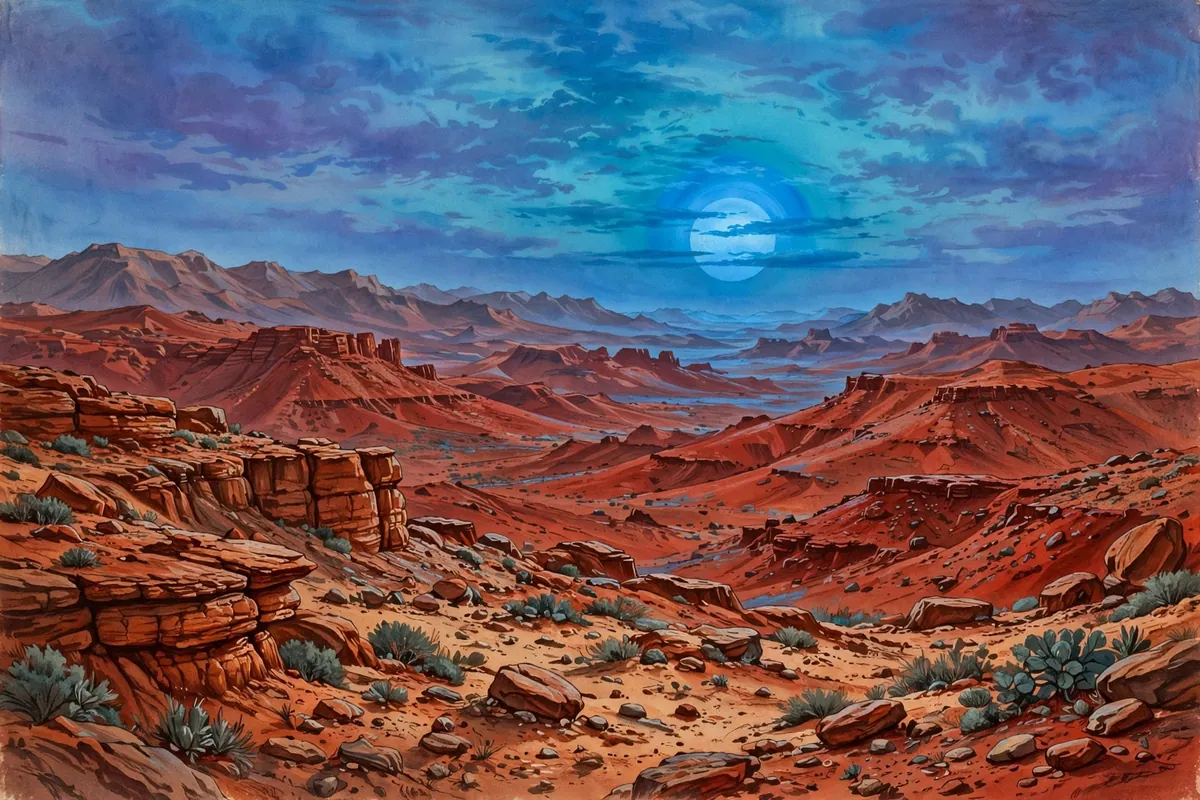
Here's the short answer: Martian sunsets are typically blue. Mars has a very thin atmosphere filled with fine reddish dust, and that dust scatters sunlight differently than the gases in Earth's air do. During the day, the dusty Martian sky looks tawny or even pinkish. When the Sun sets, the colors are typically shades of blue, nearly the reverse of what we see at home.
First, Why Earth's Sunsets Are Orange
Sunlight contains every color of the rainbow. On Earth, tiny molecules of nitrogen and oxygen scatter the shorter wavelengths, like blue and green, much more strongly than the longer ones. Scientists call this Rayleigh scattering, and it's why our daytime sky looks blue.
At sunrise and sunset, sunlight takes a much longer path through the air to reach your eyes. Along the way, the blue and green light gets scattered out almost completely. What's left are the oranges and reds that paint the evening sky.
Mars Plays by Different Rules
Mars is a different story. Its atmosphere is mostly carbon dioxide and incredibly thin, with an average surface pressure less than one percent of Earth's. There's simply not much gas to do the kind of scattering that colors our skies. In fact, the densest air anywhere on Mars matches the air you'd find about 22 miles above the ground on Earth.
What Mars does have is dust, and plenty of it. High winds lift fine particles into the air, and many are around 1.5 micrometers across, far smaller than a grain of sand. Particles that size scatter light through a process called Mie scattering, which works differently from the scattering by gas molecules on Earth. The result is more blue hues at sunset than we ever see on Earth.
A Smaller Sun and a Longer Twilight
A Martian sunset has other quirks too. Because Mars is farther from the Sun than Earth, the setting Sun looks only about two-thirds as big as it does from here.
Twilight also lingers. Dust high in the Martian atmosphere keeps catching sunlight and scattering it, so a soft glow can last up to two hours after sunset. Earth sees similar long twilights after major volcanic eruptions fill the sky with fine particles.
Not every Martian sunset is blue, though. Some last much longer and look far redder than a typical sunset on Earth. With dust storms common, the sky can change a lot from one evening to the next.
Why Mars Is Red in the First Place
The Red Planet gets its color from iron oxide, essentially rust, in the soil and dust covering its surface. Up close, the ground can look butterscotch, golden, brown, or tan depending on the minerals present. Every few Earth years, dust storms grow big enough to wrap around the entire planet.
So if you ever find yourself on Mars, pack a jacket, since temperatures can fall far below zero, and save a spot for the evening show. The planet known for red will greet the night in blue. It's a view worth the trip.