Science fiction movies love a good space battle. Engines roar, lasers zap, and explosions boom across the screen. It's thrilling, but if you were floating out there yourself, you wouldn't hear any of it.
The reason is simple. Sound is a vibration that has to travel through something, like air, water, or a solid wall. Space is the closest thing we know to a perfect vacuum, with almost no matter in it. With nothing to carry the vibrations, sound can't travel from one place to another, so space is silent to human ears.
How Sound Really Works
When you clap your hands, you push the air around them. Those air molecules bump into their neighbors, which bump into theirs, and a wave of pressure ripples outward until it reaches your ears. The stuff that carries the wave is called the medium. It can be a gas, a liquid, a solid, or even plasma.
Sound moves at different speeds through different materials. In air at room temperature, it travels about 767 miles per hour. It's generally slowest in gases, faster in liquids, and fastest in solids. But take the medium away entirely, and sound has no way to travel at all.
Just How Empty Is Space?
Very, very empty. The air you breathe contains about ten trillion trillion molecules in every cubic meter. The deep space between galaxies holds only a few hydrogen atoms in the same amount of room. Closer to home, there's no sharp line where the sky ends and space begins. The air just keeps getting thinner as you go higher, until there's essentially nothing left to carry a sound.
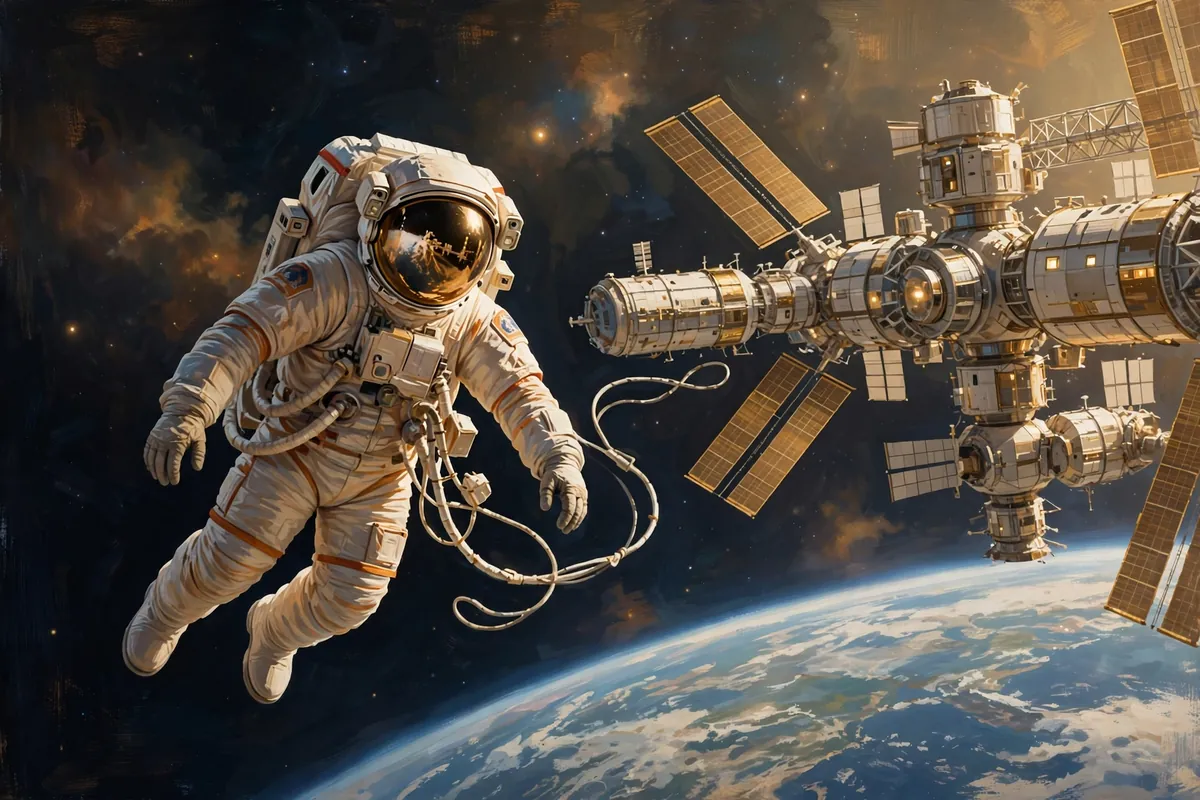
That emptiness is why light from distant stars can cross huge distances without getting scattered. Light, radio waves, and other electromagnetic waves don't need a medium. That's why astronauts outside a spacecraft talk to each other by radio. Inside the space station, where there's air, they can hear each other just fine.
The Deepest Note Ever Found
Here's the surprise. Space isn't completely empty everywhere. Inside some galaxy clusters, hot, thin gas fills the space between galaxies, and that gas can carry pressure waves, the same basic kind of wave as sound.
In 2003, a team of astronomers led by Andrew Fabian at Cambridge University spent 53 hours studying the Perseus galaxy cluster with NASA's Chandra X-ray telescope. They found ripples in the gas made by a giant black hole at the center of one galaxy. Those ripples amounted to one of the deepest notes ever detected.
Don't expect to hum along. One full vibration of that note takes 9.6 million years. That puts it about 57 octaves below the middle of a piano keyboard, far too low for any human to hear. A similar black hole in the nearby Virgo Cluster produces even lower notes.
Turning Space Data Into Sound
In May 2022, NASA released a sonification of the Perseus black hole. Scientists took the data from those pressure waves and converted it into sound people can actually hear. It's not what you'd hear if you were there, since you'd hear nothing, but it gives a sense of the waves rolling out from the black hole.
So the movies get it wrong, but the universe isn't entirely quiet either. It hums in notes so deep and slow that we need X-ray telescopes and a little creativity to listen in.