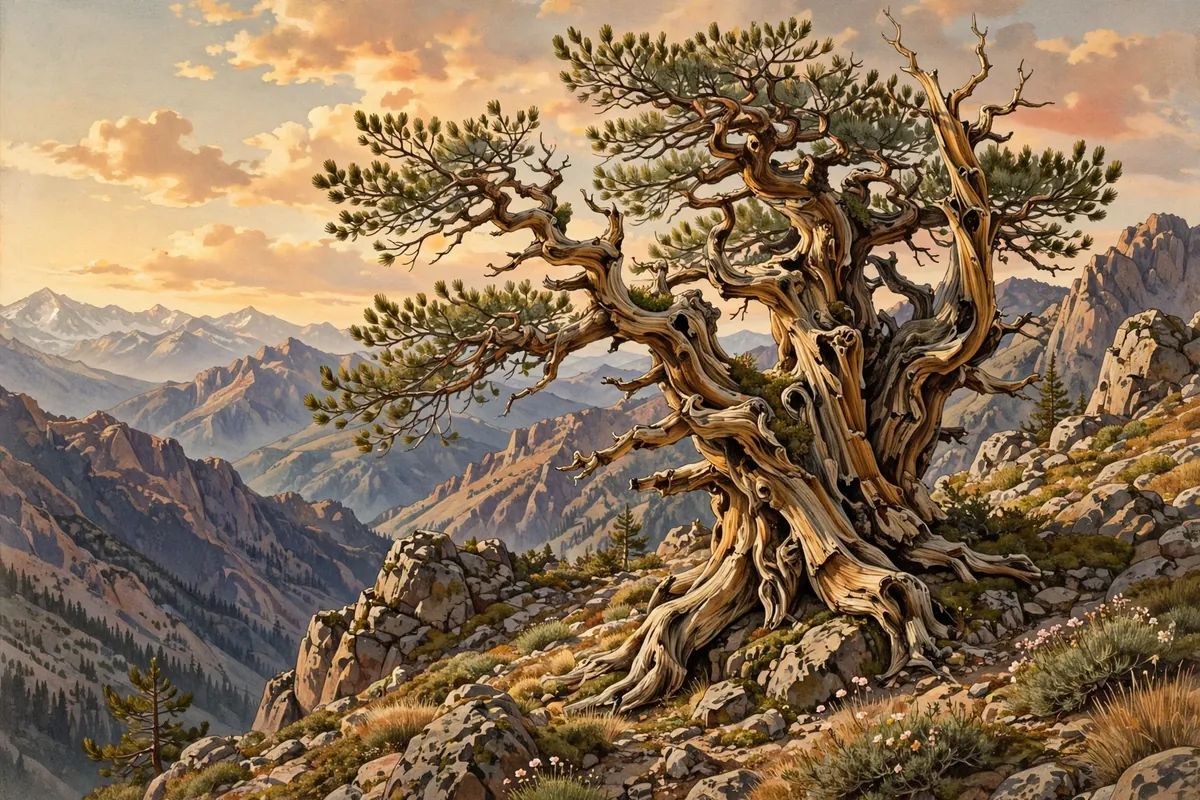
High in the White Mountains of eastern California, where the air is thin and the soil is poor, grows a gnarled, twisted tree that looks more like driftwood than a living thing. It doesn't seem like much. But it had already sprouted by the time the Great Pyramid of Giza was built.
The tree is called Methuselah, a Great Basin bristlecone pine about 4,858 years old. It's recognized as the oldest confirmed non-clonal tree in the world, meaning a single tree rather than a colony that keeps regrowing from shared roots. A few trees have been claimed at 5,000 years or more, but no living tree's claim to that mark has been confirmed.
Counting the Rings
Methuselah's age comes from counting its yearly growth rings in a thin core taken with a tool called an increment borer. Researchers Edmund Schulman and Tom Harlan sampled it in 1957, when it was 4,789 years old, putting its sprouting at around 2833 BC.
Even so, there's some debate. A researcher at the University of Arizona couldn't reproduce the original count because a core is missing, and his own estimate is about 4,669 years. Either way, it's astonishingly old.
Its exact location has long been kept quiet. The U.S. Forest Service doesn't disclose which tree it is, out of fear that it would be damaged, though its whereabouts became widely known after a leak in 2021.
Why Hard Living Means Long Life
It sounds backward, but bristlecones do best where life is hardest. Methuselah grows between about 9,500 and 9,800 feet above sea level. Harsh weather and a lack of nutrients slow down decay, which helps explain its great age.
The species is a poor competitor in good soil and thrives on rough, high-elevation ground where few other plants can grow. The oldest trees tend to sit on north-facing slopes, where they average about 2,000 years old, compared with about 1,000 years on southern slopes.
The wood is tough, too. The climate and the durability of bristlecone wood can preserve trees long after they die, and dead trees as old as 7,000 years have been found standing near living ones.
The Tree That Was Cut Down
Methuselah may not have been the oldest. In 1964, a graduate student and U.S. Forest Service staff cut down a bristlecone on Wheeler Peak in eastern Nevada for research. Nobody involved knew its record age beforehand.
That tree, later known as Prometheus, turned out to be at least 4,862 years old. After adjusting for missing rings, it was probably more than 5,000. The decision to cut it remains controversial.
Then there's the mystery tree. Tom Harlan reported a living bristlecone in 2010 that he said was 5,062 years old. But he kept its identity secret, and after his death in 2013, neither the tree nor his sample could be found.
Even Older, If You Count Colonies
If you include clonal colonies, the record stretches much further. A quaking aspen colony in Utah called Pando has been estimated at 80,000 years old, though precise ages for colonies like this are impossible to pin down with current methods.
So the next time you think of something as old, picture Methuselah, quietly hanging on to its windswept mountainside. It has outlasted empires, and with any luck, it will still be standing long after all of us.