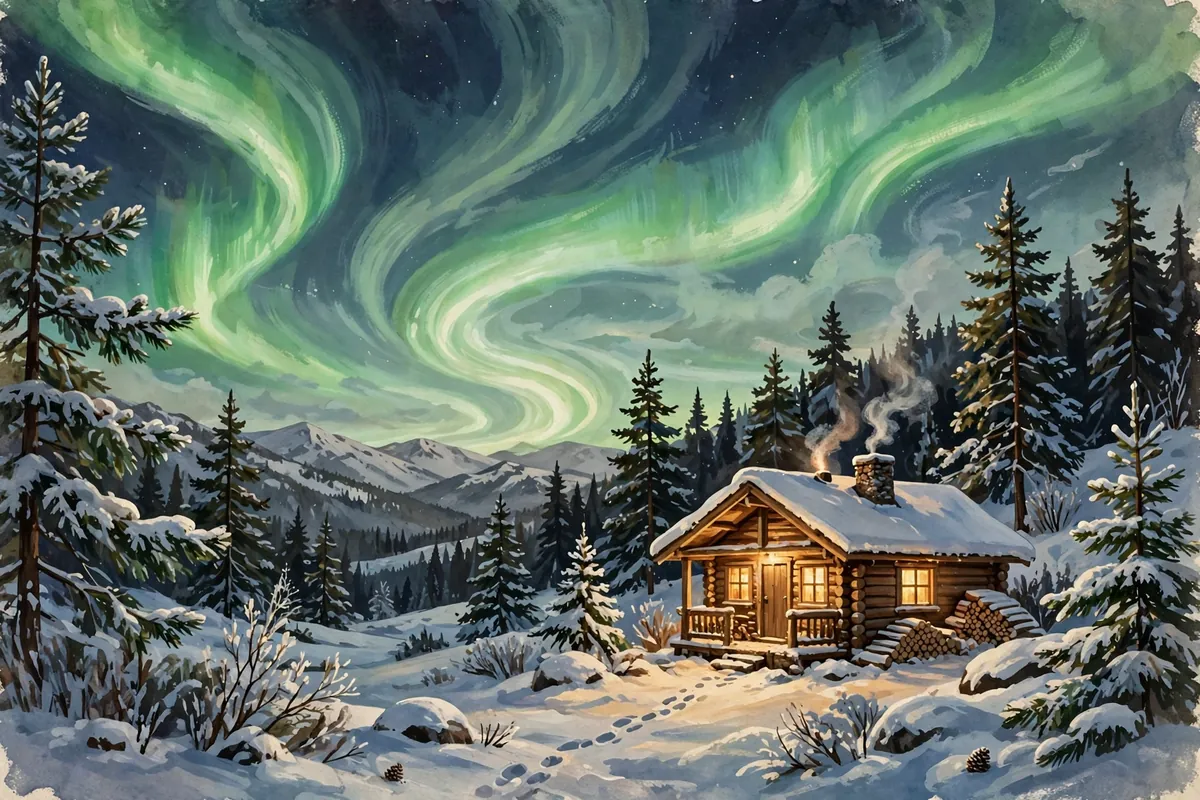
Stand under a clear winter sky in Alaska, Norway, or northern Canada on the right night, and the darkness can suddenly come alive. Ribbons of green light ripple and fold like curtains in a breeze. Sometimes there are flickers of pink, red, or purple. It's no wonder people have watched in awe for thousands of years.
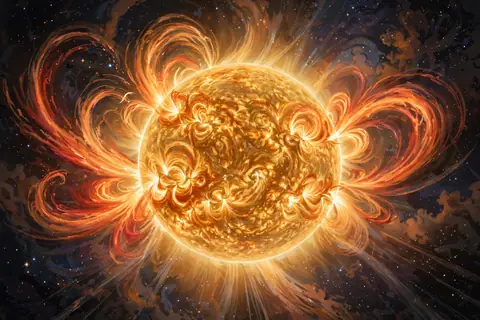
Here's how it works in short. The Sun constantly sends out a stream of charged particles called the solar wind. When that stream gets stronger, it disturbs the magnetic bubble around Earth, and charged particles, mostly electrons and protons, rain down into the upper atmosphere. There they crash into oxygen and nitrogen, which then give off light. That glow is the aurora.
A Light Show Powered by the Sun
Earth is wrapped in a magnetic field, called the magnetosphere, that acts like a shield against the solar wind. Usually it does a fine job. But when the Sun releases faster gusts from areas called coronal holes, or blasts huge clouds of material known as coronal mass ejections, the magnetosphere gets jostled.
That disturbance sends charged particles streaming down along Earth's magnetic field lines toward the polar regions. As they slam into gas high in the sky, they give the gas extra energy, and the gas releases that energy as light. It's a little like how a neon sign glows when electricity passes through it.
What the Colors Mean
The colors depend on which gas is glowing and how high up it is. Green is the most common color. It comes from oxygen atoms at lower heights, and our eyes happen to be especially sensitive to green, which helps it stand out.
Red comes from oxygen much higher up, where the air is very thin. It's usually only visible during strong solar activity. Blue and purple come from nitrogen, mostly along the lower edges of the curtains, and they show up when the Sun is especially active. When red and green mix, you can even see pink or yellow.
Where You Can See Them
Auroras appear most often in a ring called the auroral zone, centered around 67 degrees north and south. That's why Alaska, Canada, Iceland, Greenland, Scandinavia, and parts of Russia are famous viewing spots. The southern version, the aurora australis or southern lights, can be seen from Antarctica, New Zealand, and southeastern Australia.
During big solar storms, the glowing ring stretches toward the equator. On rare occasions, the northern lights have been seen as far south as the southern United States and the Mediterranean. Large storms are most common around the peak of the Sun's roughly 11-year cycle and in the few years after.
The Greatest Show on Record
In 1859, the Sun produced the greatest geomagnetic storm ever observed, now called the Carrington Event. Auroras were seen even in the tropics, and the storm disrupted telegraph networks. A Japanese diary discovered in 2017, showing auroras above Kyoto in 1770, suggests that earlier storm may have been even a bit bigger.
Earth isn't the only place with a light show. Auroras have been spotted on Jupiter, Saturn, Uranus, and Neptune. Jupiter's are especially strange, partly powered by material from its volcanic moon Io.
The name itself is a little poem. Aurora was the Roman goddess of the dawn, and Boreas was the god of the north wind. So the next time you see aurora borealis on a travel poster, you'll know it simply means the dawn of the north, a perfect name for a sky that seems to wake up in the middle of the night.