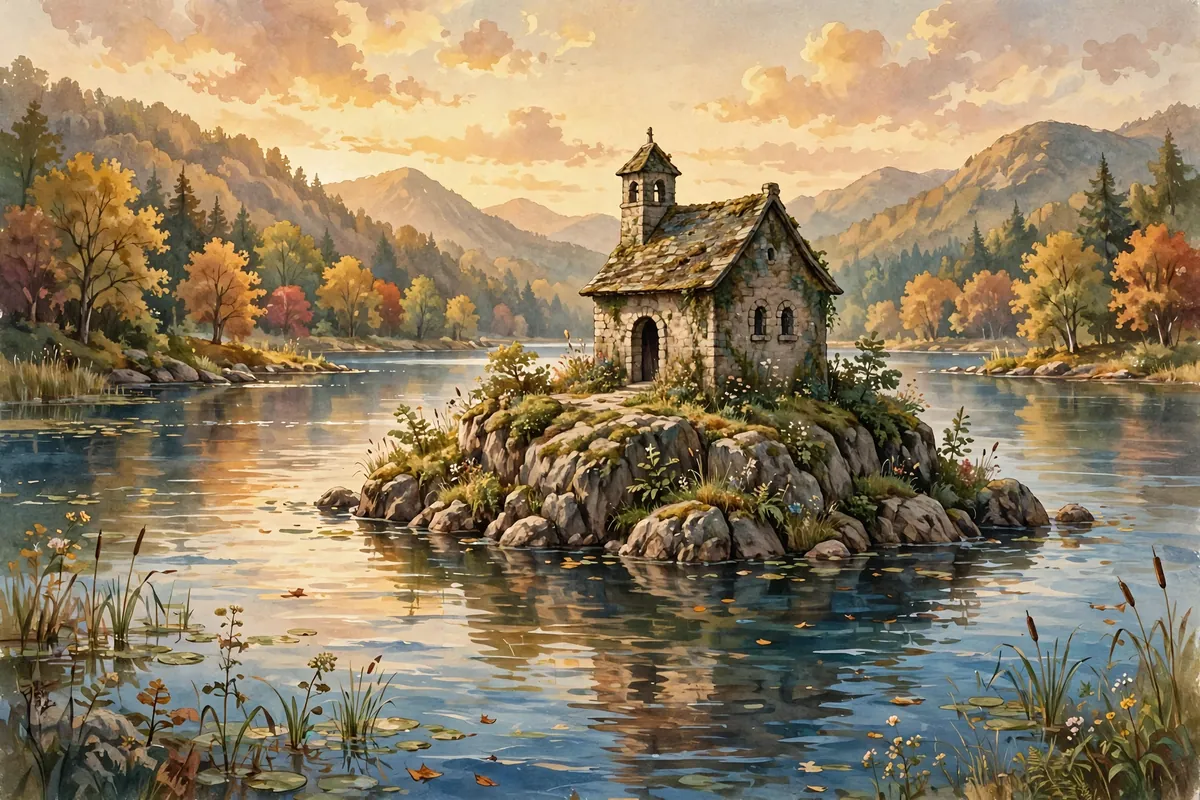
Picture a calm green lake ringed by mountains and forest. In the middle sits a tiny island, and on that island stands a white church with a tall bell tower. It looks like something out of a fairy tale, but it's real, tucked into the Julian Alps.
This is Bled Island, in Lake Bled in northwestern Slovenia. Its main building is the Pilgrimage Church of the Assumption of Mary, built in its current form near the end of the 1600s. There's no bridge, so visitors usually arrive by a traditional wooden boat called a pletna. Once ashore, they climb 99 stone steps, and many ring the church bell for luck.
A Sacred Spot for Centuries
People have treated this little island as special for a very long time. Traces of prehistoric humans have been found there. Before the church was built, a temple stood on the island dedicated to Živa, the Slavic goddess of love and fertility.
The church you see today is decorated with remains of Gothic frescoes from around 1470 and rich Baroque furnishings. Its tower rises 171 feet, and the grand Baroque stairway of 99 steps dates from 1655.
The Wedding Tradition
Weddings are held at the church regularly, and they come with a delightful custom. It's considered good luck for the groom to carry his bride all the way up the 99 steps. According to local tradition, the bride must stay silent the whole way.
Once at the top, the couple rings the bell and makes a wish inside the church. Plenty of non-newlyweds ring it too, thanks to an old legend that it brings good luck.
The Boats and the Families Who Row Them
Getting there is half the fun. The pletna is a flat-bottomed wooden boat a bit like an Italian gondola, with a colorful awning, seating about 20 passengers. The name comes from a Bavarian German word for a flat-bottomed boat. Most historians date the first ones on the lake to around 1590.
The oarsmen row standing up, using two oars. Their job dates to 1740, when Empress Maria Theresa of Austria gave 22 local families the exclusive right to ferry pilgrims to the island. The profession is still restricted, and many of today's oarsmen descend from those original families. The boats are still made by hand. To help keep the lake clean, the island boats are limited to a fixed fleet of 23.
A Lake for All Seasons
Lake Bled is about 1.3 miles long, of mixed glacial and tectonic origin. A thermal spring helps warm it, so in midsummer the surface warms to roughly 72 to 79 degrees Fahrenheit, which makes it very popular for swimming and paddleboarding. In colder winters, the whole lake can freeze, and the island can be reached on foot.
Medieval Bled Castle stands above the lake on the north shore and now houses a museum. Its story goes back to 1004, when Emperor Henry II of the Holy Roman Empire, who loved the lake, granted the estate. For centuries, Europeans have come to Bled for recreation and for the lake's reputed health benefits. The lake has also hosted the World Rowing Championships four times.
So if you ever find yourself in Slovenia, take the boat, climb the steps, and ring the bell. You might not need luck, but it never hurts to ask.