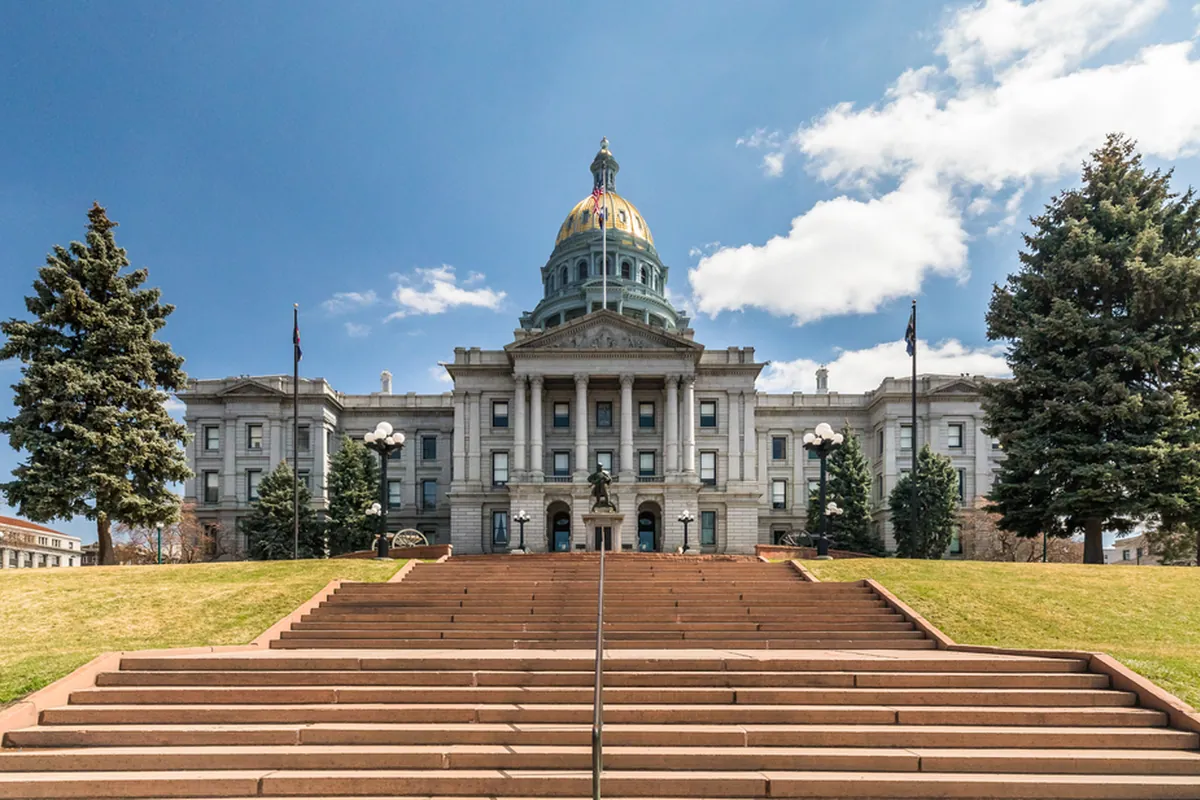
Climb the west steps of the Colorado State Capitol in Denver and you'll find tourists crouched beside one particular step, snapping photos. Engraved in the stone are the words One Mile Above Sea Level. It's a perfect souvenir for the Mile High City. But is the capitol really exactly a mile high?
Here's the truth: not the whole building. The capitol sits on a slight rise, and its dome soars high above the ground, so it spans a range of elevations. What's a mile high is a spot on its west steps, where Denver's official elevation is measured. And that spot has moved. The original marker is on the 15th step, a second was added on the 18th step in 1969, and a third went on the 13th step in 2003 after a more accurate survey.
The Steps That Keep Changing
The first marker, on the 15th step outside the west entrance, put Denver at exactly 5,280 feet. From that step, you can watch the sun set behind the Rocky Mountains.
In 1969, students from Colorado State University resurveyed the elevation and placed a second mile-high marker on the 18th step. Then, in 2003, a more accurate measurement using modern methods identified the 13th step as one mile high, and a third marker was installed there. So today, visitors can choose from three mile-high steps.
Why Denver Loves Its Mile
Denver's nickname, the Mile High City, comes from its official elevation of exactly one mile above sea level. The city was founded in 1858, during the gold rush era, where Cherry Creek meets the South Platte River. It was named after James W. Denver, then governor of the Kansas Territory.
Downtown lies about 12 miles east of the foothills of the Rockies. The city is also crossed by the 105th meridian, the reference line for the Mountain Time Zone, which runs right through Denver Union Station.
A Capitol Fit for the West
The capitol itself is a showpiece. Designed by Elijah E. Myers to recall the U.S. Capitol, it was built of Colorado granite in the 1890s and opened in November 1894. Its dome is covered in real gold leaf, first added in 1908 to honor the Colorado Gold Rush. Inside, the entrance hall rises 180 feet to the top of the dome, about the height of an 18-story building.
The builders used a rare rose-colored stone called Colorado Rose Onyx for the interior, and they used up the entire known supply. The halls also display portraits of every U.S. president.
A Mile High at the Ballpark
The capitol isn't Denver's only mile marker. At Coors Field, home of the Colorado Rockies, most seats are dark green, but the 20th row of the upper deck is purple to mark one mile above sea level.
The ballpark became famous for home runs. Studies found that Denver's dry air played a bigger role than its thin air, because dry baseballs bounce off the bat more. Since 2002, the balls have been stored in a humidor, and home runs there are now close to the numbers at other parks.
So if you visit the capitol, go ahead and take your mile-high photo, and stay for that famous view of the Rockies. Just take three pictures, one on each marked step, and you'll be covered no matter which survey you trust.