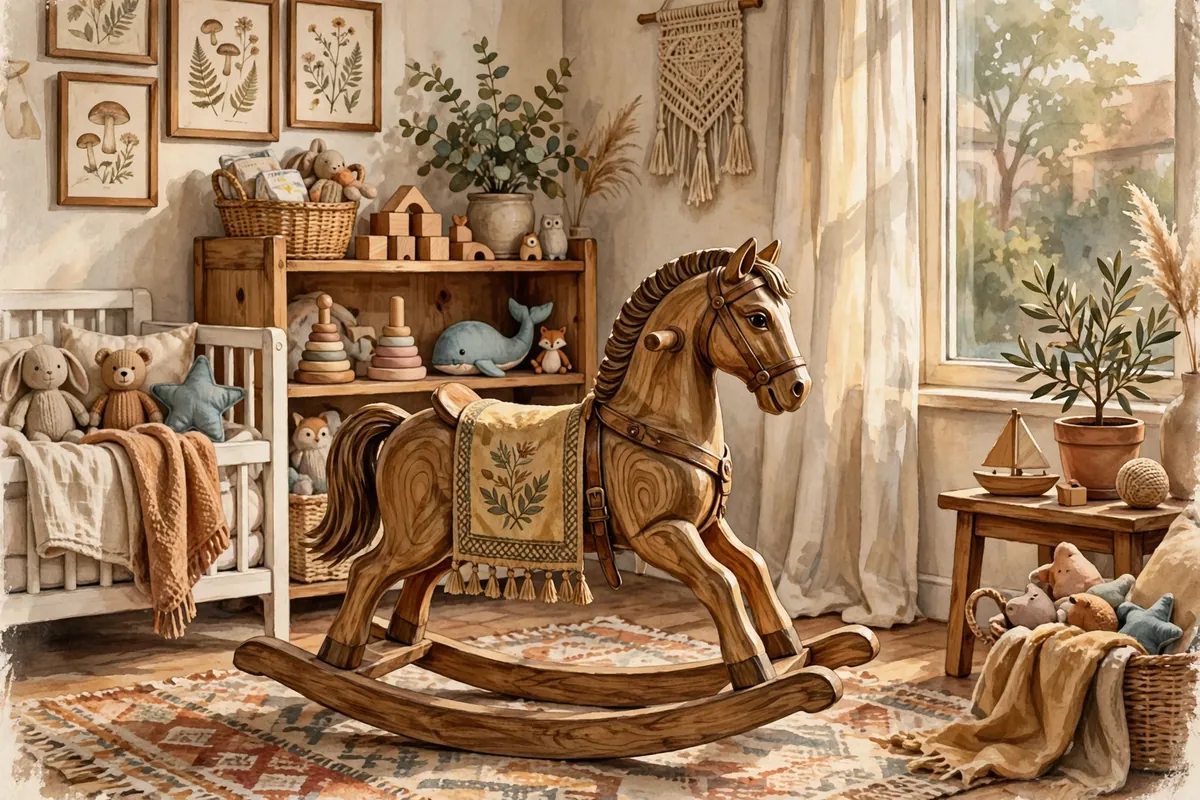
Few toys feel as timeless as a wooden rocking horse. With its painted dapples, flowing mane, and gentle back-and-forth motion, it shows up in old photos, storybooks, and grandparents' attics. Plenty of us remember galloping to imaginary places on one. So how did a horse on rockers become such a classic?
The short answer is that it grew out of much older horse toys and training gear. Historians see its forerunners in the tilting seats used in the Middle Ages for jousting practice and in the simple stick-and-head hobby horse. The rocking horse as we know it appeared by the 1600s, became widely seen as a children's toy in the 1800s, and was mass-produced from the late 19th century on.
From Jousting Seats to Nurseries
In medieval times, tilting seats helped riders practice for jousting, the famous contests where armored knights charged at each other. These rocking or tilting devices are seen as one of the rocking horse's ancestors. Some sources point to medieval manuscripts that mention carved rocking horses, presumably as toys, though accounts conflict.
What's clear is that the toy in its current form didn't appear before the 17th century. Through the 1800s, rocking horses became more commonly thought of as children's toys. Most were built by hobby woodworkers, ranging from fairly rough to finely decorated. Some were even made for future kings.
Two Kinds of Rockers
There are two main styles. In the classic version, the horse is fixed to a pair of curved rockers that sit on the floor, just like a rocking chair. In the other, the horse hangs from a sturdy frame on iron straps, so the horse swings while the frame stays put.
Production finally became industrialized in the late 19th century, which put rocking horses within reach of many more families. Later came the spring rider, the bouncy playground horse on a big metal spring. A horse spring toy was patented in 1956 in Pasco, Washington, and an Italian company developed the outdoor spring rider in the 1960s.
The Humble Hobby Horse
Before rockers, there was the hobby horse: a straight stick with a horse's head on one end, sometimes with reins or a little wheel at the bottom. It was also called a cock horse, as in the nursery rhyme "Ride a cock horse to Banbury Cross."
Here's a surprise. The hobby horse gave us the word hobby. The old word hobby meant a small horse or pony, and it's linked to Hobin, a nickname English farmers gave cart horses, just as they did Dobbin. From the toy came the saying "to ride one's hobby-horse," meaning to follow a favorite pastime, and eventually our modern word hobby. Even the art movement Dada may be named after a French child's word for hobby horse.
Still Galloping Today
Rocking horses still capture imaginations. In 2006, Guinness certified a California couple's hand-carved rocking horse, 7 feet 8 inches tall and 1,200 pounds, as the largest on record. In South Australia, the Big Rocking Horse roadside attraction stands about 60 feet tall. And in Lincoln, Massachusetts, a field called Ponyhenge holds roughly fifty rocking horses and other toy horses, arranged in a circle like Stonehenge.
So if there's an old rocking horse in your family attic, give it a gentle push for old times' sake. It's carrying a long history on that painted back, from knights in training to generations of little riders.