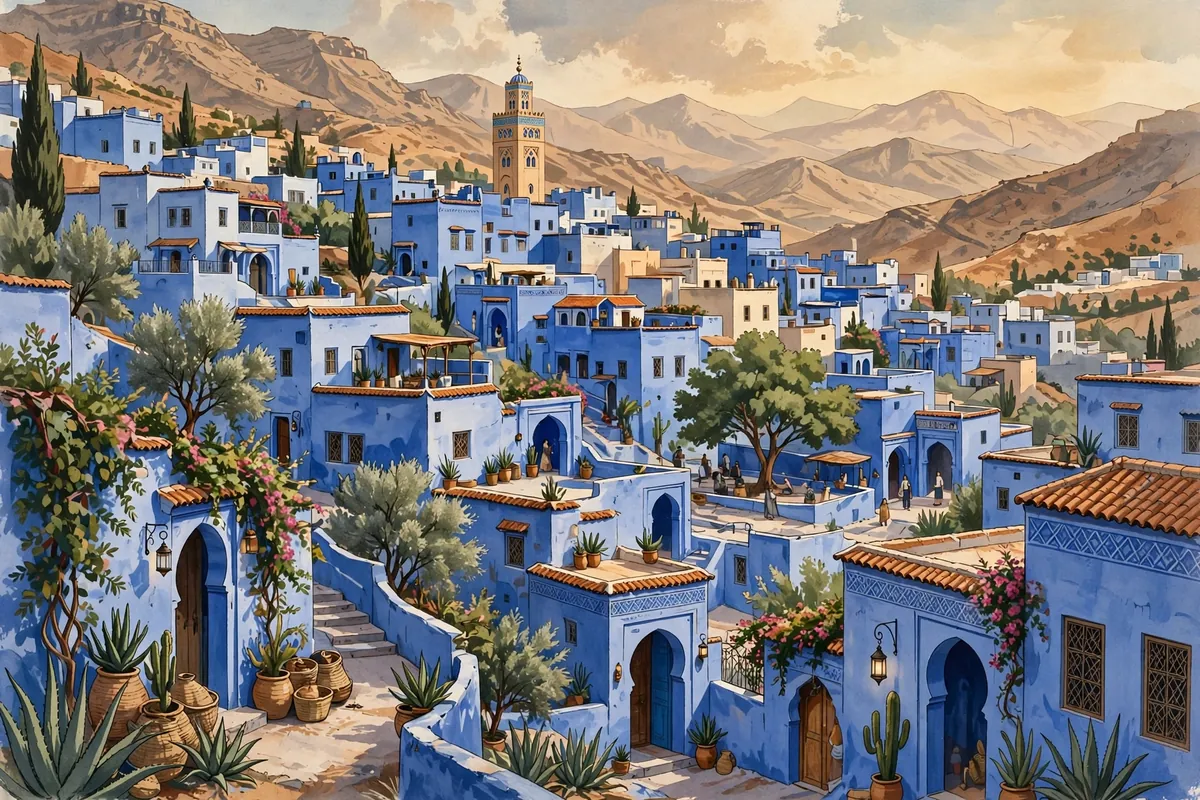
Imagine walking through narrow, winding alleys where nearly everything around you is blue: the walls, the steps, the doorways, even the archways overhead. Pots of flowers pop against the color. It sounds like a movie set, but it's a real town in the mountains of northern Morocco.
The town is Chefchaouen, nicknamed the Blue City and the Blue Pearl of Morocco. Its historic old quarter, the Medina, is dominated by houses painted in shades of blue and white. But not every building in town is blue, since a newer town has grown up outside the old walls. And no one agrees on exactly why the blue started. Theories range from keeping mosquitoes away to a 1970s push for tourists.
A Fortress in the Mountains
Chefchaouen sits about 2,000 feet above sea level in the Rif Mountains. It was founded in 1471 as a small fortress, or kasbah, built to defend the area against Portuguese attacks on northern Morocco.
Its name roughly means “look at the horns,” a nod to the two mountain peaks overlooking the town. Locals often just call it Chaouen.
The town grew after the fall of Granada in 1492. Over the following generations, Muslims and Jews leaving Spain settled there, building neighborhoods in an Andalusian style much like the old quarters of Granada.
The last Moriscos, descendants of Muslims, were expelled from Spain in 1609, and some of these refugees also chose Chefchaouen. Within a few decades, the fortress had become a prosperous city, with walls pierced by about ten gates and several mosques, including the Great Mosque.
So Why Blue?
Here's where it gets interesting. There are several theories, and none is settled. One popular idea is that the blue helps keep mosquitoes away.
Another says the blue symbolizes the sky and heaven, serving as a daily reminder to lead a spiritual life.
Then there's the most down-to-earth explanation. According to some locals, the walls were required to be painted blue in the 1970s to attract tourists. If that's true, it certainly worked, because the blue walls are now what the town is best known for.
Behind the Blue Doors
Traditional houses in Chefchaouen were built from stone, brick, tile, wood, soil, and lime. Each had an open courtyard in the middle, surrounded by corridors and bedrooms, often decorated with orange and lemon trees, grapevines, and fragrant jasmine.
Andalusian influence shows up everywhere, from curved brick archways that strengthen the houses and decorate the narrow alleys to the traditional water network. Many families also keep alive the art of Andalusian music, which plays a central role in local festivals and ceremonies. The town's original residents were Andalusian Arabs and Spanish Jews, later joined by Berbers from the surrounding region.
The town had a turbulent 20th century. Spanish forces occupied it in 1920. From 1924 to 1926 it was part of the short-lived Republic of the Rif, led by Abd el-Krim, before Spanish troops retook it, and it returned to Moroccan rule when the country gained independence in 1956. According to the 2024 census, about 46,000 people live there today.
So not every house in Chefchaouen is blue, and the reason behind the paint may be part faith, part folklore, and part marketing. Either way, few towns anywhere have turned a single color into such a beautiful signature.