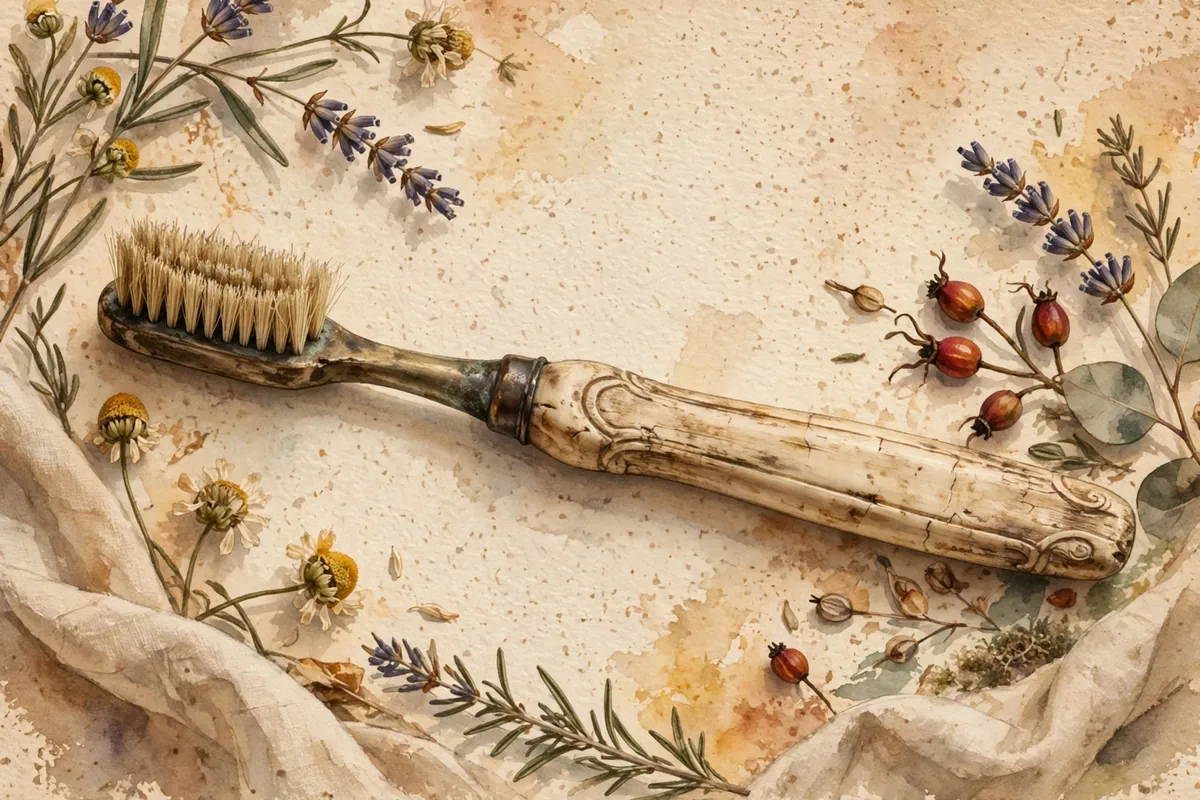
Look at the toothbrush in your bathroom. The handle is probably plastic, and the bristles are almost certainly nylon. It seems like such a basic object that it's hard to picture it any other way. But for most of its history, the toothbrush was made from bone, bamboo, and animal hair.
The first bristle toothbrush resembling the modern kind was found in China and used during the Tang dynasty, which lasted from 619 to 907. Its bristles were hog hair, and makers preferred hogs from Siberia and northern China because the cold climate gave them firmer bristles. Animal bristles, including boar hair, remained the standard until nylon took over in the 20th century.
Before the Brush: Chew Sticks
People were cleaning their teeth long before the toothbrush. The ancestor of the toothbrush is the chew stick, a twig with a frayed end used to scrub the teeth while the other end served as a toothpick.
The earliest chew sticks have been found in Sumer, in ancient Mesopotamia, from around 3500 BC, and in an Egyptian tomb from about 3000 BC. Chew sticks are still used today in parts of the world, including Africa and the rural southern United States. In the Islamic world, a chewing stick called the miswak has been used since the 7th century, and in India, twigs of the neem tree are still used.
Too Stiff for European Teeth
Travelers brought the bristle toothbrush from China to Europe, where it caught on in the 1600s. The earliest known use of the word toothbrush in English comes from 1690, when Anthony Wood wrote that he had bought one.
Europeans found the Chinese hog bristles too firm. Many preferred softer brushes made from horsehair. Later, pig bristles were used for cheaper brushes and badger hair for the more expensive ones.
A Toothbrush Invented in Jail
In England, William Addis is believed to have made the first mass-produced toothbrush around 1780. The idea reportedly came to him in prison, where he'd been jailed for causing a riot. He decided that rubbing his teeth with a rag, soot, and salt wasn't good enough.
So he saved a small bone from a meal, drilled holes in it, and tied in tufts of bristles he got from a guard. After his release, he started a toothbrush business and became wealthy. His family owned the company until 1996, and under the name Wisdom it still makes about 70 million toothbrushes a year.
Across the Atlantic, H.N. Wadsworth received the first U.S. toothbrush patent in 1857. American mass production began in 1885, with bone handles and Siberian boar hair bristles.
Why Nylon Won
Animal bristles had real drawbacks. They held on to bacteria, didn't dry well, and often fell out. So when DuPont introduced nylon bristles, it was a big improvement. The first nylon toothbrush went on sale on February 24, 1938.
Around the same time, celluloid gradually replaced bone handles. The first electric toothbrush was invented in Switzerland in 1954. Interestingly, brushing every day didn't become routine for most Americans until after World War II, when soldiers had to clean their teeth daily.
Boar bristle brushes haven't vanished completely. You can still find them, along with bamboo-handled brushes, sold as alternatives to plastic. But most of us are happy to leave the Siberian hogs out of our morning routine.