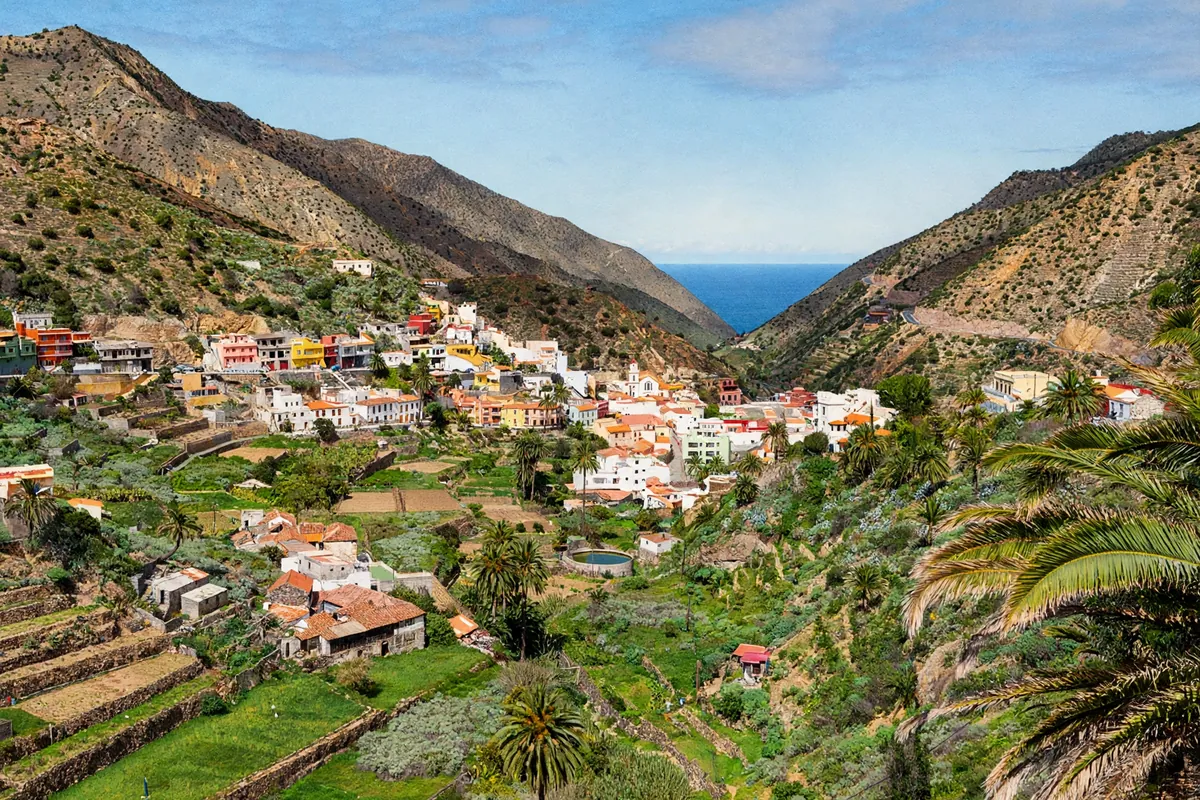
Picture a steep green island cut by deep ravines. Walking from one side of a valley to the other could take hours. Shouting wouldn't carry far enough. So the people of La Gomera, in Spain's Canary Islands, found another way to talk: they whistled.
Their whistled language is called Silbo Gomero, and it's a way of whistling ordinary Spanish. It isn't quite a village where everyone whistles their conversations, though. It's a whole island, and while a 2009 UNESCO report said all of La Gomera's residents understand Silbo, not everyone can speak it. Mostly older islanders and younger people who learned it in school can.
Spanish, Turned Into Whistles
Silbo isn't a secret code. It swaps the sounds of spoken Spanish for whistles that rise and fall in pitch. Different pitches and patterns stand in for vowels and consonants, so a skilled whistler can send real sentences.
Researchers have long debated how many distinct sounds it has. Some studies count as few as two vowels, others five. Recent research found that expert whistlers can make all five Spanish vowels distinct at close range, though a couple of them blur together over long distances. Scientists think the language grew more precise as people began using it for shorter-range chats, not just shouts across valleys. Even accents exist: small differences in a whistler's style can reveal where on the island they come from.
The big advantage is range. Silbo messages can travel up to about five kilometers, roughly three miles, across ravines and narrow valleys. Because it's so loud, it's mostly used for public messages, from party invitations to community announcements. A Silbo speaker is called a silbador, or whistler.
Older Than the Spanish Settlers
Whistled speech on the Canary Islands goes back further than Spanish. The islands' original inhabitants, the Guanches, used a whistled language before Spanish settlers arrived. It also existed on El Hierro, Tenerife, and Gran Canaria.
When Spanish settlers came in the 16th century, the whistles were adapted to Spanish, and Silbo stayed widely used into the 1600s.
Nearly Lost, Then Saved
In the 1950s, Silbo began to fade. Hard economic times pushed many speakers to leave the island for work, and telephones made long-distance whistling less necessary. From the 1960s to the 1980s, many families saw Silbo as old-fashioned and connected to poor rural life, so they didn't teach it to their children. That's why many islanders born between 1950 and 1980 understand it but can't whistle it.
Then the islanders fought back. Expert whistlers offered to teach it for free, and parents spread the idea to every school. In 1997, the Canary Islands parliament called for Silbo to be taught in schools, and since 1999 it has been a required subject in primary and secondary education on La Gomera. In 2009, UNESCO recognized it as part of the world's intangible cultural heritage.
Other Whistling Places
La Gomera isn't alone. In the Turkish village of Kuşköy, near the Black Sea coast, people still use a whistled form of Turkish known as bird language. Long ago, the Greek writer Xenophon described people in that same region who could hear each other across great distances in the valleys.
Today, children on La Gomera grow up learning to whistle their words. It's a lovely reminder that people will always find a way to be heard, even across a canyon.