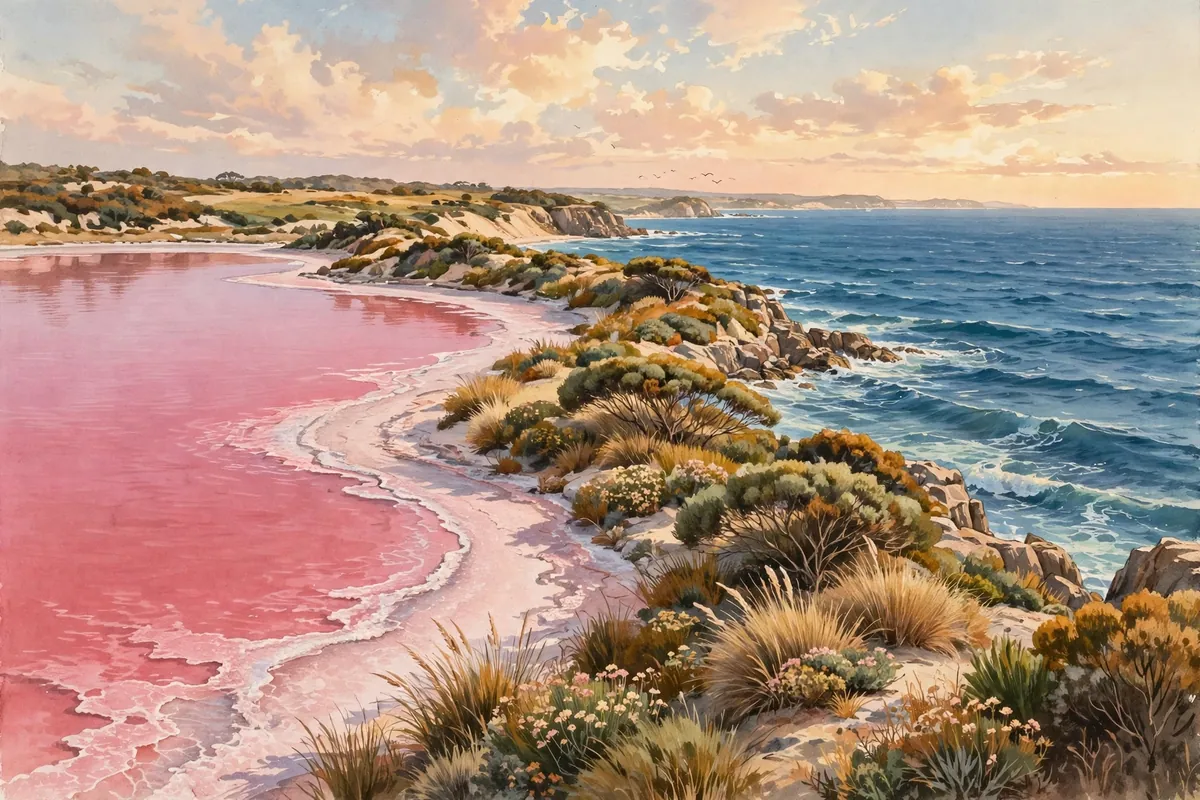
Picture an island off the southern coast of Australia. On one side, the deep blue ocean stretches to the horizon. On the other, separated by a thin strip of sand and trees, lies a lake the color of bubble gum. It looks like a filter was applied to the photo, but it's real.
This is Lake Hillier, a salt lake on Middle Island in Western Australia. Its pink color is believed to come mainly from a tiny salt-loving alga called Dunaliella salina, which packs itself with a reddish-orange pigment called beta-carotene. Salt-loving bacteria living in the lake's salt crusts add to the rosy shade.
Life in Very Salty Water
Lake Hillier is extremely salty, with salt levels comparable to the Dead Sea. Few living things can handle that. The only life in the lake is microscopic. The lake is fairly small, about 2,000 feet long, and it's ringed by sand, paperbark and eucalyptus woodland, and a thin strip of dunes that keeps the ocean out.
Dunaliella salina is one of the few organisms that thrive in such conditions. To survive the harsh sunlight, it stores large amounts of beta-carotene, the same kind of pigment that makes carrots orange. The pigment appears to protect the alga from long-term exposure to ultraviolet light. When there are enough of these tiny cells, the whole lake turns pink.
In 2015, scientists from the Extreme Microbiome Project analyzed the lake's DNA. They found Dunaliella along with a variety of salt-loving bacteria and other microbes, including one called Salinibacter ruber.
A Color That Stays Put
Unlike a sunset reflection, Lake Hillier's color doesn't vanish up close. If you scoop the water into a container, it stays pink. From the air, the lake looks like solid bubble gum, while from the shoreline it appears more of a clear pink.
The color isn't completely fixed, though. In recent years, it has noticeably faded, partly because heavy rainfall diluted the salt. Scientists expect the pink to return as the water level drops. And despite its unusual look, the lake is safe to swim in, though visitors rarely get the chance since tours generally don't stop on the island.
Named for a Sailor
The first written record of the lake comes from explorer Matthew Flinders, whose expedition visited in January 1802. Flinders climbed the island's highest peak and spotted the pink lake below. The peak is now called Flinders Peak.
Flinders returned in May 1803, partly to collect salt from the lake. He reportedly named it after William Hillier, a crew member of his ship who died of dysentery on the island before the expedition left.
Other Pink Lakes
Lake Hillier isn't the only one. In Senegal, Lake Retba, also known as Lac Rose, gets its pink color from the same alga. It's so salty, up to 40 percent in places, that people can float easily, much like in the Dead Sea.
Lake Retba is also a working lake. Up to 3,000 collectors harvest about 38,000 tons of salt from it each year, protecting their skin with shea butter. The salt helps Senegalese fishermen preserve fish.
So if you ever see a photo of a bubble-gum lake and think it must be fake, you'll know the truth. It's simply a crowd of very tough, very tiny living things, painting the water pink one cell at a time.