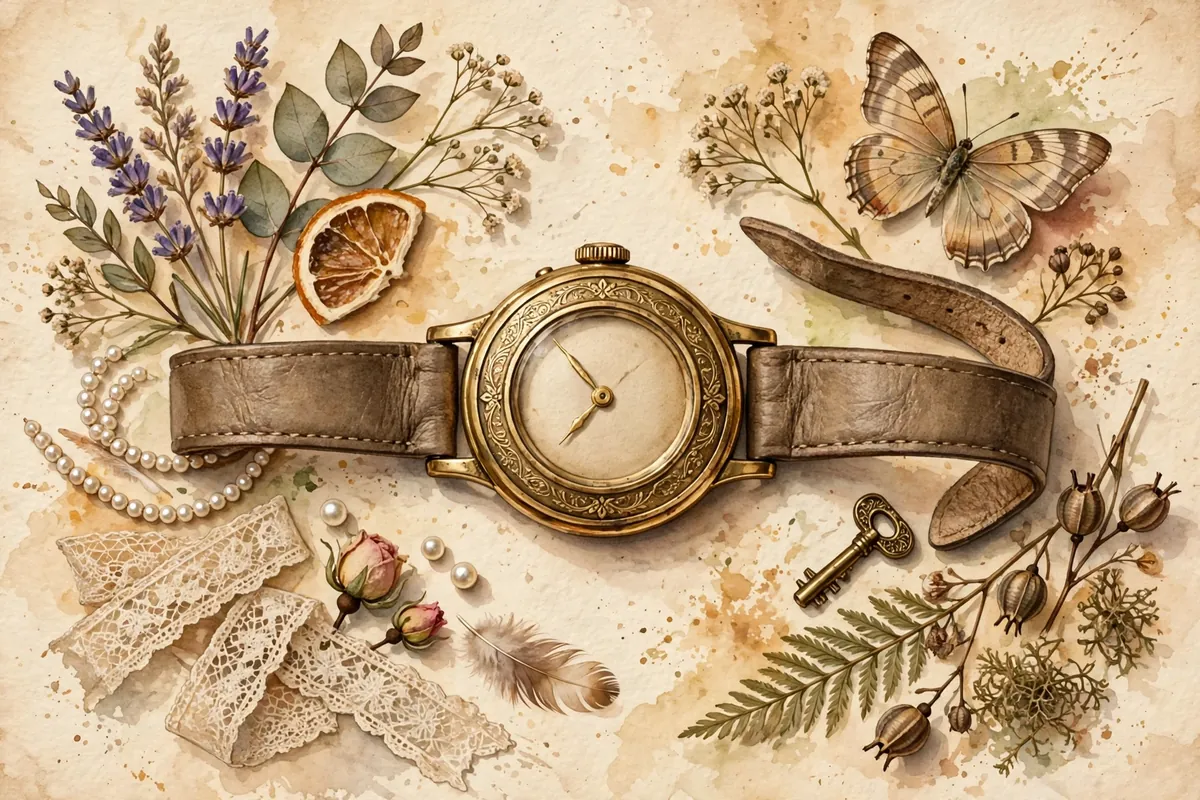
Today, a wristwatch is about as unisex as an accessory gets. But for most of their history, wristwatches were firmly a ladies' item. A respectable gentleman carried a pocket watch on a chain.
The short answer: early wristwatches, often called wristlets or bracelet watches, were made almost entirely for women for roughly their first hundred years. One likely reason is that women's clothing often lacked pockets, so a watch on the wrist was practical as well as pretty. Men stuck with pocket watches until the early 20th century.
Royal Beginnings
The idea goes back surprisingly far. In 1571, Queen Elizabeth I of England received an "armed watch" from Robert Dudley, an early form of wristwatch.
The oldest surviving wristwatch, then called a bracelet watch, was made in 1806 and given to Joséphine de Beauharnais, the wife of Napoleon. In 1810, the famous watchmaker Abraham-Louis Breguet made a wristwatch for the Queen of Naples. And the first Swiss wristwatch was made by Patek Philippe in 1868 for a Hungarian countess.
Why Women Wore Them First
Historians think the trend had practical roots. In the 1800s, women's public lives were expanding, and they needed a way to keep track of time. Women's clothing generally lacked pockets, which made pocket watches awkward. A watch worn on the wrist solved the problem neatly.
Men, meanwhile, considered the pocket watch the proper masculine choice well into the late 1800s.
Soldiers Change Their Minds
The military helped change things. Toward the end of the 19th century, officers realized how important it was to coordinate movements in battle without signaling plans to the enemy.
British Army officers used wristwatches in colonial campaigns in the 1880s, and the habit spread during the First Boer War. Swiss watchmakers including Girard-Perregaux began supplying German naval officers with wristwatches around 1880.
Watchmakers took notice. The Garstin Company of London patented a "Watch Wristlet" design in 1893. Mappin & Webb started making a successful "campaign watch" for soldiers during the 1898 campaign in Sudan, then ramped up production for the Second Boer War. Many early models were simply pocket watches fitted onto a leather strap, but by the early 20th century, companies were building true wristwatches from scratch.
Civilians got a push too. In 1904, Louis Cartier made a wristwatch for his friend, the aviator Alberto Santos-Dumont, so he could check the time while keeping both hands on the controls of his airship.
The War That Settled It
World War I sealed the deal. New artillery tactics required precise timing between gunners and the soldiers advancing behind the barrage. Service watches were built for trench warfare, with glowing dials and unbreakable glass, and the British War Office began issuing wristwatches to fighting men in 1917.
That year, a British watch journal noted that the wristlet watch, once little used by men, was now on the wrist of nearly every man in uniform and many civilians. After the war, the fashion stuck. By 1934, Switzerland was exporting nearly twice as many wristwatches as pocket watches.
Time for a New Look
So the next time you check the time on your wrist, tip your hat to the queens and countesses who wore wristwatches first, and to the soldiers who made them acceptable for everyone.
Fashion has a funny way of coming full circle, and the humble wristwatch is proof.