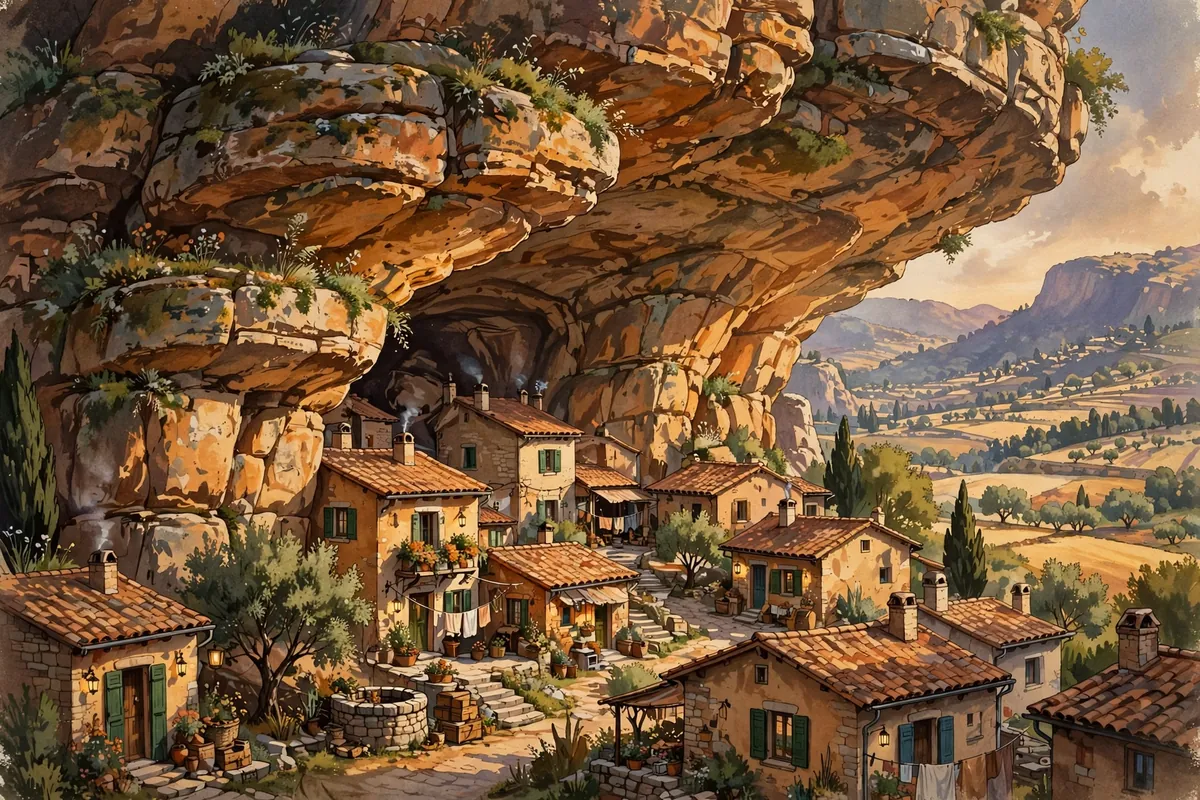
Most towns are built on rock. One little town in southern Spain decided to build under it. Walk its narrow streets and you'll see white houses snuggled right up against a cliff, with massive stone ledges hanging overhead like a ceiling. It looks like the mountain is giving the whole town a hug.
The town is Setenil de las Bodegas, in the province of Cádiz in the Andalusia region. It's famous for its homes built into a rock formation above a river gorge. In some parts of the village, the rocky cliffs serve as the walls and roofs of the houses, so residents simply built fronts onto the stone and moved in. About 2,600 people live there today.
One of Spain's White Towns
Setenil is one of the Pueblos Blancos, or White Towns of Andalusia. These towns are scattered across the hills of northern Cádiz and Málaga provinces, many within the Sierra de Grazalema Natural Park, the rainiest area in Spain.
They share a look: whitewashed walls, red or brown tile roofs, narrow alleys, steep hills, and a central square with a church and town hall. Whitewashing arrived in Roman times, but it became widespread during the waves of plague from the 1300s onward, when people coated the walls of houses and churches inside and out.
A Fortress Town With a Stubborn Past
Modern Setenil grew out of a fortified Moorish town on a bluff above a sharp bend in the river. Its castle dates back at least to the 12th century, and its ruins still tower over the town.
Local tradition says the name Setenil comes from the Latin phrase septem nihil, meaning seven times nothing. The story goes that the town held out against Christian armies through seven sieges. What's certain is that it resisted an attack in 1407 and finally fell in 1484, when Christian forces using gunpowder cannons took fifteen days to capture the castle.
The victory was celebrated widely and inspired several local legends. One claims that Queen Isabella of Castile lost a baby during the siege and that a small chapel was built in his memory, though historians find no basis for the story.
Where the Bodegas Went
The second part of the town's name, de las Bodegas, means of the wineries. It dates from the 15th century, when new settlers planted vineyards alongside the olive and almond groves already there.
The olives and almonds still thrive. The wineries didn't survive. In the 1860s, a tiny insect pest called phylloxera spread through Europe and destroyed most of the continent's grapevines, wiping out Setenil's once-flourishing bodegas. The name stayed anyway.
Living in Stone Has Deep Roots
People have sheltered in the rocks of this region for a very long time. At the nearby Cueva de la Pileta, west of the town of Ronda, human habitation has been traced back more than 25,000 years, and the cave holds paintings estimated to be over 20,000 years old. Setenil may have been lived in that early too, though centuries of continuous living there would have erased the evidence.
So if you ever find yourself in the hills of Andalusia, look for the town where the mountain does the roofing. It's living proof that sometimes the best way to build a home is to let nature do half the work.