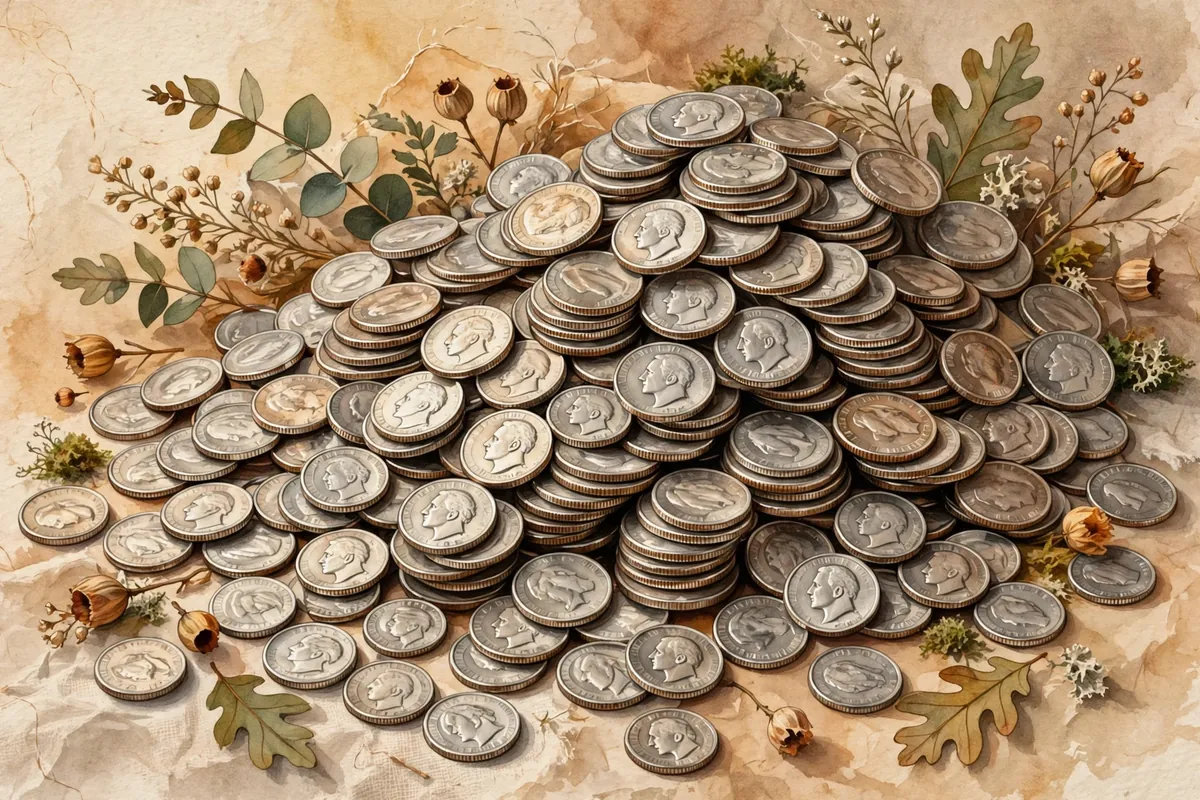
Some phrases slip into conversation so easily we never stop to think about them. Opinions are a dime a dozen. Good plumbers are not. We all know what it means: something so common that it's practically worthless. But why a dime, and why a dozen?
Here's the honest short answer. Calling something a dime a dozen means it's plentiful and cheap. The exact moment the phrase was born isn't well documented, so be wary of anyone who claims to know the precise first use. What we can say is that it pairs two very old words, both rooted in counting, and that the dime has long been a symbol of cheap, everyday things in America.
The Dime: A Tenth of a Dollar
The word dime comes from the Old French disme, meaning a tithe or tenth part, which goes back to the Latin decima. That's exactly what a dime is: one tenth of a dollar.
The U.S. Coinage Act of 1792 created the coin, spelled disme in the law. A small number of dismes were struck in 1792, but they never circulated. Because of low demand and production problems at the Mint, the first dimes for everyday use didn't appear until 1796.
Here's a fun detail. The dime is the only U.S. coin in general circulation that isn't labeled in dollars or cents. It's also the smallest and thinnest U.S. coin made for circulation today.
Since 1946, the dime has carried the face of President Franklin D. Roosevelt. He was chosen partly because of his role in founding the National Foundation for Infantile Paralysis, later renamed the March of Dimes, which raised money for polio research and helped people with the disease and their families.
The Dozen: Counting by Twelves
The word dozen comes from the French douzaine, meaning a group of twelve, from the French word for twelve, douze. Grouping things by twelve may be one of humanity's oldest ways of counting, perhaps because there are roughly a dozen cycles of the Moon in a year.
Twelve is also handy because it divides evenly in so many ways, by two, three, four, and six. That's one reason everyday items like eggs are often sold by the dozen. Twelve dozen make a gross, and twelve gross make a great gross.
Then there's the baker's dozen, which means thirteen. One explanation is a medieval practice in which bakers gave bread sellers thirteen loaves for the price of twelve, with the extra loaf serving as the seller's profit.
When a Dime Meant Cheap
By the late 1800s, the dime had become shorthand for a bargain in American life. In 1860, publishers launched a series of cheap paperbacks called Beadle's Dime Novels, and dime novel became the name for inexpensive popular fiction.
Dime museums, which grew popular starting around 1870, offered working-class crowds cheap entertainment, from oddities to dioramas. Variety stores were once known as five and dimes. So the idea of getting a dozen of something for a mere dime fits right in with how Americans talked about money.
So the next time you call something a dime a dozen, you're mixing a French word for a tenth with a French word for twelve, and adding a dash of old American bargain talk. Not bad for a phrase that's meant to describe ordinary things.