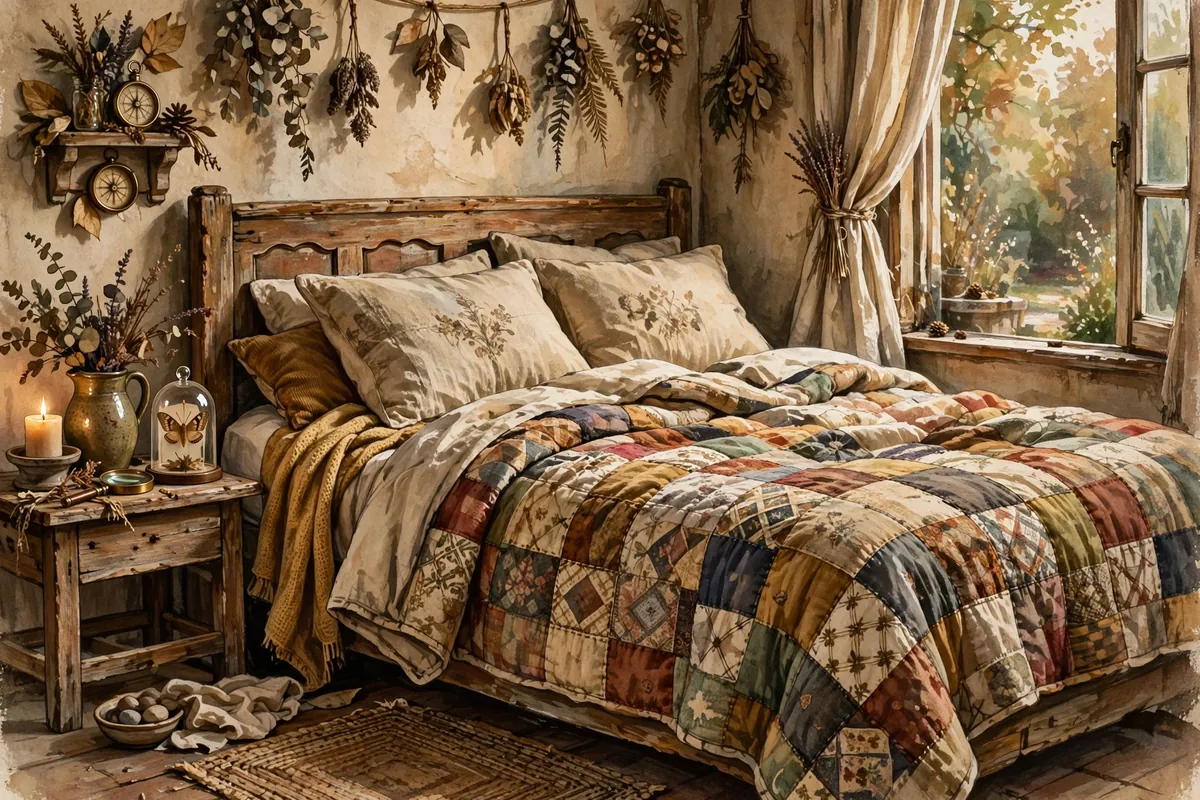
"Goodnight, sleep tight, don't let the bedbugs bite." Many of us heard it as children and later said it to our own kids and grandkids. It's sweet and sing-song. But when you stop and think about it, it's a little odd. Why would anyone want to sleep tight?
A popular explanation points to old rope beds. Instead of wooden slats, these beds were held up by a crisscross lattice of rope. The ropes sagged over time and had to be tightened regularly. The need to tighten those bed cords has been said to be the origin of sleep tight. But be warned: some word experts disagree, and the true origin isn't settled.
How a Rope Bed Worked
A rope bed is a type of platform bed. Instead of slats, the sleeper and the mattress rest on a lattice of rope stretched across the frame.
Ropes stretch, so the beds sagged. To fix it, owners tightened the ropes using a tool called a bed wrench, sometimes with wedges too. Every so often, the whole bed had to be re-strung, which reduced the sag and evened out the wear.
There was one handy bonus. When the ropes were loosened or removed, the bed could be packed flat for moving. Some fold-away Murphy beds have even used rope or wire.
What Went on Top
A rope bed wasn't very comfortable on its own. In cold climates, it was topped with one or more stuffed mattresses, known as bed ticks. These were large bags of tough fabric filled with materials like straw, chaff, horsehair, wool, or down feathers. A straw-filled tick was called a paillasse or pallet. Each morning, as beds were aired, the loose filling could be shaken and smoothed out.
In the 1500s, people sometimes laid woven mats of rush across the widely spaced ropes, then put the bed ticks on top. That kept the mattress from bulging down between the ropes. Some beds also had canopies hung with warm curtains.
Rope beds weren't only a Western idea, either. In South Asia, a traditional woven bed called a charpai has long been used. Its name means four-footed.
And Those Bedbugs?
The second half of the rhyme is no invention. Bedbugs have bothered people for a very long time. Fossils found in Egypt show they've been human pests for at least 3,500 years, and ancient Greeks wrote about them as early as 400 BC.
Before the 1950s, about 30 percent of houses in the United States had bedbugs. Their numbers dropped after World War II, but infestations have risen again since the 1990s. Experts point to more international travel, the trade in secondhand goods, and pests that have grown resistant to pesticides.
There's a strange twist in that story. Cockroaches eat bedbugs, so when insecticides cut down cockroach populations, that may have helped bedbugs bounce back. Earlier, the use of DDT against cockroaches is believed to have been part of the reason bedbugs declined in the first place.
Oddly, the ancient Roman writer Pliny claimed bedbugs had medicinal value, including for treating snake bites and ear infections. That belief hung on until at least the 1700s.
A Bedtime Mystery
So did sleep tight really come from rope beds? It's a lovely image, but it remains just one theory. Whatever its true origin, the phrase has lasted because it's warm and comforting. And that's the best way to end any day.