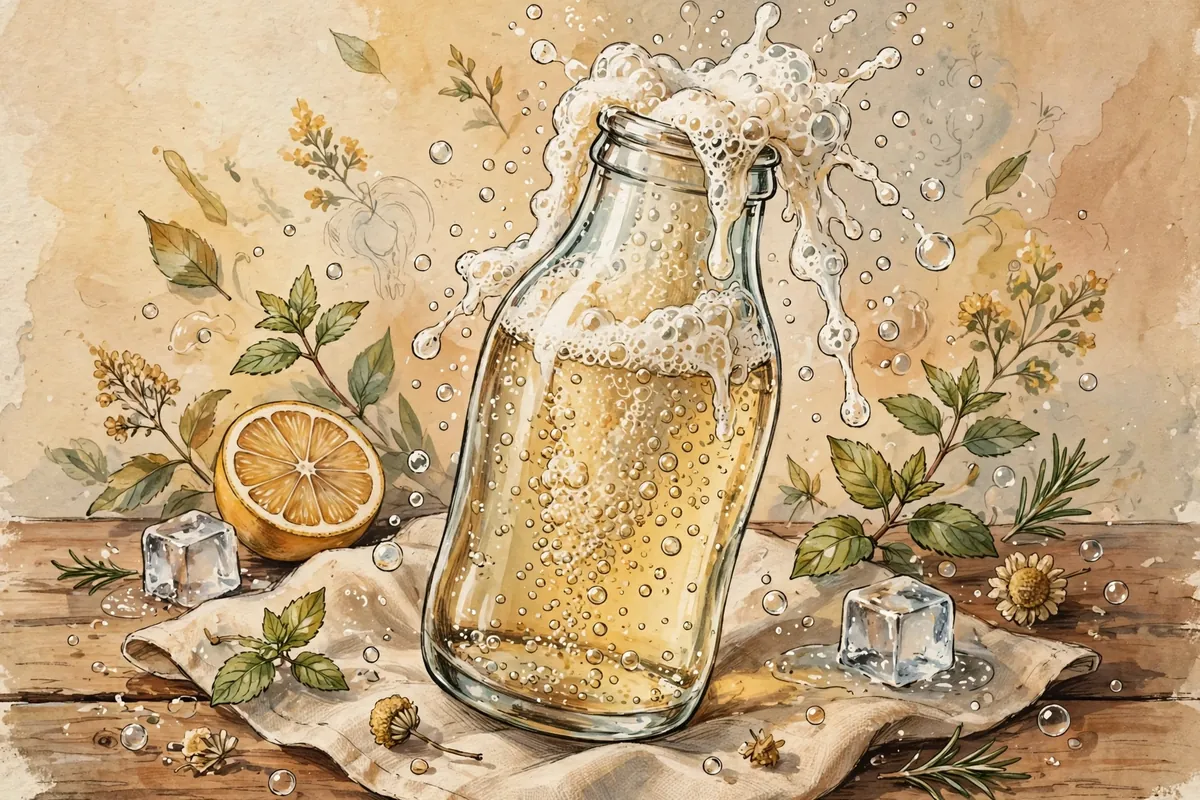
You grab a soda that's been rattling around in a grocery bag, twist the cap, and whoosh. Foam everywhere. We all learn the lesson eventually: let a shaken soda sit before you open it. But what's actually going on inside that bottle?
Here's the short answer. Soda is packed with carbon dioxide gas dissolved in the liquid under pressure. When you open it, the gas wants to escape, but it needs a place to start forming bubbles. Normally there are very few of those starting points, so the fizz comes out slowly. Shaking scatters the gas at the top of the bottle into countless tiny bubbles throughout the drink, giving the carbon dioxide millions of places to escape all at once.
Gas Hiding in Plain Sight
Carbonated drinks contain extra carbon dioxide held in the liquid under pressure. While it's dissolved, you can't see it. When you open the bottle and release the pressure, the drink suddenly holds more gas than it can keep, and the carbon dioxide starts coming out as bubbles.
Temperature matters too. Cold liquid can hold more dissolved carbon dioxide than warm liquid, which is one reason a warm soda tends to fizz more aggressively than a cold one.
Bubbles Need a Head Start
Here's the key idea. It takes a lot of energy for a brand-new bubble to form in the middle of a liquid all by itself. It's much easier for gas to flow into a tiny bubble that already exists.
In a soda, nearly all bubbles grow this way. The dissolved gas seeps into tiny pre-existing pockets of gas, often trapped in little fibers or tiny crevices on the inside of the bottle. Since an unshaken bottle has only a few of these starting points, the gas escapes slowly and politely.
Shaking changes everything. It breaks up the gas at the top of the bottle into a huge number of tiny bubbles mixed through the drink. When you open it, the dissolved carbon dioxide rushes into all of them at once. They swell rapidly, and the expanding foam shoots out of the bottle.
The Mentos Connection
The famous soda geyser works the same way. A Mentos candy's surface is covered with millions of microscopic pits that stay dry when dropped into soda. Each one is a ready-made starting point for a bubble. Researchers estimate that around 100,000 of those pits actively produce bubbles on a single candy.
That's why the reaction is physical, not chemical. Measurements suggest a Mentos eruption can produce as many as 14 million bubbles per liter of soda. Grains of salt or sand can trigger the same effect, though Mentos work better than most. Experiments have even shown the geyser works better at higher elevations.
A Bubbly History
Fizzy drinks have a surprisingly scientific origin. In 1767, English scientist Joseph Priestley figured out how to infuse water with carbon dioxide by suspending a bowl of water above a beer vat at a brewery in Leeds. Within a few years, inventors began making it in larger quantities, and in 1783 J. J. Schweppe founded Schweppes and began selling the world's first bottled soft drink.
So the next time a soda takes a tumble, give it a few minutes to settle. Once those tiny bubbles rise back to the top, your drink will be far less likely to give you a surprise shower.