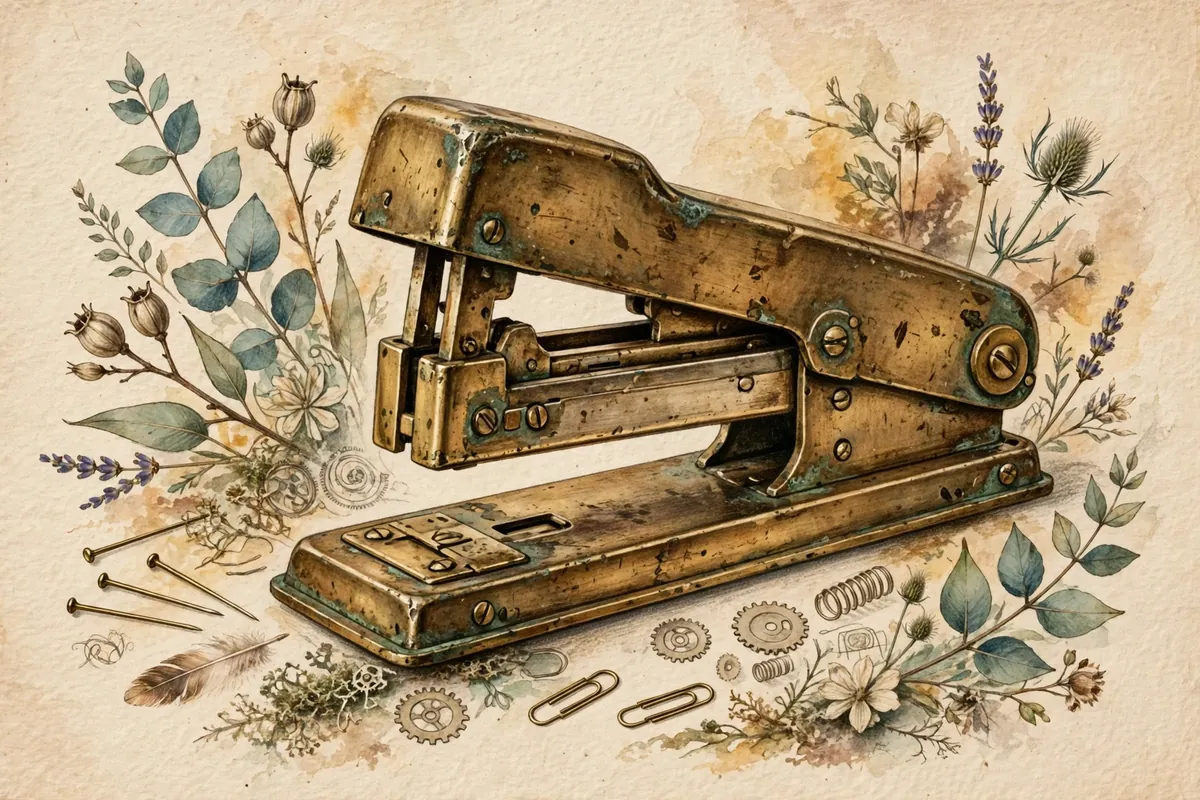
It sits on nearly every desk, usually ignored until it jams. But the humble stapler has an origin story you may have heard: that the very first one was made for a king. It's a charming tale. Unfortunately, it isn't where the documented history begins.
Standard histories of the stapler don't support the royal story. The recorded history starts in the 19th century, when the growing use of paper created demand for a better way to fasten pages together. A string of inventors, including George McGill and Henry R. Heyl, developed the staples and machines we'd recognize today.
Not the First Stapler After All
In 1841, inventors named Slocum and Jillion patented a Machine for Sticking Pins into Paper. It's often believed to be the first stapler, but the patent was actually for a device used to package pins.
The real groundwork came in the 1860s. In 1866, George McGill patented a small, bendable brass paper fastener, a forerunner of the modern staple. The next year, he patented a press to push that fastener into paper. In 1868, C. H. Gould received an English patent for a stapler, and Albert Kletzker of St. Louis patented a device, too.
One Stroke Does It All
McGill showed his invention at the 1876 Centennial Exhibition in Philadelphia. In 1877, Henry R. Heyl filed a patent for the first machines that both inserted and clinched a staple in one step, which is why some consider him the inventor of the modern stapler.
In 1878, the first machine to hold a magazine of many pre-formed staples appeared. On February 18, 1879, McGill patented his Single-Stroke Staple Press, the first commercially successful stapler. It weighed more than two and a half pounds and drove a single half-inch wire staple through several sheets of paper.
The word stapler, meaning a machine that fastens papers with thin metal wire, first appeared in print in a 1901 advertisement in Munsey's Magazine.
Your Stapler's Secret Setting
The most common type of desk stapler took shape in 1941 with the four-way stapler. It could fasten papers the usual way, tack them to wood or cardboard, or work like pliers on bags.
Here's a feature most people never use. The little metal plate under the stapler, called the anvil, often has two settings. The usual one folds the staple's legs inward for permanent fastening. Rotate or slide it, and the legs fold outward instead, making a temporary staple that's much easier to remove. It's almost never used, partly because few people know it's there.
Staplers Keep Evolving
Inventors even tried skipping the metal. In the early 1900s, machines like the Clipless Stand Machine, sold from 1909 into the 1920s, cut a tongue in the paper, folded it back, and tucked it in to hold the pages together.
Today there are easy-squeeze staplers that need less force, flat-clinch models that press the legs completely flat so papers stack neatly, and electric staplers that can fasten up to 20 sheets at a time. Some photocopiers even staple documents automatically as they print.
So the stapler wasn't born in a palace, as far as the records show. It grew out of patent offices and trade fairs, one clever tweak at a time. Not bad for a gadget most of us only notice when it runs empty.