Most of us take rivers for granted. They run through our towns, show up on every map, and supply drinking water to millions. It's hard to imagine a large, modern country without a single one. Yet such places exist.
The short answer: Saudi Arabia, one of the largest countries in the world, has no permanent rivers. Instead, it relies on groundwater, springs, desalinated seawater, and very scarce surface water. And it has company. Seventeen countries have no permanent natural river flowing within them.
Rivers That Only Flow Sometimes
Saudi Arabia isn't completely without watercourses. It has wadis, dry riverbeds that trace the paths of ancient rivers. Most of the year they're dusty channels, but when rare rains arrive, they carry the water down toward the plains.
Many wadis cross the country from the mountains near the Red Sea toward the Persian Gulf. Some of the best known are Wadi Hanifa and Wadi ar Rummah. On the western mountain slopes, infrequent but violent rainstorms have stripped away the soil over time.
Where the Water Comes From
So how does a country of big cities stay supplied? Today, about half of Saudi Arabia's drinking water comes from desalination, which removes salt from seawater. Around 40 percent is pumped from underground water that isn't being replaced, and only about 10 percent comes from surface water in the mountainous southwest.
The capital, Riyadh, sits in the middle of the country. Its desalinated water is pumped from the Persian Gulf across a distance of about 290 miles.
Nature lends a hand in a few spots. In the eastern region of al-Ahsa, large, deep pools are constantly refilled by artesian springs, where underground pressure pushes water to the surface. Springs and wells like these support irrigation in local oases.
It depends a lot on where you are. In the Hijaz, in the west, wells are plentiful and springs are common in the mountains. In the central Najd region and the great deserts, watering places are fewer and scattered far apart, and water often has to be hoisted or pumped to the surface.
The Empty Quarter
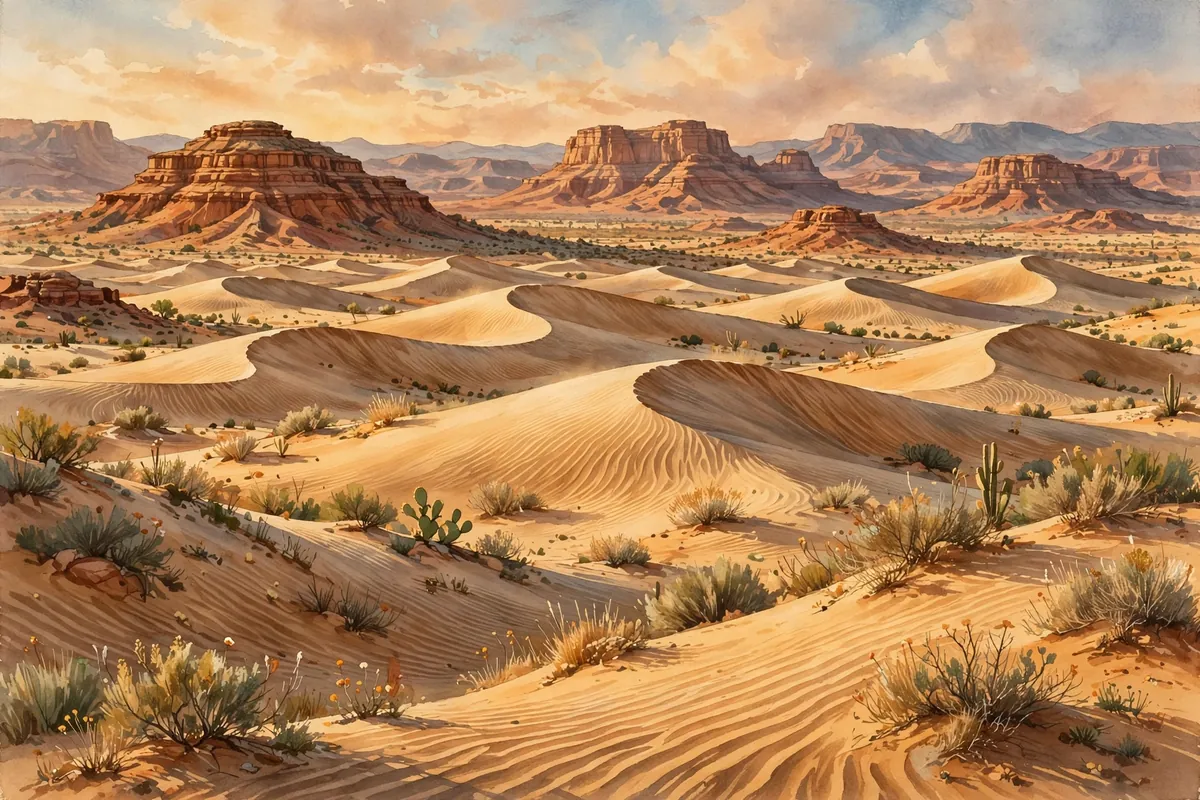
In the south lies the Rub' al Khali, often called the Empty Quarter. It covers more than 212,000 square miles and is one of the most forbidding sand deserts on Earth. Until the 1950s, it was one of the least explored places in the world.
Some of its sand mountains rise nearly 1,000 feet. Most of the area is completely waterless and uninhabited, apart from a few wandering Bedouin tribes.
Other Countries Without Rivers
Most of the Arabian Peninsula shares the same situation. Apart from Oman, the countries there make up the largest region in the world without any permanent natural river. Kuwait, Qatar, the United Arab Emirates, and Yemen all rely on wadis instead.
The list stretches far beyond the desert. Libya and Djibouti in Africa are on it. So are tiny European nations like Malta, Monaco, and Vatican City, along with island nations such as the Maldives, Tonga, Tuvalu, and Nauru.
Making the Most of Every Drop
Life without rivers takes planning, investment, and plenty of engineering. Saudi Arabia has spent heavily on desalination, water pipelines, and wastewater treatment, and treated wastewater is now used to water green spaces and farms.
The next time you drive over a river without a second glance, it's worth remembering that in some parts of the world, every glass of water has traveled a long way to get there.