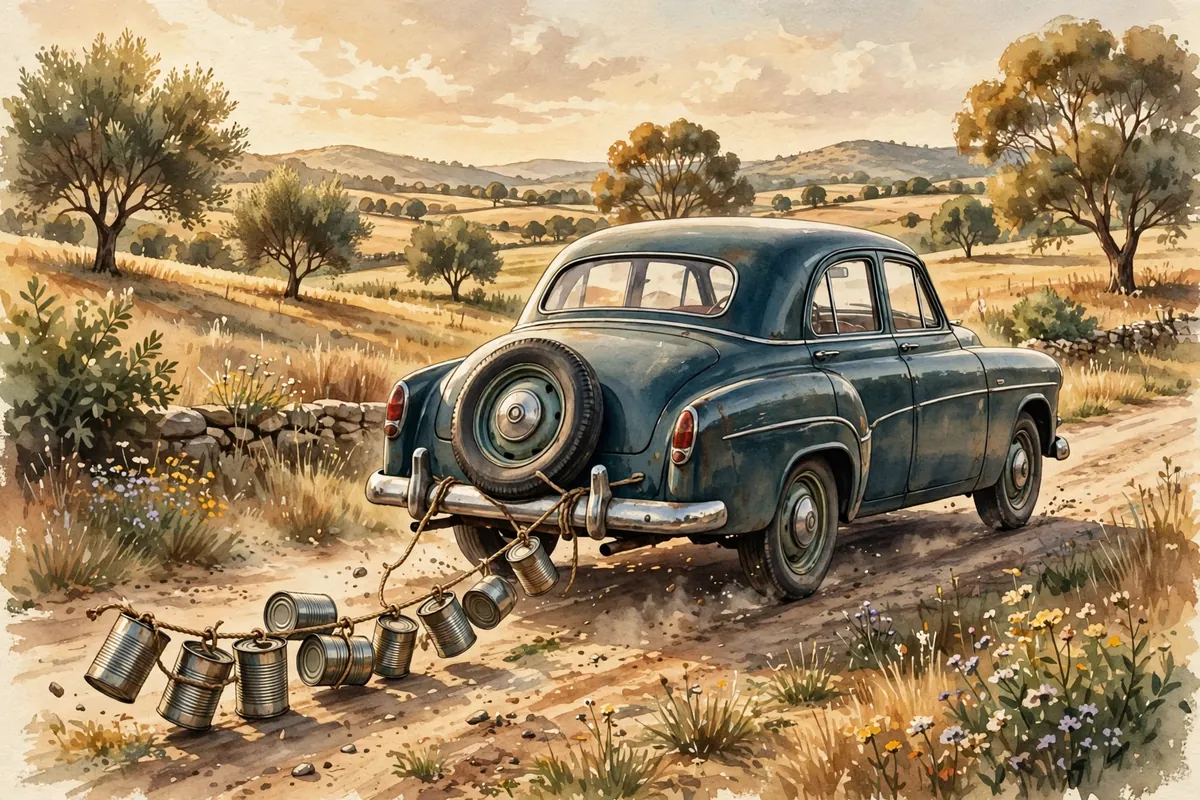
The ceremony is over, the rice or birdseed has been tossed, and the happy couple climbs into the getaway car. As they pull away, a string of old shoes and tin cans bangs and rattles behind them down the street. Everyone cheers. But why on earth do we tie footwear and garbage to a wedding car?
Here's the short answer. The custom seems to blend two older traditions. One is throwing old shoes after a newly married couple for good luck, a habit recorded in Victorian England and America. The other is the shivaree, a noisy folk prank played on newlyweds, which may be where the rattling tin cans come from. The exact path from those customs to the car isn't fully documented.
A Shoe for Good Luck
Throwing shoes at weddings is a superstition in several cultures. In Victorian England, people would pelt a bride and groom with old shoes as they set off on their honeymoon. It was meant as a send-off for luck, not an insult.
Charles Dickens even wrote it into his 1850 novel David Copperfield. After the narrator marries Dora, a character named Mr. Peggotty shows up with an old shoe to be thrown after the couple for luck.
The custom was already ancient by then. In 1887, The New York Times wrote that throwing old shoes after a bride and groom was so old that no one could remember how it began.
The Noisy Shivaree
The clanging cans have a different ancestor. Across Europe and North America, communities practiced a custom called charivari, known in the United States as a shivaree. Crowds made as much racket as possible by banging pots and pans, a noise people called rough music.
In Europe, it was often used to shame people who broke community rules. But in North America, it frequently became a good-natured prank on newlyweds. In parts of the Midwest, such as Kansas, shivarees continued as friendly wedding humor into the 1960s and 1970s, in the playful spirit of the musical Oklahoma! Pranks included wheeling the bride around in a wheelbarrow or tying cowbells under the wedding bed.
This noisy ritual may well be the origin of fastening tin cans to the newlyweds' car. Once cars replaced carriages, the racket simply came along for the ride.
Other Wedding Shoe Superstitions
Shoes pop up in plenty of wedding traditions. The Victorian rhyme says a bride needs "something old, something new, something borrowed, something blue, and a sixpence in her shoe," with the sixpence promising lasting wealth.
A Swedish bride might tuck a silver coin from her father in one shoe and a gold coin from her mother in the other. And one Polish superstition warns that open-toed bridal shoes will let a couple's future wealth fly away.
A Fun Send-Off That Stuck
Today, few couples know the history behind the clatter. The shoes and cans are just part of the fun, along with a "Just Married" sign and plenty of honking horns from passing drivers. Yet each one carries a wish from friends and family: good luck, a joyful noise, and a happy road ahead.
So if you ever help decorate a getaway car, tie on an old shoe with pride. You're keeping alive a tradition that's been wishing newlyweds well for a very long time.