Ask a child to draw a star, and you'll almost always get the same shape: five points, like the ones on the American flag. Stars with five points are everywhere, from flags around the world to the sidewalks of the Hollywood Walk of Fame. But why five, and not six or eight?
The short answer is tradition, and a big boost from the United States. Five-pointed stars were long preferred in English and Scottish heraldry, the old art of coats of arms. When the American flag adopted five-pointed stars, it helped make them the standard star for flags around the world. Not every flag follows the rule, though.
An Old Choice From Heraldry
In medieval heraldry, stars were fairly rare. But from an early date, English and Scottish designs favored five points, as seen in an English roll of arms from around 1270. German heraldry, by contrast, usually preferred six-pointed stars.
One English star even changed history. At the Battle of Barnet in 1471, the Earl of Oxford's star badge was mistaken for the sun badge of King Edward IV. His own ally attacked him by mistake, and the battle was lost, which may have changed the outcome of the Wars of the Roses.
The Flag Law Didn't Say
The Flag Act of 1777 called for stars on the American flag but didn't specify how many points they should have, or how to arrange them. That was up to whoever made the flag. Some flag makers arranged the stars into one big star or a circle, and some even replaced a state's star with its initial.
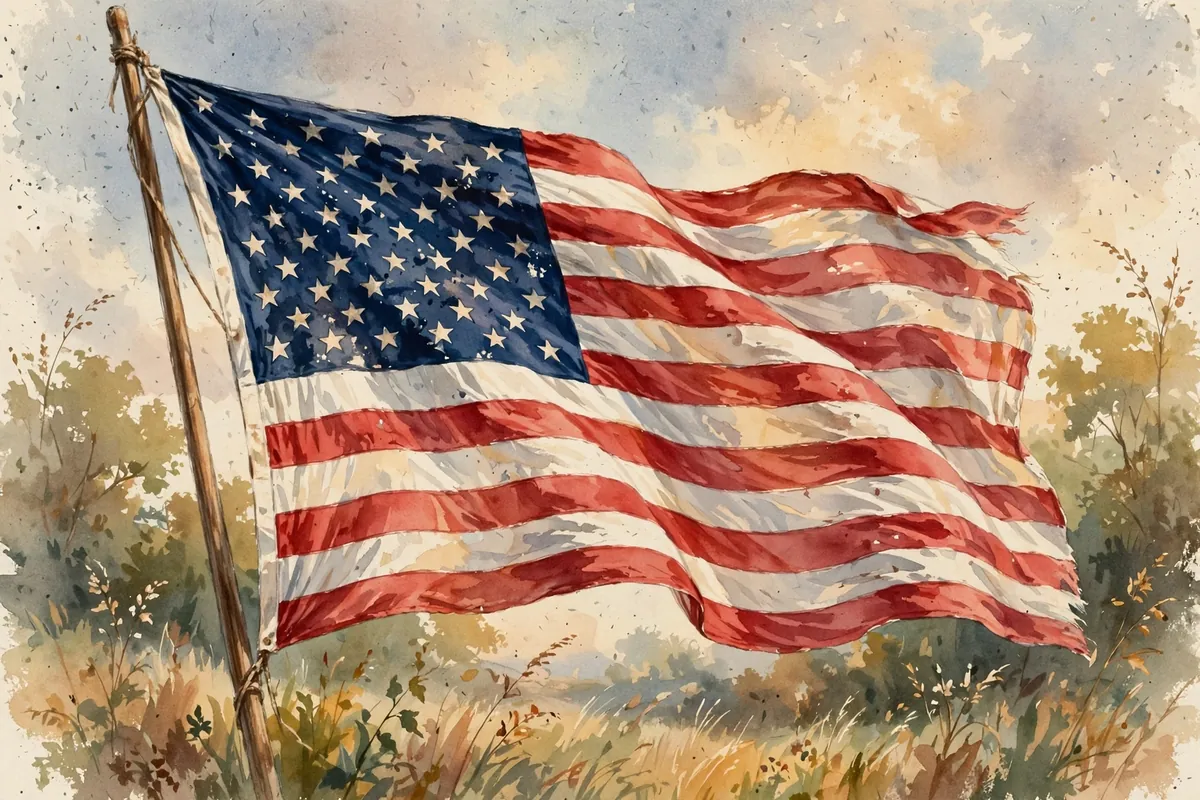
One well-known early design shows 13 five-pointed stars in a circle, called the Betsy Ross flag. The earliest known example of it appears in a 1792 painting by John Trumbull. Today's flag has 50 white five-pointed stars in nine offset rows.
The Betsy Ross Legend
You may have heard a charming story. In 1776, George Washington supposedly showed Philadelphia upholsterer Betsy Ross a flag sketch with six-pointed stars, and she convinced him to switch to five points by showing that they were quicker and easier to cut.
It's a great tale, but historians have long dismissed it. There's no record to back it up. The story first surfaced in 1870, nearly a century later, from her grandson, and even he admitted that his search of official records turned up no proof. A painter later featured it in a huge oil painting shown at the 1893 Chicago World's Fair, helping spread the legend.
Five Points Around the World
After the United States, five-pointed stars spread to many flags. Chile adopted its Lone Star flag in 1817, and the similar flag of Texas came in 1839. Venezuela, Honduras, Puerto Rico, the Philippines, Cuba, Panama, and Pakistan all added five-pointed stars between 1859 and 1947. The flag of Europe has a circle of 12.
But not every flag follows the pattern. Israel's flag features the six-pointed Star of David. Australia's flag has a large seven-pointed star, with six points for its states and one for its territories, and four more seven-pointed stars in its Southern Cross.
So the next time you see Old Glory waving, take a closer look at those 50 stars. Their five points carry a little bit of medieval heraldry, a lot of American history, and one famous legend that's more fun than true.