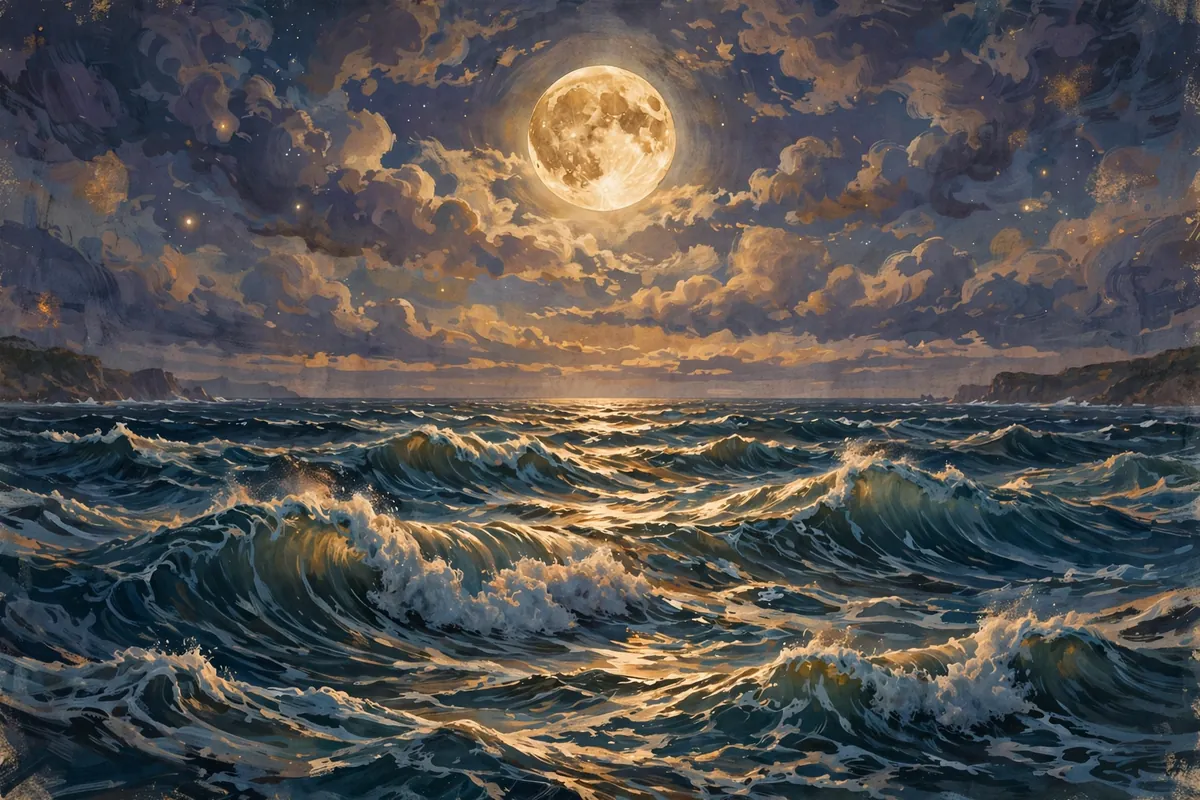
If you've ever spent a day at the beach, you've watched the water creep up the sand and then pull back hours later. People have connected the tides to the Moon since ancient times. But how can something so far away move an entire ocean?
The short answer is gravity, with a twist. The Moon pulls a little harder on the side of Earth facing it and a little less on the far side. That difference stretches the oceans into two bulges, one toward the Moon and one away from it. As Earth spins, your stretch of coast passes through both bulges, which is why many places get two high tides a day.
Why Two Bulges, Not One
The bulge facing the Moon makes intuitive sense. The surprise is the second one, on the opposite side of the planet. Isaac Newton's simple model, called equilibrium theory, explains it.
Earth and the Moon swing around each other as a pair. On the side nearest the Moon, the Moon's gravity is slightly stronger, so water is pulled toward it. On the far side, the effect of that swinging motion slightly wins out, so water piles up there too. The solid Earth feels these forces as well, but it's rigid and keeps its round shape, while the oceans flow into the two bulges.
Why High Tide Shifts Every Day
If you've noticed high tide arriving later each day, you've spotted the Moon at work. The Moon orbits in the same direction Earth spins, so it takes about 24 hours and 50 minutes for the Moon to return to the same spot in the sky.
That means in many places, high tides come about every 12 hours and 25 minutes. The highest water doesn't always arrive exactly when the Moon is overhead, though, because the shape of the coastline and the sea floor affect the timing.
The Sun Joins In
The Sun raises tides too, though its effect is roughly half as strong as the Moon's. The Sun's gravity on Earth is about 179 times stronger than the Moon's, but tides depend on the difference in pull across the planet. Because the Sun is about 389 times farther away, that difference is smaller.
About twice a month, around the new moon and full moon, the Sun, Moon and Earth line up. Their tidal forces add together, making high tides higher and low tides lower. These are called spring tides, but they have nothing to do with the season. The name comes from an old meaning of spring, to jump or rise. About a week later come the milder neap tides.
The World's Biggest Tides
The Moon's distance matters too. When it's closest to Earth, tides are a bit bigger. A few times a year, that close approach lines up with a new or full moon, producing extra-large spring tides that can be as much as a foot higher in some places.
Geography does the rest. Canada's Bay of Fundy is often said to have the highest tides in the world, thanks to its shape and depth. In 1998, a range of about 53 feet was measured there between low and high water. Northern Quebec's Ungava Bay has recorded nearly the same.
So the next time you watch the tide roll in, take a glance at the sky. That quiet Moon is gently tugging on the whole planet, and the ocean is simply following along.