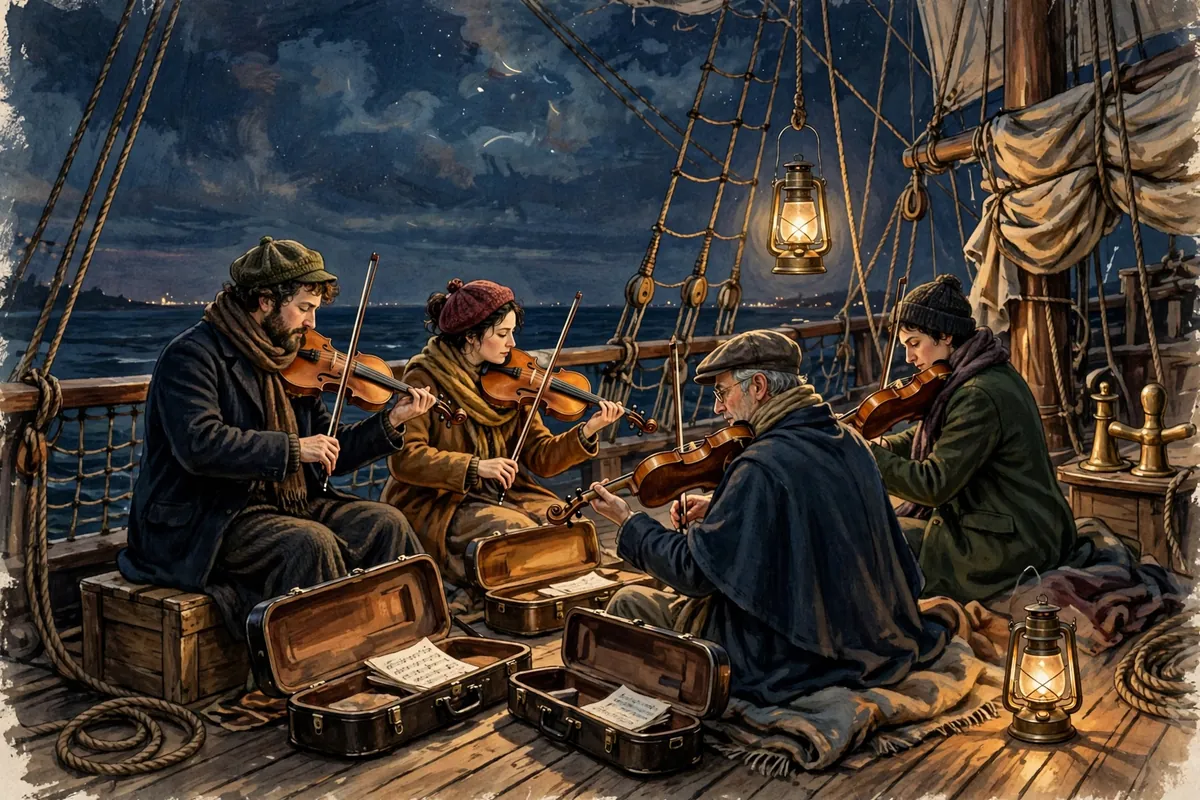
Of all the stories from the night the Titanic sank, one stands out for its quiet courage. As the ship tilted and the lifeboats were lowered, a small group of musicians stayed on deck and played. It sounds almost too movie-perfect to be true.
But it really happened. The Titanic's eight musicians played to help keep passengers calm as the crew loaded the lifeboats, and many survivors said they kept going until the very end. All eight died in the sinking. What remains uncertain is exactly which song they played last.
Two Bands Became One
The musicians weren't actually on the White Star Line's payroll. They were booked through a Liverpool agency, C. W. & F. N. Black, which placed musicians on almost all British liners, and they traveled in second class.
Until the night of the sinking, they played as two separate groups. A quintet led by violinist and bandleader Wallace Hartley played at teatime, after-dinner concerts, and Sunday services. A trio of violin, cello, and piano played at the ship's À La Carte Restaurant and Café Parisien.
Many of them were very young. Pianist William Brailey was 24, violinist Jock Hume was 21, and French cellist Roger Bricoux was only 20.
The Mystery of the Last Song
Many people believe the final tune was the hymn “Nearer, My God, to Thee.” A first-class passenger named Vera Dick was among those who said so, and Hartley had reportedly once told a friend it would be one of the songs he'd play on a sinking ship.
But there are doubts. Dick left in a lifeboat about an hour and 20 minutes before the end, so she couldn't have heard the band's final moments. Wireless operator Harold Bride, one of only two witnesses close enough to the band, said he heard a song called “Autumn” just before the ship went down. He may have meant the popular waltz “Songe d'Automne,” which was in the White Star Line's songbook.
Another survivor, Colonel Archibald Gracie, said the tunes were cheerful and that he didn't recognize any of them. He wrote that if the band had played “Nearer, My God, to Thee,” he would certainly have noticed.
Hartley's Violin
Wallace Hartley grew up in Colne, England, where his father was a chapel choirmaster who introduced “Nearer, My God, to Thee” to the congregation. Hartley's body was recovered almost two weeks after the sinking, and his violin, a gift from his fiancée Maria Robinson, was returned to her.
The violin later dropped out of sight. In 2013, after years of research and forensic testing, experts announced that a violin found in a British attic was Hartley's, identified partly by an engraving from his fiancée. It sold at auction that October for £900,000, about $1.7 million.
A Bill and a Tribute
Not every part of the story is noble. About two weeks after the sinking, the agency sent Jock Hume's father a letter asking him to pay a small sum his son owed, along with the bill for his uniform. The letter caused controversy when a musicians' union newsletter reprinted it, and his father decided not to pay.
The public's feelings ran the other way. On May 24, 1912, London's seven chief orchestras performed together at a memorial for the lost musicians.
More than a century later, nobody can say for sure what the band's last notes were. But the image of eight musicians playing on while the great ship slipped away has never faded, and it probably never will.